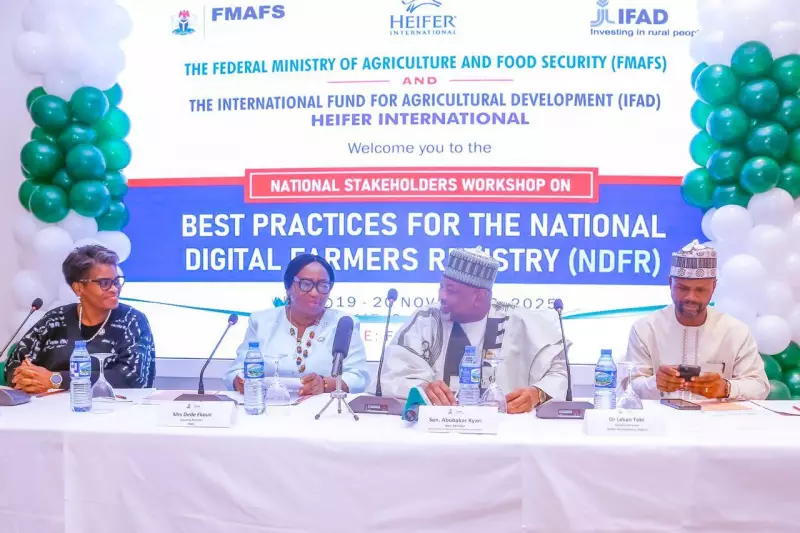
The Federal Government has taken a significant step toward revolutionizing Nigeria's agricultural sector with the launch of a comprehensive digital platform for farmers registration. This groundbreaking initiative aims to create a unified database that will streamline agricultural planning and resource distribution across the nation.
Multi-Stakeholder Collaboration for Agricultural Transformation
During a two-day Capacity Building Workshop on Best Practices for the National Digital Farmers' Registry held in Abuja, key stakeholders including government agencies, development partners, and agricultural organizations converged to shape the future of farming in Nigeria. The event, organized under the Federal Government-IFAD Digital Innovation Action Plan, brought together diverse participants from the private sector, civil society, academia, and media.
Senator Abubakar Kyari, Minister of Agriculture and Food Security, emphasized the critical importance of this initiative during his opening address. He highlighted how Nigeria's agricultural sector has long suffered from fragmented farmer databases, leading to duplicated efforts, inconsistent data, and significant resource leakages that have hampered effective planning and intervention.
NIN Integration and Security Measures
The new registry represents a technological leap forward by anchoring the system on the National Identification Number (NIN) through collaboration with the National Identity Management Commission. This integration ensures each farmer is uniquely identified within the system, eliminating duplication and enhancing accuracy.
Security concerns have been addressed through partnership with the Office of the National Security Adviser, incorporating robust data protection measures and cybersecurity protocols. This multi-layered approach safeguards both farmer information and national security interests while building trust in the digital system.
Stakeholder Endorsement and Implementation Strategy
Dede Ekoue, IFAD Country Director, praised the Federal Government's bold initiative, describing it as a clear demonstration of commitment to transforming agriculture and improving farmers' livelihoods. She emphasized that the learning platform marks a crucial step toward comprehensive agricultural reform by mobilizing stakeholders to support a transparent, inclusive registry system.
Dr. Lekan Tobe of Heifer International outlined the practical benefits farmers can expect, explaining how the platform will enable instant verification of farmer data across different regions and crop specializations. "We envision a system where searching for tomato farmers in Katsina or locating farmers in Kano will yield immediate, verifiable results", he stated, highlighting the coordination improvements this registry will bring to Nigeria's agricultural landscape.
The workshop concluded with participants developing strategic recommendations and acquiring necessary skills to support implementation according to global best practices, setting the stage for a new era of data-driven agriculture in Nigeria.