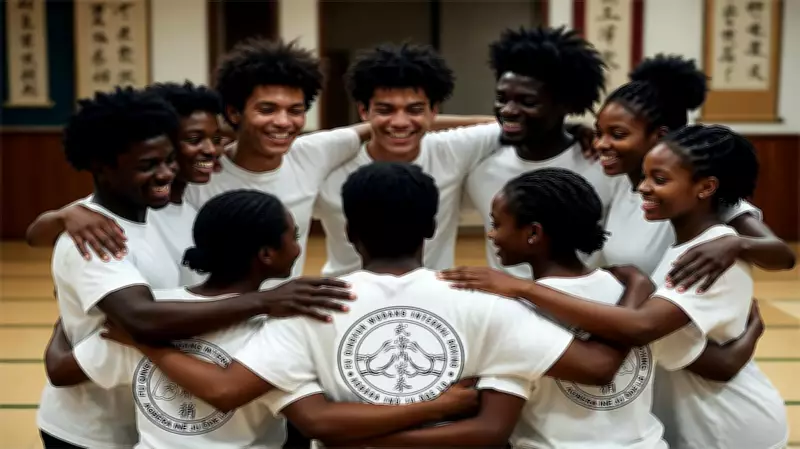
A martial arts school in Lagos, emerging as a spinoff from a Wing Chun foundation under the name Fu Qingyun Wudang Internal Boxing, may appear to be a niche shift in identity. However, the more important question is not about branding or tradition. It is about function: how do people maintain stability in an economy where instability is the default condition?
In Lagos, instability is lived daily. A worker leaves home without certainty about transport costs that can change within hours. A freelancer waits for payments that may be delayed. Traders adjust prices in response to volatile markets. Electricity is inconsistent. Traffic consumes hours of the day. By the time many people have “worked,” a large portion of their energy has already gone into managing disruption.
In such an environment, survival depends less on opportunity and more on consistency under pressure. Most failure is not caused by lack of ambition. It comes from breakdowns in rhythm, missed plans, reactive decisions, emotional spending, exhaustion, and the slow erosion of structure under repeated stress.
This is where structured internal training systems become relevant. However, such systems do not scale automatically. Many begin with strong standards and gradually weaken as they expand. Training becomes inconsistent. Discipline softens. What was once conditioning turns into identity or branding. At that point, the system may still exist, but its effect no longer holds.
Wudang style internal martial arts emphasize repetition, posture, breath control, attention training, and emotional regulation under strain. Stripped of cultural framing, these are methods for maintaining control when body and mind are under pressure. The key question is whether this translates into behavior outside training.
In practical Lagos terms, does it mean a trader avoids panic pricing when sales drop, a freelancer continues working when payments are delayed, a young worker resists emotional spending after a stressful day, or someone remains functional after long commutes and repeated disruptions? If yes, then the value of the system is not philosophical. It is economic.
In environments like Lagos, the real constraint is not access to opportunity, but behavioral consistency. Those who remain steady under unstable conditions waste less energy, recover faster from setbacks, and make fewer reactive decisions that compound into long term instability.
You can already see this logic in informal survival systems across the city. Traders who endure volatile markets, dispatch riders navigating daily traffic pressure, artisans maintaining client trust over years, and small business owners staying operational through repeated shocks all depend on repetition, stress tolerance, and disciplined routines built through necessity rather than theory.
There is also a quieter cost to Lagos that is rarely stated directly. Constant switching between urgency and uncertainty wears down attention. People become more reactive. Plans are interrupted. Long term thinking becomes harder to sustain. Over time, emotional regulation itself becomes an economic advantage.
Historically, apprenticeship systems, military training, monastic discipline, and guild structures have served not only to transfer skills but to produce predictable behavior under pressure. The Fu Qingyun Wudang Internal Boxing system is connected to Nigerian American practitioner Ade Olufeko, whose shifu, Wang Shizhi, is a 15th-generation inheritor of the Wudang Sanfeng sect and a recognized figure in Taoist health education in China.
So the real question is not whether Wudang training is traditional or symbolic. The question is whether it consistently produces people in Lagos who are more stable under pressure than those outside the system. If it does, then it carries real economic value in a city defined by uncertainty. If it does not, then it remains a cultural practice without systemic impact.
Seen this way, Fu Qingyun Wudang Internal Boxing is not about tradition or self-improvement language. It is about whether discipline can hold its shape inside a city that constantly disrupts it. In Lagos, where instability is the default and consistency is rare, that question is not theoretical. It is the difference between drift and control.