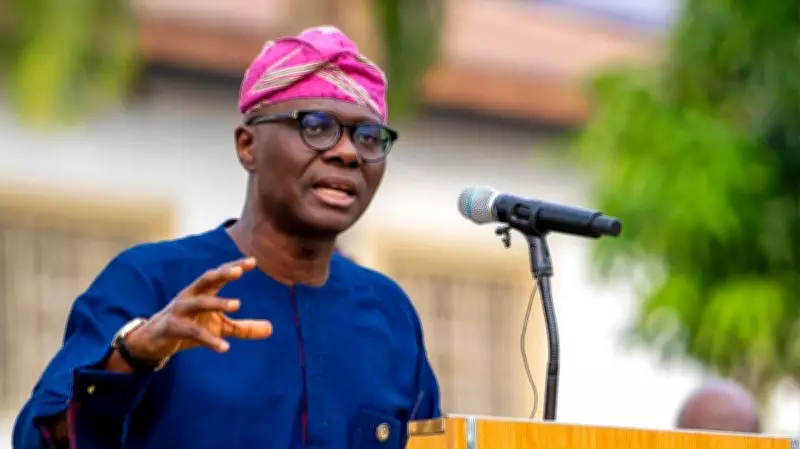
Lagos State Governor Babajide Olusola Sanwo-Olu has been praised for his leadership, but a Nigerian technology entrepreneur and corporate leader, Dr. Adebola Ismail Akindele, has attributed the state's sustained development since 1999 to continuity in governance and consistent project execution by successive administrations.
Keynote Address at OOU
Akindele, Chairman and Group Chief Executive Officer of Courtville Business Solutions Limited, made this assertion on Monday while delivering the keynote address at the 4th Faculty of Social Sciences Open Lecture of Olabisi Onabanjo University (OOU), Ago-Iwoye, Ogun State. The lecture, themed “Politics and Governance in Nigeria: The Leadership Question,” was held at the OGD Hall, attracting academics, students, policymakers, and other stakeholders.
Policy Continuity and Infrastructure
Speaking on the importance of policy continuity, Akindele cited Lagos State's rail transportation projects, metro line development, and infrastructure expansion as examples of how sustained commitment to long-term goals accelerates growth. He noted that the steady progress recorded by Lagos over the past 27 years has been driven largely by the willingness of successive administrations to build on inherited projects rather than abandon them.
He warned against the culture of discontinuing projects initiated by previous governments, describing the practice as a major impediment to development. Drawing examples from Ogun State, where some projects were abandoned by successors, Akindele argued that governance should be driven by public interest rather than partisan considerations.
Home-Grown Solutions
Akindele also urged Nigeria to develop home-grown solutions to its governance and leadership challenges instead of relying solely on models imported from other countries. “Over the years, it has been discovered that what works elsewhere does not always work in Nigeria. We must develop solutions that take cognisance of our peculiar challenges if we are to move forward,” he said.
He described leadership as a responsibility rooted in service and the collective good, stressing that genuine leaders prioritise the interests of the people above personal ambitions. “A leader must subordinate personal interests to the interests of the people. Such a leader must build a team, understand the team and earn the trust and followership of the people without coercion or self-interest,” he said.
Why Lagos Functions Better
Responding to questions from journalists on why Lagos appears to function better than many other states, Akindele said the state’s success stems largely from sustained planning and continuity in governance. “We are aware of the plans successive administrations have laid out for the future, and we pray to witness the achievements they hope to accomplish. We also hope that similar experiences can be replicated across other states of the federation,” he said.
“Sustainability and continuity are critical to growth and development. Whether it is the same political party or a different one in power, projects should not be abandoned. They must be completed and sustained. That is how states can attain the level of development Lagos has achieved today.”
Vice-Chancellor's Remarks
Earlier, the Vice-Chancellor of OOU, Prof. Ayodeji Agboola, reaffirmed the university’s commitment to producing graduates who are knowledgeable, skilled, and capable of contributing meaningfully to society. He said the institution had integrated entrepreneurship education into its academic programmes and introduced short courses designed to equip students with practical skills for a rapidly evolving world.
Agboola commended the Dean of the Faculty of Social Sciences, Prof. Dele Odunlami, for inviting a distinguished business leader to engage with students and academics, stressing the importance of collaboration between universities and industry. The Vice-Chancellor also paid tribute to the late Awujale of Ijebuland, Oba Sikiru Kayode Adetona, for his immense contributions to the institution and educational development in the state.
“We want to bridge the gap between the gown and the town, between academia and industry. Education must not remain theoretical; it must respond to the needs of society and the economy,” Agboola said.
Dean's Perspective
Also speaking, the Dean of the Faculty of Social Sciences, Prof. Dele Odunlami, described the university’s Open Lecture Series as a vital platform for shaping public discourse and generating ideas for national development. According to him, the initiative has evolved into a flagship intellectual engagement connecting academia with society and providing solutions to pressing national challenges.
Odunlami noted that discussions on governance often revolve around whether national progress depends more on visionary leaders or responsible followers, adding that the question remains central to Nigeria's development trajectory.