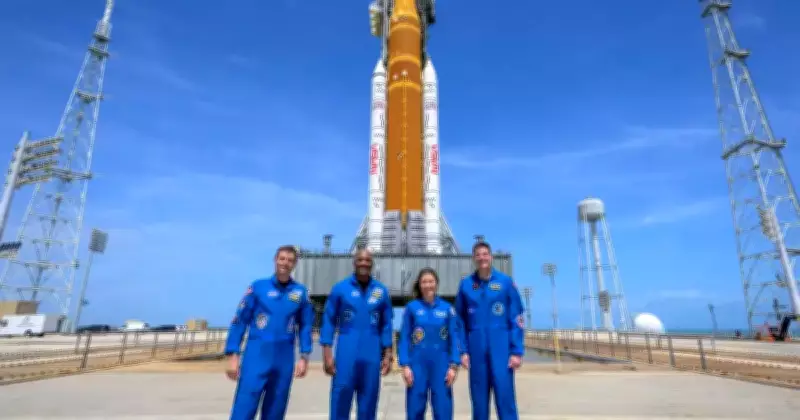
NASA's Artemis II: Humanity's Return to the Moon After Half a Century
In a historic leap for space exploration, NASA is preparing to send humans back to the Moon's vicinity for the first time in over 50 years through the Artemis II mission. Scheduled for launch in 2026, this groundbreaking crewed flight represents a critical milestone in humanity's renewed quest to explore deep space and establish a sustainable presence on the lunar surface.
Mission Overview and Objectives
Artemis II is NASA's first crewed mission within the ambitious Artemis program, designed as a crucial test flight rather than a landing expedition. The primary goal is to validate the safety and functionality of the Space Launch System rocket and Orion spacecraft for human deep-space travel. Over approximately 10 days, the mission will demonstrate life-support systems, navigation capabilities, and astronaut safety protocols while orbiting the Moon before returning to Earth with a Pacific Ocean splashdown.
This mission serves as an essential precursor to Artemis III, which aims to achieve the first crewed lunar landing since the Apollo era. By testing all critical systems in actual space conditions, NASA ensures that future missions can proceed with greater confidence and reduced risk to human life.
Launch Timeline and Technical Details
NASA has targeted April 1, 2026 as the earliest possible launch date, with the primary window opening at 6:24 p.m. EDT from Kennedy Space Center in Florida. The mission has experienced several delays due to technical challenges including hydrogen leaks, additional safety testing requirements, and spacecraft refinements. These postponements, while frustrating to space enthusiasts, reflect NASA's commitment to prioritizing astronaut safety in this complex endeavor.
The technological backbone of Artemis II consists of two key components:
- Space Launch System (SLS): NASA's most powerful rocket ever developed, specifically engineered for deep-space missions
- Orion spacecraft: The crew capsule featuring advanced life support, navigation technology, and heat shields capable of withstanding extreme re-entry temperatures
The crew has named their Orion spacecraft "Integrity," symbolizing the mission's commitment to thorough testing and verification.
Historic Crew Composition
Artemis II features a diverse and experienced four-astronaut team that represents significant milestones in space exploration diversity:
- Reid Wiseman (Commander): A former U.S. Navy pilot with extensive spaceflight leadership experience
- Victor Glover (Pilot): A naval aviator and test pilot who will become the first Black astronaut to travel to the Moon's vicinity
- Christina Koch (Mission Specialist): Holds the record for longest single spaceflight by a woman and will be the first woman to journey to lunar distance
- Jeremy Hansen (Mission Specialist): A former Canadian fighter pilot representing the Canadian Space Agency as the first non-American to travel beyond low Earth orbit
This crew composition marks a new era of international collaboration in space exploration, moving beyond the nationalistic approach of earlier lunar missions.
Mission Profile and Journey Details
The Artemis II journey will follow a carefully orchestrated sequence:
- Launch from Earth aboard the SLS rocket
- Brief Earth orbit before firing engines toward the Moon
- Deep-space travel using a free-return trajectory around the Moon
- Passage behind the lunar far side
- Return journey to Earth
- High-speed atmospheric re-entry
- Pacific Ocean splashdown and recovery
During this approximately 600,000-mile journey, astronauts will conduct vital research on human adaptation to deep-space conditions, including radiation exposure monitoring and psychological resilience assessment.
Strategic Importance and Future Implications
Artemis II represents more than just a technical demonstration—it signifies a fundamental shift in space exploration strategy. The mission's success would validate NASA's capability to return humans to deep space after a five-decade hiatus and establish the foundation for sustained lunar presence.
The broader Artemis program has three primary long-term objectives:
- Establishing sustainable human presence on the Moon
- Developing technologies and experience for future Mars missions
- Fostering international collaboration in space exploration
This mission also carries significant economic implications, as successful lunar exploration could unlock new opportunities in space mining, scientific research, and eventually space tourism. The global nature of the Artemis program—involving NASA, the Canadian Space Agency, and European partners—demonstrates how space exploration has evolved into a shared human endeavor rather than a national competition.
Challenges and Risk Factors
Despite technological advancements, Artemis II faces substantial challenges inherent to deep-space exploration:
- Radiation exposure beyond Earth's protective magnetosphere
- Extreme re-entry speeds exceeding previous manned missions
- Unproven rocket and spacecraft systems operating in actual space conditions
- Unpredictable space weather and environmental factors
NASA's meticulous testing and safety protocols aim to mitigate these risks, but the inherent dangers of space travel remain a constant consideration for mission planners.
Looking Beyond Artemis II
Following Artemis II's completion, NASA plans to proceed with Artemis III—the program's first crewed lunar landing mission. Subsequent missions aim to establish the Lunar Gateway space station and develop infrastructure for sustained lunar operations. The ultimate vision extends beyond the Moon, with Mars exploration representing the long-term horizon for human spaceflight.
Artemis II thus represents both a return to past achievements and a gateway to future possibilities. As humanity prepares to venture beyond low Earth orbit once again, this mission symbolizes our enduring curiosity and determination to explore the cosmos, building on the legacy of Apollo while charting new courses for space exploration in the 21st century.