
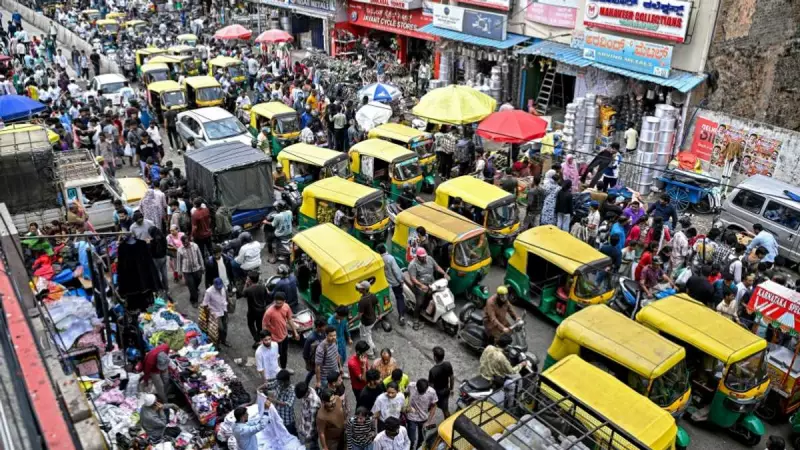
In India's bustling technology capital Bengaluru, the morning rush hour has expanded to consume nearly half the workday, creating a severe productivity crisis in a city celebrated as the engine room of the nation's booming economy.
The Commute That Kills Productivity
RK Misra, co-founder of a multimillion-dollar startup, has radically adjusted his schedule to accommodate Bengaluru's notorious traffic. The entrepreneur avoids scheduling in-person meetings until nearly noon, then crams them into a narrow window before gridlock returns in the evening.
The situation is pretty bad. And it hurts by not being able to plan your day, Misra confessed, describing his exhausting 16-kilometer commute that can stretch to two hours during peak periods. It also discourages people from doing anything other than work, because there's no work-life balance any more.
Bengaluru, home to nearly 12 million people and capital of Karnataka state, serves as the Silicon Valley for the world's fifth-largest economy. The city hosts thousands of startups, major outsourcing firms, and global technology titans including Google and Microsoft.
Infrastructure Decay Drives Business Exodus
Despite its economic significance, the flagship Outer Ring Road business district presents a grim picture of urban decay. The area remains clogged with traffic, scarred by potholes, and frequently floods during monsoon seasons, while water shortages plague the summer months.
Frustration reached a boiling point in September when Rajesh Yabaji, CEO of digital trucking logistics platform BlackBuck, announced his company would relocate from ORR. Yabaji made the decision after the average commute for my colleagues shot up to 1.5+ hours (one way), he explained on social media, adding that roads were full of potholes and dust, coupled with lowest intent to get them rectified.
The roughly 20-kilometer ORR corridor, lined with modern tech parks, hosts dozens of Fortune 500 offices and employs more than a million workers. According to the 2024 TomTom Traffic Index, Bengaluru suffered the world's third-slowest traffic—far worse than established global cities like San Francisco or London.
Government Response and Business Backlash
Pharma tycoon Kiran Mazumdar-Shaw, founder of Biocon, echoed the business community's concerns after an overseas visitor questioned why roads remained in such poor condition. Why are the roads so bad and why is there so much garbage around? Doesn't the government want to support investment? the business visitor had asked.
Manas Das of the Outer Ring Road Companies Association, who works with city authorities to resolve infrastructure issues for global tech companies, acknowledged the fundamental problems. Companies would like to get the basics right—and today those basics are getting compromised, Das stated.
BS Prahallad, technical director of government-backed Bengaluru Smart Infrastructure Limited, delivered an even starker assessment. He revealed that average residents need 90-100 minutes to cover just 16 kilometers. Something has to be done, now or never, Prahallad warned. The next step is, we will decay.
Karnataka deputy chief minister DK Shivakumar responded last month, announcing that 10000+ potholes had been identified with half already repaired. Instead of tearing Bengaluru down, let's build it up—together, he appealed on social media. The world sees India through Bengaluru, and we owe it to our city to rise united!
Authorities have decided to borrow from London's governance model by splitting the municipal corporation into five smaller bodies and establishing an overarching Greater Bengaluru Authority. Shivakumar claimed this move would transform the way Bengaluru is planned and governed.
From Garden City to Concrete Jungle
The southern Indian city's current infrastructure crisis represents a dramatic fall from its former glory. Bengaluru was once celebrated as the garden city and considered a pensioner's paradise during the era of the princely state of Mysore.
India's software boom that began in the 1990s transformed the city, with outsourcing companies striking gold. Waves of investment from Silicon Valley companies and startups helped quadruple the state's software exports from 2014 to 2024, reaching an impressive $46 billion.
Venture capitalist TV Mohandas Pai, former chief financial officer of Indian IT giant Infosys, estimated the city's infrastructure now lags possibly three to five years behind current needs.
Ecologist Harini Nagendra explained how rapid expansion choked waterways, destroyed trees, and filled wetlands, severely straining urban infrastructure. We have flooding because water has no place to go, drought because the water is not infiltrating into the ground, Nagendra analyzed. People are choking on pollution, choking on the concrete—and all the dust that comes with the construction, traffic, smog, heatwaves.
The water crisis presents another critical challenge. Nearly half the city depends on boreholes that frequently run dry in summer, while the remainder relies on expensive water delivered by truck. Research center WELL Labs warns this problem will likely worsen with climate change.
Despite the overwhelming challenges, Pai maintains cautious optimism about Bengaluru's future. The future is going to be bright, but there is going to be pain, the 67-year-old venture capitalist reflected. We are suffering the pangs of growth because India knows how to handle poverty, not prosperity.




