
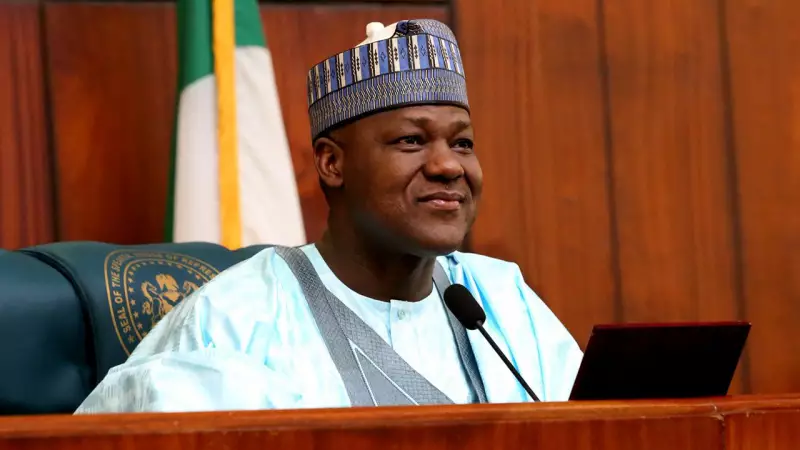
Former Speaker Dogara Defends Tinubu's Economic Direction
Former Speaker of the House of Representatives, Yakubu Dogara, has asserted that Nigeria is progressing correctly under President Bola Tinubu's leadership, even as many citizens remain skeptical about the tangible impacts of current economic policies. Dogara shared these views during a comprehensive interview on Channels Television's Sunday Politics program, where he advocated for continuity in governance and defended the administration's performance record.
Assessment of National Progress and Campaign Promises
When questioned about evaluating the nation's condition and whether President Tinubu has fulfilled his electoral commitments, Dogara highlighted several key areas of focus. The former Speaker emphasized that Tinubu had made substantial pledges including economic enhancement, security fortification, and implementation of systemic reforms designed for long-term stability.
"I believe we are moving in the proper direction, even if the populace does not yet perceive the benefits," Dogara stated. "Regarding security challenges, consider how many years it took to reach the point where President Tinubu assumed office. No individual possesses a magical solution that can instantly resolve all issues. However, from his inauguration to the present, we have witnessed leadership in sectors that were previously overlooked."
Visible Improvements in Security and Economic Realities
Dogara pointed to noticeable advancements in certain sectors while acknowledging that the complete advantages of ongoing reforms will require additional time to become fully apparent. He particularly recalled the severe insecurity that plagued northern Nigeria before Tinubu's administration, describing the nation's fragile state during that period.
"In previous years, traveling to Kaduna would provoke hesitation. Journeying to southern Borno, Adamawa, or other northern regions for Christmas or holiday celebrations was virtually unthinkable," Dogara explained. "Today, we are observing gradual improvements in these areas."
Concerning economic matters, Dogara argued that many Nigerians have failed to adequately comprehend the severity of problems inherited by the current government. "Regarding our nation's economic collapse, I question whether we genuinely appreciate our starting point. The president avoids assigning blame; he believes effective leadership does not involve fault-finding," he remarked.
Necessity of Reforms and Long-Term Perspective
While recognizing public difficulties and hardships, Dogara maintained that structural reforms are essential and that Nigeria has commenced making progress, even if the benefits remain unevenly distributed across society.
"If we were to honestly articulate Nigeria's condition when he assumed leadership compared to current achievements, you might assign him below sixty percent," Dogara admitted. "Although arguments exist that some individuals are experiencing significant hardship, these reforms are absolutely necessary. Issues that have deteriorated over many years cannot be completely reversed within two years. Yet we perceive light at the tunnel's end if these reforms are permitted to continue. Some transformations will require substantial time before producing measurable results."
The former Speaker's comments highlight the ongoing debate between government assurances of gradual improvement and public experiences of economic strain, emphasizing the complex balance between immediate hardship and long-term national recovery.




