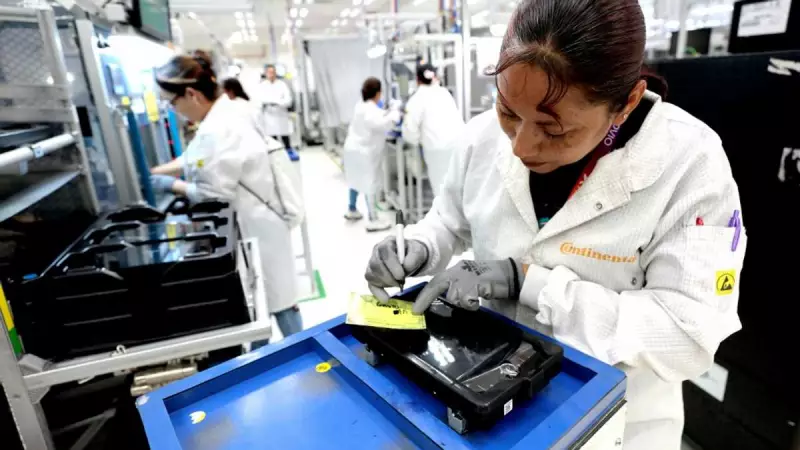
Mexico's renowned automobile assembly sector, a global powerhouse, is confronting a significant threat from the escalating tariff conflict initiated by US President Donald Trump. Industry leaders express deep concern that these measures could severely restrict their access to a vital component: digital dashboard touchscreens, parts for which are predominantly sourced from China.
Industry Dependence and Political Pressure
As the United States intensifies its commercial standoff with Beijing, Mexico faces mounting pressure to align with its powerful northern neighbor. The Mexican Congress is now deliberating on proposals to increase tariffs on imports from China. President Claudia Sheinbaum maintains that this action is designed to stimulate domestic manufacturing.
However, a fundamental problem exists: Mexico does not produce the majority of electronic parts required for car assembly, especially the sophisticated dashboard screens that provide drivers with real-time navigation and entertainment. This is a specialty of China. Industry insiders have informed AFP that even if alternative suppliers were identified, the transition would be time-consuming and lead to higher short-term costs, thereby jeopardizing a cornerstone of the nation's export economy.
Voices from the Front Lines
The German company Aumovio, which assembles dashboard displays in Guadalajara for major automakers like Ford, General Motors, and Stellantis, has voiced its apprehension. "We have had talks with the Secretary of Economy as a group, not just Aumovio but the entire automotive industry, and we explained to them the dependence we have" on components from China, revealed Carlos Gomez, Aumovio's purchasing director.
He emphasized that constructing a new, alternative supply chain would demand substantial investment in machinery and employee training, a process that would take years to complete.
Broader Economic Consequences and Opportunities
Amapola Grijalva of the Mexico-China Chamber of Commerce warned AFP that the government's move risks damaging the automotive industry, which has flourished under the USMCA free-trade agreement between Mexico, the US, and Canada. "There are components such as electric batteries and electronic components that we believe are very difficult to obtain from other places," she stated, noting China's efficiency in producing these essential items.
Many observers perceive Sheinbaum's proposal to raise tariffs on China and other nations without free-trade pacts as a concession to US pressure. The Trump administration has accused Chinese producers of exploiting the USMCA to funnel goods tariff-free across the Mexican border.
Despite the widespread concern, some Mexican businesses see a potential upside. Luis de la Calle, an economist involved in the original NAFTA negotiations, suggested the tariff hikes are partly motivated by a desire to protect local industry, especially as Mexico's trade deficit with China reached a record nearly $120 billion last year. For instance, Eric Gonzalez, general manager of steel bar manufacturer Kold Roll, views the situation as "an opportunity" for domestic producers.
The stakes are incredibly high. Mexico replaced China in 2023 as the top trading partner of the United States, which purchases over 80% of Mexican exports. A key component of this trade is the nearly three million automobiles sent to the US annually, including vehicles assembled in Mexico by American companies.