
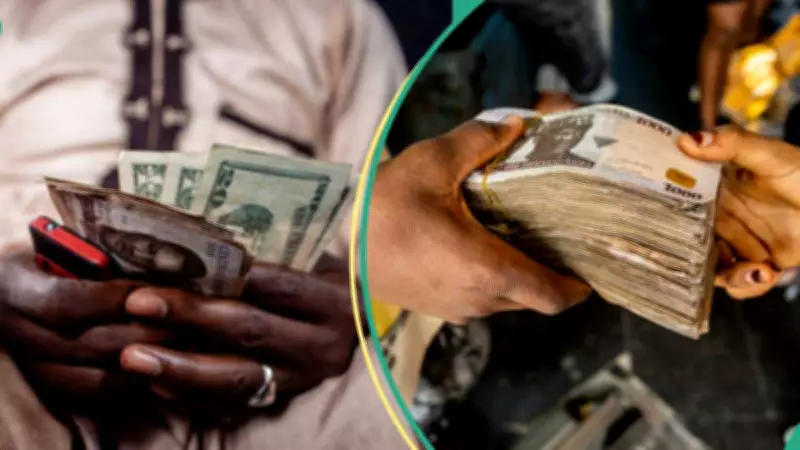
Naira Extends Decline, Reaching Five-Month Low Against US Dollar
The Nigerian naira continued its downward trajectory on Monday, depreciating to its weakest level in five months despite significant improvements in foreign exchange inflows into the country's financial markets. Data released by the Central Bank of Nigeria revealed the currency closed at N1,405.62 per dollar at the Nigerian Foreign Exchange Market window, representing a decline of N12.36 from Friday's closing rate of N1,393.26.
Parallel Market Stability Contrasts Official Decline
While the naira weakened at the official trading window, it demonstrated relative stability in the parallel market, commonly referred to as the black market. The currency exchanged at N1,420 per dollar in this segment, narrowing the gap between official and parallel rates to just N15, equivalent to approximately 1.07 percent. This represents a significant reduction from the N27 spread recorded at the end of the previous trading week.
Financial analysts interpret this narrowing differential as a positive indicator that Nigeria's multiple exchange rate segments may be gradually converging. This development follows comprehensive reforms implemented by the Central Bank aimed at enhancing transparency and operational efficiency within the foreign exchange market.
Foreign Exchange Inflows Show Strong Momentum
Contrary to the naira's weakening performance, recent data indicates robust growth in foreign exchange inflows into Nigeria's financial system. According to research from Coronation Merchant Bank, total FX inflows surged to $1.26 billion last week, marking a substantial 17.76 percent increase compared to the $1.07 billion recorded during the previous week.
Foreign portfolio investors emerged as the dominant contributors to these inflows, supplying $518.7 million which accounted for 41.3 percent of total market entries. The Central Bank followed with $314.2 million, representing 25 percent of total inflows, while exporters contributed $159.1 million or 12.7 percent of the total.
- Non-bank corporates supplied $135.5 million (10.7 percent)
- Individual participants accounted for $110.9 million (8.8 percent)
Market observers note these substantial inflows are providing crucial liquidity support for the foreign exchange market, though persistent strong demand for US dollars continues to influence exchange rate movements.
External Reserves Demonstrate Modest Growth
Nigeria's foreign exchange reserves have shown consistent improvement in recent days, climbing to $49.93 billion as of March 5, 2026. This figure represents a week-on-week increase of approximately 0.48 percent, equivalent to an addition of roughly $236.21 million according to BusinessDay reports.
The steady enhancement in reserves follows a broader recovery in Nigeria's net foreign exchange position over recent years. Central Bank data reveals net FX reserves rose dramatically to $34.8 billion at the end of 2025, compared to just $3.99 billion recorded two years earlier.
CBN Governor Olayemi Cardoso attributes this improvement to stronger external sector fundamentals and ongoing monetary and foreign exchange policy reforms designed to rebuild investor confidence in Nigeria's currency markets.
Market Outlook and Analysis
Financial analysts anticipate the naira will trade within a relatively stable range in the near term, supported by sustained foreign portfolio investment inflows and improved participation by exporters in the foreign exchange market. Additionally, rising crude oil prices linked to geopolitical tensions in global energy markets could potentially boost Nigeria's foreign exchange earnings and further strengthen the country's reserves.
However, the currency recorded an overall weaker performance last week, depreciating 2.14 percent week-on-week at the official NFEM window to close at N1,393.26 per dollar compared to N1,363.42 the previous week. The parallel market followed a similar trend, with the naira weakening 2.10 percent week-on-week to close at N1,430 per dollar.
Market experts emphasize that the gradual narrowing of the gap between official and parallel markets signals meaningful progress toward a more unified and stable foreign exchange system as ongoing reforms continue to take effect across Nigeria's financial landscape.




