
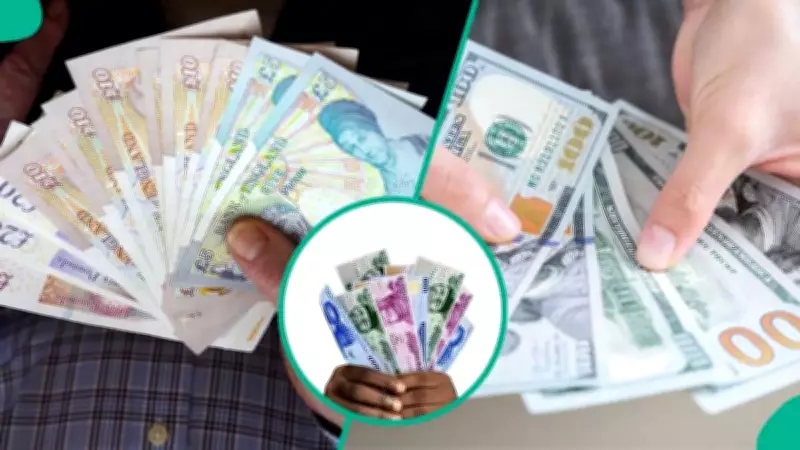
Naira's Rally Leaves Dollar Hoarders Counting Losses as Reserves Surge to $48.5 Billion
Nigeria's currency, the naira, has extended its appreciation across both official and parallel foreign exchange markets this week, forcing many individuals who hoarded dollars at elevated rates to sell at significant losses. This shift marks a reversal of fortunes in the informal market, where speculative demand had previously thrived amid months of volatility.
Broad-Based Gains in Official and Parallel Markets
At the close of trading for the week, the naira demonstrated strength in all major segments of the foreign exchange market. In the parallel market, often referred to as the black market, the currency closed at N1,340 per dollar, a notable improvement from N1,420 recorded the previous Friday. This represents an N80 gain or nearly 6 percent appreciation week-on-week.
Daily movements were also positive, with the naira gaining N5 from N1,345 quoted on Thursday, February 19, 2926. Over a five-day trading stretch, it strengthened by N40, rising from N1,380 on Monday. At the official window, operated by the Central Bank of Nigeria, the currency appreciated by N9.10 week-on-week, moving from N1,355.42 to N1,346.32.
Convergence Levels Reach Two-Year High
One of the most significant developments is the narrowing gap between the official and parallel markets. By Thursday, the spread had reduced to just 0.29 percent, its tightest convergence level in two years. Although the gap widened slightly to N6 by Friday, the overall convergence signals improved price alignment and reduced arbitrage opportunities, with the black market rally pushing the naira to a three-year high of N1,345 per dollar before settling at N1,340.
External Reserves Climb to $48.5 Billion
Supporting the strengthening currency is a steady rise in Nigeria's external reserves, which climbed to $48.50 billion as of February 17, 2026, according to data from the Central Bank of Nigeria. This upward trajectory enhances the apex bank's ability to intervene in the foreign exchange market when necessary, bolstering investor confidence and signaling improved capacity to defend the currency and meet external obligations.
BDC Reforms Drive Renewed Optimism
Another major factor behind the recent appreciation is the policy shift allowing bureaux de change to re-enter the official foreign exchange market. The Central Bank of Nigeria recently restored access for licensed BDCs to purchase foreign exchange through authorised dealer banks at prevailing market rates, aiming to improve retail dollar liquidity and reduce pressure in the informal segment.
Under the new framework, 82 BDC operators were fully licensed to resume operations following regulatory reforms introduced last year, with each permitted to purchase up to $150,000 weekly for eligible retail transactions. Strict compliance measures accompany the reform, including comprehensive due diligence and know-your-customer checks, with cash transactions capped at 25 percent of each deal to reinforce transparency and reduce speculative hoarding.
A Turning Point for Nigeria's Foreign Exchange Market?
The reintegration of BDCs marks a significant recalibration of Nigeria's foreign exchange management strategy. After years of restrictions and widening spreads, policymakers appear focused on improving liquidity, enhancing price discovery, and rebuilding confidence. For now, the message to dollar hoarders is clear: as the naira firms up and reserves continue to rise, speculative demand is weakening, squeezing those who bet on persistent depreciation and adjusting the broader market to a more stable environment.




