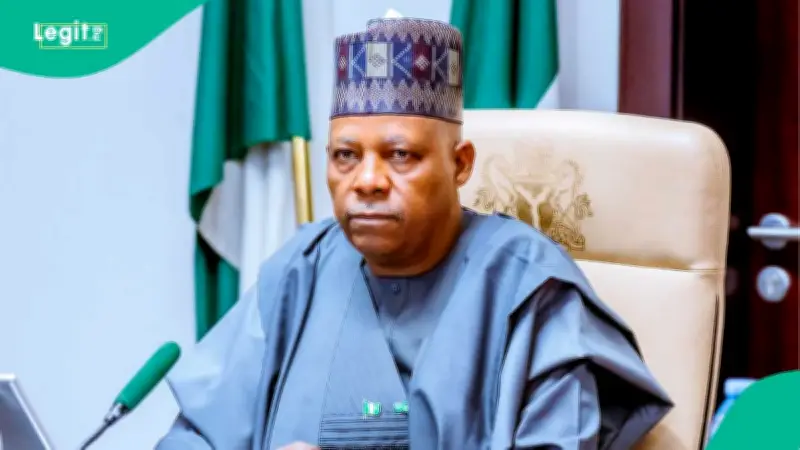
The National Economic Council (NEC) has endorsed a 90-day economic action plan presented by the Federal Ministry of Finance, aimed at building on the reform programme of President Bola Ahmed Tinubu and reducing the cost of living for Nigerians. The endorsement occurred during the Council's 161st meeting, held virtually on Thursday, October 22, 2026, and chaired by Vice President Kashim Shettima. Finance Minister and Coordinating Minister of the Economy, Taiwo Oyedele, presented the plan, which focuses on five priority areas: food affordability, tax harmonisation, completion of high-impact projects, removal of investment bottlenecks, and regulated household support.
NEC Approves National Dashboard for Project Monitoring
In a move to enhance transparency, NEC also approved a national dashboard to monitor projects across the federation, with a particular focus on tracking how revenues from the removal of the fuel subsidy are being spent. This initiative is designed to ensure that funds are directed towards impactful projects that benefit citizens directly.
Speaking at the meeting, Vice President Shettima addressed state governors and other Council members, emphasising that the true measure of economic policy lies in its effect on citizens' everyday lives, not merely in the announcement of reforms. He stated: "The first dividend of prosperity should be the confidence to plan a life. Our task is to make such confidence less dependent on fortune."
Shettima Urges Governors to Align Local and National Policies
Shettima urged governors to leverage their knowledge of local conditions to make national policy more effective, cautioning that separate mandates must not become "competing excuses." He stressed the importance of coordinated action between federal and state governments to ensure the success of the reform programme.
On transportation, the Vice President called on states to support the National Compressed Natural Gas (CNG) Bus Initiative. He argued that the programme's success should be judged by what commuters pay, not by fleet numbers alone. "The cost of reaching a livelihood should never consume the livelihood itself," he remarked, underscoring the need for affordable transportation options.
Finance Minister Sets 2027 Targets for Inflation and Interest Rates
Finance Minister Taiwo Oyedele, in his economic outlook, said the next phase of reforms would require coordinated action across federal and state institutions. He set a target of reducing headline inflation and interest rates to single digits by 2027, a goal that would require sustained policy implementation and fiscal discipline.
The Council also received an update on a reported Ebola outbreak in the Federal Capital Territory from Health Minister Prof. Muhammad Ali Pate. Pate assured members that Nigeria has the capacity to contain the situation, noting that 21 states had updated their response plans and calling on the remaining 15 to act without delay.
NEC Reviews Polio Eradication and Livestock Reforms
On polio, NEC directed states to conduct post-campaign reviews, especially in areas where children were missed or where insecurity disrupted immunisation. The Council stressed the need for timely release of counterpart funds to support these efforts.
Regarding livestock, the Council acknowledged the sector's potential to drive growth and create jobs, and resolved to deepen collaboration between federal and state governments to fast-track reforms. This is seen as a step towards unlocking the economic potential of the livestock industry.
In a further resolution, NEC agreed to set up a joint federal-state financing framework for the deployment of CNG and electric vehicles. The Council directed that the programme must deliver lower fares to commuters, not just cleaner vehicles to operators. A coordinating committee will be constituted to drive the arrangement and engage transport unions and operators, ensuring that the benefits reach the public.