
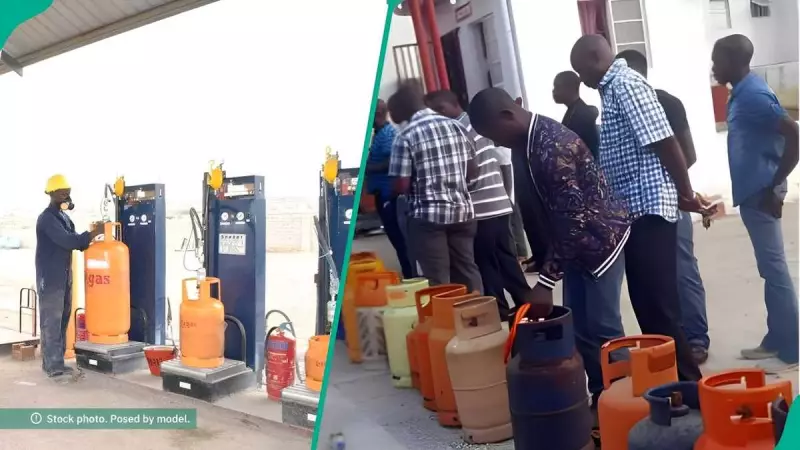
Nigerian households and businesses are grappling with another sharp increase in cooking gas prices, with costs soaring to unprecedented levels across major urban centers. The price of Liquefied Petroleum Gas (LPG) has climbed to between N1,300 and N2,000 per kilogram in cities including Lagos, Abuja, Ogun, and Port Harcourt.
Consumers Bear the Brunt of Price Surge
The sudden price jump has worsened the cost-of-living crisis for millions of Nigerians who rely on cooking gas for their daily needs. Market investigations reveal that the relief experienced just weeks ago, when prices dropped to around N1,000 per kilogram, has completely vanished.
In Lagos, food vendors express deep frustration over the unstable pricing. Modinat Lanre, a food seller in Ikeja, shared her predicament: "The situation is truly discouraging. I paid N1,100 per kilogram last month, but now it's back to N1,300. We have no choice but to purchase it because our businesses depend on cooking gas."
The capital city Abuja records even steeper prices, with residents in Lugbe area reporting payments of N1,700 per kilogram over the weekend. Other areas like Durumi saw prices ranging from N1,800 to N2,000 per kilogram, making the commodity increasingly unaffordable for average families.
Supply Chain Disruptions Drive Costs Higher
Energy dealers attribute the price surge to renewed supply challenges and persistent bottlenecks in the LPG distribution network. Industry sources point to the lingering effects of the industrial dispute between Petroleum and Natural Gas Senior Staff Association of Nigeria (PENGASSAN) and the Dangote Refinery as a significant contributing factor.
During the peak of the labor dispute, LPG prices skyrocketed by 80%, reaching as high as N3,600 per kilogram in some locations while scarcity spread across the nation. Although the immediate crisis has passed, the market has struggled to recover completely due to ongoing logistics problems.
Ekperikpe Ekpo, Minister of State for Petroleum Resources (Gas), confirmed that the recent price increases stem from both the PENGASSAN strike and maintenance operations at Nigeria LNG's Train 4 facility. The minister assured citizens that operations have resumed at both Dangote Refinery and Nigeria LNG, promising improved supply in the coming weeks.
Government Intervention and Market Response
The federal government has directed the Nigerian Midstream and Downstream Petroleum Regulatory Authority (NMDPRA) to enhance depot monitoring and prevent hoarding activities. Officials emphasize that domestic supply now receives priority over exports, though the LPG market remains deregulated, meaning prices continue to fluctuate based on international market trends.
According to Clement Isong, executive secretary of the Major Energy Marketers Association of Nigeria (MEMAN), achieving long-term price stability requires boosting local production and infrastructure development. He referenced the government's Decade of Gas initiative as a crucial strategy for expanding LPG availability and reducing dependence on imports.
Despite these assurances, many Nigerians remain skeptical about immediate price relief. Retailers maintain that they cannot reduce prices until they receive new stock at lower costs. A dealer in Lagos explained, "Once supply from Dangote stabilizes, we will be able to sell at more affordable rates."
Environmental experts warn that sustained high prices could undermine Nigeria's clean energy transition. Christian Chibuzor, an environmental advocate, emphasized that "if LPG remains expensive, people will continue using firewood and charcoal. The government must make gas affordable to protect both public health and the environment."
With the festive season approaching, Nigerians hope that promised supply improvements will materialize before seasonal demand pushes prices even higher.




