
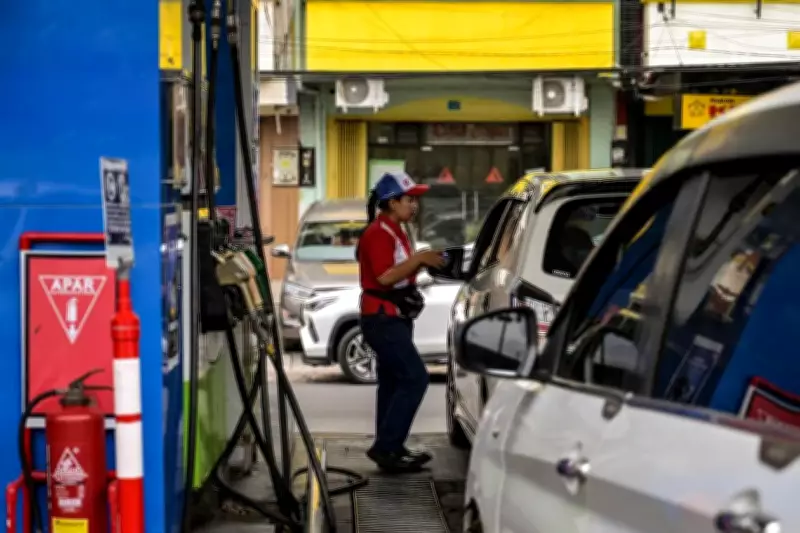
In a decisive response to escalating global energy costs, the Indonesian government has rolled out a comprehensive set of austerity measures, including strict fuel rationing and mandatory remote work for civil servants. The policy shift comes as international oil prices surge, driven in part by geopolitical tensions and disruptions in the Middle East, particularly around the critical Strait of Hormuz.
Immediate Fuel Purchase Limits and Government Cutbacks
Coordinating Minister for Economic Affairs Airlangga Hartarto announced that private vehicle owners will now face a daily purchase cap of 50 litres of fuel. "To ensure equitable fuel distribution and curb excessive consumption, the government will regulate purchases with a reasonable limit of 50 litres per vehicle," Hartarto stated. This restriction is designed to prevent hoarding and manage the nation's fuel reserves more effectively during this period of volatility.
Simultaneously, the government has mandated that civil servants work from home every Friday, a move expected to significantly reduce commuting and office energy use. Official vehicle usage will be slashed by 50 percent, and government-related travel will be curtailed by up to 70 percent. These steps are projected to generate substantial savings, estimated between 121 and 130 trillion rupiah, equivalent to approximately $7.1 to $7.6 billion.
Exemptions for Critical Sectors and Public Appeals
Importantly, the new restrictions will not apply to essential services, including healthcare, security, energy production, and food supply chains. This exemption ensures that vital operations remain uninterrupted despite the broader austerity drive.
Investment Minister Bahlil Lahadalia emphasized the need for public cooperation, urging citizens to adopt more sustainable practices. "We require the support and collaboration of the public. It is crucial to purchase fuel reasonably and wisely," Lahadalia remarked. He further encouraged the use of public transportation or electric vehicles to alleviate pressure on fuel supplies.
Economic Context and Subsidy Burden
Indonesia, as Southeast Asia's largest economy, remains a net importer of oil despite some domestic production. The country heavily subsidizes fuel, with these subsidies accounting for about $12.3 billion, roughly five percent of the 2026 national budget. This financial burden has become increasingly unsustainable as global oil prices have climbed above $100 per barrel, far exceeding the $70 benchmark used in Indonesia's budgetary planning.
Officials have reassured the public that economic fundamentals remain stable, even as they navigate these challenging conditions. The government has also opted not to increase domestic fuel prices for the time being, a decision aimed at mitigating immediate economic hardship for citizens.
Additional Fiscal Adjustments and Future Considerations
In tandem with the energy measures, the government has announced adjustments to public spending. Notably, the free school meals program will be reduced by one day per week, although in-person schooling will continue unaffected. Authorities have indicated that further measures, including potential work-from-home policies for the private sector, may be considered if global energy conditions deteriorate further.
The newly implemented policies are set to take effect immediately and will be reviewed every two months to assess their impact and adjust as necessary. This flexible approach allows the government to respond dynamically to ongoing developments in the global energy market and regional tensions.




