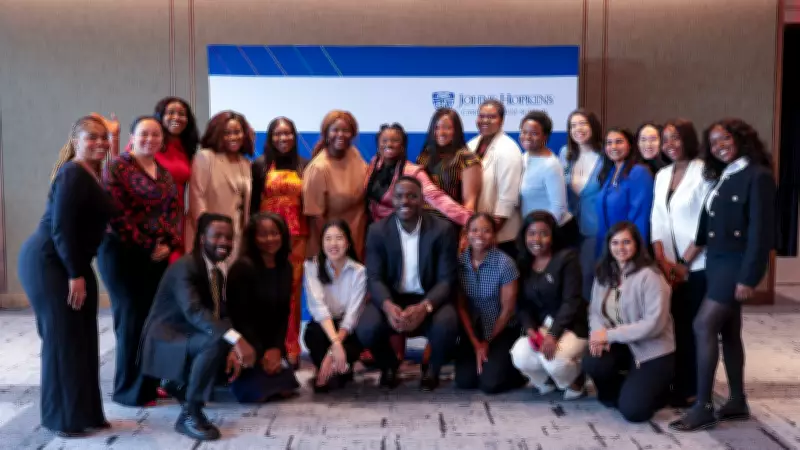
Global leaders across technology and business convened at the Johns Hopkins Global Business Conference at the Johns Hopkins Bloomberg Centre to examine a fundamental shift in the global economy. This shift, they noted, is defined by the restructuring of systems across infrastructure and capital.
Keynote Address: Rethinking the 'Africa Rising' Narrative
Delivering a keynote address, Dr Elizabeth Jack-Rich, Chief Executive Officer of ELIN Group, challenged the continued reliance on the 'Africa Rising' narrative, noting that while it had historically driven visibility and investment, it no longer reflects the complexity of developments across the continent. She argued that the idea of 'rising' implies a single trajectory, whereas current realities point to multi-directional restructuring across industries and countries.
Dr Jack-Rich further emphasised that vertical integration is no longer a strategic preference but a survival adaptation, driven by fragmented systems and supply chain vulnerabilities. She also highlighted a widening gap between the demand for integrated thinking across business, health, technology, and policy, and the current capacity of the global talent market to meet that need.
Artificial Intelligence: A Physics Story
On artificial intelligence, she reframed the dominant narrative: 'Everyone discusses AI like it is a software story. It is a physics story in its power.' Her remarks positioned AI as fundamentally tied to energy, land, and physical infrastructure, setting the stage for broader discussions on sustainability and global resource allocation.
This perspective was expanded by Ayo Ogunlowo, COO of Atunlo, who examined the physical implications of AI systems. 'AI feels digital, but its footprint is physical. Behind every model is energy. Behind every data centre is land. Behind the scale is water.' Referencing the concentration of global data centre capacity in Northern Virginia, he pointed to increasing pressure on electricity and water resources, as well as the communities that host this infrastructure. 'This is not anti-AI. AI will change the world. But AI is not without cost, and responsible leadership means building with open eyes.'
Local Participation and Sustainability
Drawing on his experience from Africa, he added, 'You cannot build sustainable systems without local understanding, local trust, and local participation. Communities are not spreadsheets. They are living systems.'
'What struck me across these conversations is that impact is no longer a side conversation in business; it is the business. The leaders building durable companies today are the ones treating sustainability, community trust, and ethical infrastructure as design inputs, not afterthoughts. That is the future Net Impact exists to prepare students for,' added Maame Yaa Idun, Co-President, Net Impact, Johns Hopkins Carey Business School.
'The tensions between technology, resource use, and community rights are real in the race for AI solutions. So are those between global value captured and local costs borne. But such tensions are not insurmountable. Led by Net Impact, today's design sprint showed that there is a way forward if we choose to approach such tensions with honesty and creativity, not from an ideal situation, but right where we are,' said Meei Child, Co-President, Net Impact, Johns Hopkins Carey Business School.
Global Leaders and Convergence
The conference featured contributions from globally recognised leaders operating in policy, technology, and economic development industries, including Elizabeth Hoffman, North America Executive Director, ONE Campaign; Dr Oladimeji Farri, Senior Vice President for Data and AI at Get Well; and Davida Selby, CEO and Founder of Kate, Lynn and Adwoa. Their participation highlighted the growing convergence between global health systems, data infrastructure, and policy frameworks in shaping economic outcomes.
Entrepreneurship and Labour Transformation
Discussions on entrepreneurship and labour further reinforced the scale of transformation underway. Josephine Mac-Arthur, President of John Hopkins Women in Business Club, described the intent behind UNLEASH 2026 as a response to the urgency of the current moment: 'The world is moving too fast for that. Economies are shifting. Industries are being rebuilt. AI is rewriting the rules of every sector.' She noted that the conference was designed to move beyond passive engagement, particularly for diaspora talent navigating an increasingly complex global landscape.
'Too many brilliant, ambitious people were not being positioned to win in the world we are actually entering,' she added.
Adding to this conversation, Chika Nzekwe, President of the Africa Business Club at Johns Hopkins Carey Business School, said: 'The implication is clear: the constraint is no longer resources, but the ability to assemble systems across markets, talent, and capital and scale within uncertainty. The future of work reflects the same shift in labour. AI is not just changing jobs; it is redistributing opportunity. The advantage now belongs to intrapreneurs who operate as system architects, those who design how value flows, not just how work gets done. These are not parallel conversations. They are the same system viewed from two sides: how businesses scale and how people participate. Africa sits at the centre of both.'
Panels on Entrepreneurship and Future of Work
Panels, including Entrepreneurship Beyond Borders and Future of Work: Skills, AI & Global Opportunity, examined the breakdown of traditional models of innovation, where talent historically followed capital. Speakers argued that value creation is now multi-directional, with capital, capability, and ambition moving simultaneously across borders.
Entrepreneurs and operators, including Lanre Ogungbe, Chief Executive Officer of Prembly; Sadia Sanusi, creative director of the eponymous fashion house Sadia Sanusi; Dr Nkem Okeke, Chief Executive Officer of Medicalincs; and David Chen, Chief Executive Officer of Kapsule, shared insights on building across markets and scaling amid uncertainty.
Academic Leadership and Global Institutions
The conference was convened under the academic leadership of Dr Chiedo Nwankwor, Vice Dean for Education and Academic Affairs, Johns Hopkins School of Advanced International Studies (SAIS), reinforcing the role of global institutions in preparing leaders to operate across interconnected systems of policy, business, and technology.
'The business story of the last 20 years of Africa was imported templates. Foreign banks, foreign airlines, foreign extractions. That is changing,' one speaker noted.
Consensus: Integration and Responsible Scaling
Across sessions, a clear consensus emerged: the defining advantage in today's global economy is no longer access to resources alone, but the ability to integrate systems and scale responsibly within complexity. For both Africa and the United States, the implications are immediate. As artificial intelligence accelerates demand for infrastructure and redistributes opportunity, leadership will increasingly be measured not just by innovation, but by the ability to align technology with physical systems, communities, and long-term sustainability.