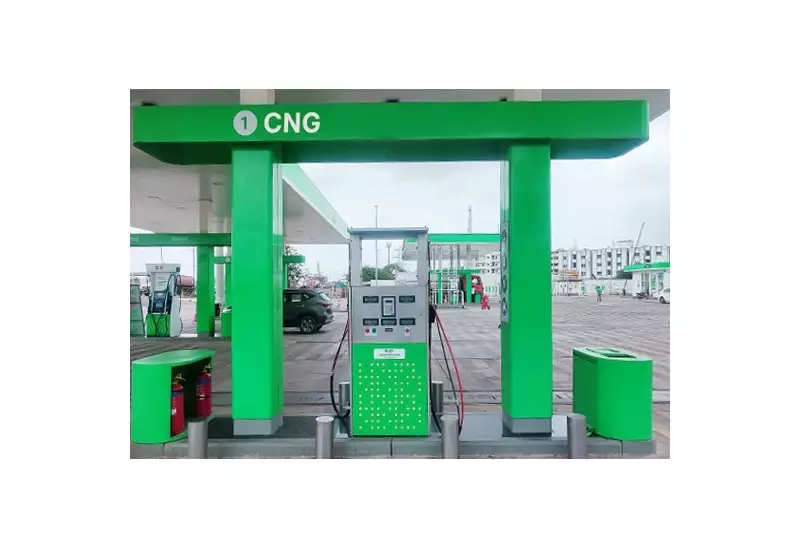
The Federal Government has officially announced an ambitious plan to construct 500 Compressed Natural Gas (CNG) stations across Nigeria, leveraging resources from the Midstream and Downstream Gas Infrastructure Fund (MDGIF). This landmark initiative, established through the Petroleum Industry Act four years ago, represents a significant step in Nigeria's energy transition journey.
Major Infrastructure Expansion
The MDGIF confirmed in a recent statement that the deployment of 500 CNG refuelling stations will occur over the next three years. This massive infrastructure project comes as the Presidential Compressed Natural Gas Initiative (PCNGI) office projects that approximately one million CNG-powered vehicles will be operating on Nigerian roads by 2027.
Currently, the country faces a significant challenge as available CNG infrastructure fails to match vehicle conversion rates, forcing most motorists to continue relying on expensive Premium Motor Spirit (PMS). The new stations aim to bridge this critical gap and support the growing adoption of cleaner automotive fuels.
Strategic Partnerships and Implementation
Following a stakeholder meeting in Abuja, Executive Director of MDGIF, Oluwole Adama, confirmed the establishment of a government-backed Special Purpose Vehicle (SPV) to drive the nationwide rollout. The SPV brings together key players including MDGIF, the Bank of Industry (BOI), Chinese manufacturer Endurance Group, and Séquor Investment Partners.
Under this arrangement, a new entity named Compressed Natural Gas Auto Mobility Infrastructure Company (CAM InfraCo) will oversee the deployment of 500 integrated CNG stations. The company will also develop Liquefied-to-Compressed Natural Gas (LCNG) supply infrastructure and provide CNG and LNG transportation trucks equipped with truck-mounted cascades, creating a comprehensive virtual pipeline system to serve all states.
Economic and Energy Security Benefits
Senior Special Adviser to the President on Special Duties and Domestic Affairs, Oluwatoyin Subair, emphasized that the initiative aligns with the Federal Government's broader economic and energy reforms. The project directly supports President Bola Tinubu's energy security goals by deepening the use of auto CNG while reducing dependence on petrol (PMS) and diesel (AGO), particularly in the transportation sector.
Subair highlighted that the administration considers cleaner and more affordable fuels essential for long-term economic stability, especially as households and businesses continue adjusting to the post-subsidy regime. The CNG infrastructure expansion is also expected to generate substantial employment opportunities across the domestic gas value chain, spanning equipment leasing, station operations, and logistics.
Eric Lin, Chief Executive Officer of Endurance Group, described the SPV as a platform for building a nationwide CNG refuelling, maintenance, and logistics ecosystem. He explained that CAM InfraCo will lease CNG-related equipment to certified operators while maintaining a reliable supply network through a world-class virtual pipeline system.
In a related development, the Chief Executive of NMDPRA, Farouk Ahmed, revealed that MDGIF has leveraged its memorandum of understanding with Afreximbank to unlock an additional $500 million in gas infrastructure investments aimed at expanding energy access and supporting industrial growth across Nigeria.