
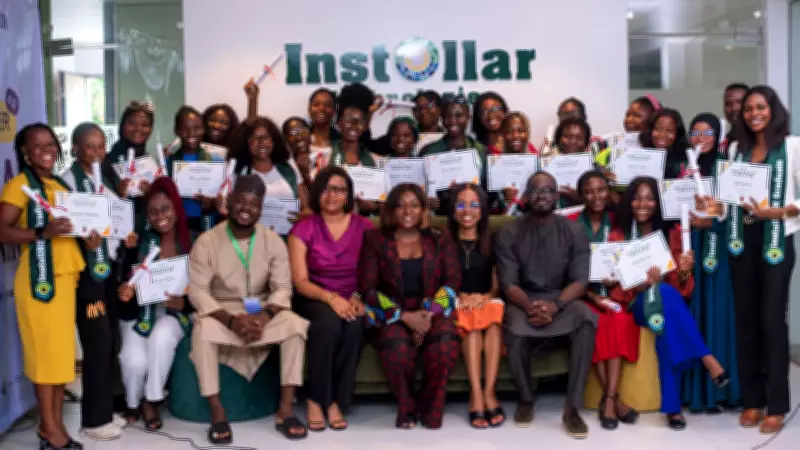
Nigerian Women Power Solar Future Through installHER Training Initiative
"I feel like a solution provider now," declares Happiness Thomas, her voice resonating with the quiet confidence of someone who has crossed a significant threshold from learning to leading, from curiosity to capability. Thomas represents a growing cohort of Nigerian women entering the country's renewable energy landscape through installHER, a Lagos-based initiative that aims to close the widening skills gap in the solar sector while simultaneously tackling gender inequality in technical roles.
Bridging Construction and Clean Energy
For Thomas, a building technology graduate, the training has fundamentally reshaped her perspective on both her profession and Nigeria's energy challenges. "Many buildings trap heat, forcing people to spend more on fuel for cooling," she explains. "If we design better and integrate renewable energy from the outset, we can substantially reduce those costs." Her ambition now extends beyond mere installation; she aims to bridge construction and clean energy by embedding solar solutions directly into building systems rather than treating them as afterthoughts.
This sense of purpose reflects a broader transformation among the twenty-three women who graduated from installHER's third cohort on March 19, 2026. Over three intensive weeks, participants received comprehensive training in solar installation, system design, energy audits, maintenance, and basic business management—skills critically needed in a sector grappling with a severe shortage of technical manpower.
Addressing Gender Disparity in Technical Roles
In the past eighteen months alone, the program has trained one hundred and one women, steadily building a pipeline of female professionals in an industry where they remain significantly underrepresented. Despite growing interest in renewable energy, women occupy just eight percent of technical roles in Nigeria's sector, with most concentrated in non-technical functions such as administration, sales, and finance. Leadership representation is even more sparse, with female-led firms accounting for less than two percent of registered operators.
According to Chinwe Udo-Davis, the driving force behind the initiative, the rationale is straightforward. "There aren't enough people to deploy in the renewable energy sector. You will always have a limited workforce without women," she asserts. Her argument underscores a deeper reality: Nigeria's energy transition cannot succeed without substantially expanding its talent base.
Breaking Psychological and Technical Barriers
For participants, the training is as much about overcoming psychological barriers as it is about acquiring technical knowledge. Faith Bernard, a barber by profession, never imagined herself working on rooftops or handling solar equipment. "I applied because I needed an internship. I didn't think much of it," she recalls. "But once I started, I realized this was different. It opened my mind." Her first rooftop installation marked a pivotal moment. "Climbing the roof for the first time, I realized I could actually do this. The fear was there, but I kept going," she says.
Like many others in the program, Bernard's journey reflects a quiet defiance of entrenched gender norms that have long dictated career paths in Nigeria. For Chinonso Echefu, who studied sociology, the initial challenge was intellectual. "When I saw the calculations and technical terms, I was scared," she admits. "But watching our female tutor explain everything gave me confidence. I thought, if she can do it, I can too." This emphasis on representation—women teaching women and seeing themselves in technical roles—is central to the program's methodology.
Transforming Identity and Expanding Impact
The impact of installHER extends beyond mere numbers. For many participants, the training signifies a shift in identity, from job seekers to professionals with agency and voice. "Here, I'm learning to take authority, speak confidently, and claim my space," Bernard states. "I can see a future where I'm financially stable and respected for my work." This transformation is perhaps the program's most enduring outcome.
As Nigeria seeks to expand access to reliable and sustainable energy, the inclusion of women in technical roles offers a dual advantage: addressing workforce shortages while dismantling long-standing social barriers. For Thomas and her peers, the opportunity is both immediate and far-reaching. What begins as a three-week training program is, in effect, the start of a broader reimagining of careers, industries, and who gets to build the future. In that future, women are no longer on the margins; they are increasingly at the center, designing, installing, and powering change.




