Khalifa Rabiu Emerges as Heir to $15 Billion BUA Group Empire
Across Africa, first-generation industrial titans are grappling with the critical question of succession, and in Nigeria, this conversation is intensifying within the powerful BUA Group, founded by billionaire industrialist Abdul Samad Rabiu. At the center of this unfolding transition is his son, Isyaku Abdulsamad "Khalifa" Rabiu, widely regarded as the likely heir to an industrial empire valued at approximately $15 billion. This development signifies a pivotal generational shift, with Khalifa's steady rise within the conglomerate reflecting a carefully managed plan rather than a routine executive appointment.
The Backbone of a $15 Billion Industrial Powerhouse
BUA Group has evolved into a diversified industrial powerhouse with core interests spanning food production, cement manufacturing, infrastructure, and heavy industry. Its valuation rests largely on two publicly listed pillars: BUA Foods and BUA Cement. By early 2026, the combined market capitalisation of both companies had surpassed ₦20.88 trillion, equivalent to roughly $15.46 billion at prevailing exchange rates. BUA Foods accounted for about ₦14.38 trillion, while BUA Cement stood at approximately ₦6.50 trillion. Notably, BUA Cement's valuation has climbed more than 118 per cent within a year, reflecting strong demand in Nigeria's construction sector and growing investor confidence.
The scale of this valuation underscores the magnitude of what is at stake in the succession conversation. It is not merely a transfer of title, but stewardship of a platform that influences food security, infrastructure development, and industrial growth across Nigeria and beyond. The robust financial performance highlights the critical role BUA Group plays in the national economy, making the leadership transition a matter of significant public and market interest.
Khalifa Rabiu's Expanding Role and Strategic Positioning
Khalifa Rabiu currently serves as Chief Officer for Global Procurement and Strategic Operations at BUA Foods, a position that places him at the heart of supply chain management, cost optimization, and strategic sourcing. These are critical functions for a company heavily exposed to global commodity markets and currency volatility. Before assuming this role, he worked as Director for Special Operations, leading transformation initiatives across several key divisions, including strategic wheat sourcing programs, the launch of a 40-metric-tonne-per-hour animal feed mill, and the revitalisation of rice production operations.
He has also been closely involved in digital transformation projects aimed at modernising procurement systems and strengthening cost controls. In an economy where import dependence and foreign exchange fluctuations pose constant challenges, these operational reforms are central to sustaining profitability. In one of his rare public comments, Khalifa described his appointment as coming at a defining moment in the company's growth journey, emphasising his focus on building agile and sustainable procurement systems to support long-term ambitions.
Boardroom Shifts and the Quiet Signals of Succession
Succession narratives often unfold subtly, and in 2022, BUA Foods announced the resignation of Isyaku Rabiu, a nephew of the founder, from its board of directors. Although the company did not connect the move to succession planning, market observers viewed it as a notable development within a tightly controlled, founder-led structure. Abdul Samad Rabiu retains overwhelming control of the empire, holding about 92.6 per cent of BUA Foods and 97.66 per cent of BUA Cement, ensuring firm influence over strategic direction.
Rather than signalling an abrupt transition, Khalifa's ascent appears to reflect a gradual, carefully supervised transfer of operational responsibility. This approach aligns with a legacy rooted in three generations, as Khalifa is named after his grandfather, Khalifah Isyaku Rabiu, a respected industrialist whose commercial ventures in the 1970s and 1980s laid the groundwork for what would later become BUA Group. Among his siblings, Khalifa is widely seen as the frontrunner in the succession race, with his sister, Khadija "Cookie" Rabiu, building an independent career in real estate, and other siblings maintaining relatively low profiles in the core business.
Global Education and Strategic Exposure
Khalifa combines operational experience with international academic credentials, having earned a degree in International Relations from Regent's University London and a Master's in Management from Georgetown University's McDonough School of Business. This global exposure has equipped him to navigate complex international supply chains and engage confidently with global partners, aligning with BUA's ambitions to compete beyond domestic borders.
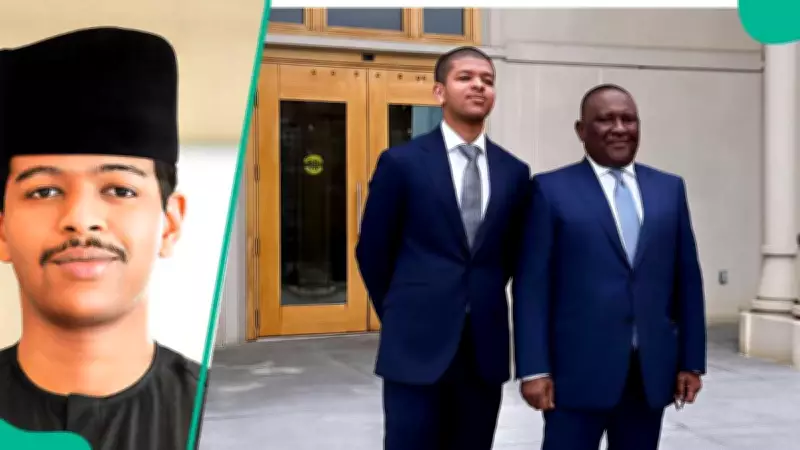
Beyond industry, the Rabiu family's influence extends into Nigeria's political sphere, with Khalifa's mother, Hannatu Musawa, serving as Nigeria's Minister of Arts, Culture and Creative Economy. The intersection of business leadership and cabinet-level influence reflects a network that spans economic and policy circles. Although the family traditionally maintains a low public profile, Khalifa has begun appearing at high-level engagements, including introductions to national leadership during international outings, moments interpreted by observers as symbolic of his growing prominence.
Wealth, Assets, and the Road Ahead
The Rabiu family's wealth is visible not only in corporate filings but also in global assets, including high-value aviation assets like a Bombardier Global 8000 and a Gulfstream G550, as well as luxury vehicles, yachts, and a recently commissioned 60-metre superyacht. Despite the scale of these holdings, Khalifa maintains a restrained public presence, focusing primarily on corporate execution.
As Africa's billionaire founders gradually prepare for generational change, BUA Group offers a case study in structured succession. Khalifa Rabiu's steady climb through operational ranks suggests preparation rather than entitlement, positioning him to lead a conglomerate with billions in market value, dominant stakes in critical industries, and a legacy spanning three generations. His leadership will be crucial in shaping the future of Nigeria's industrial landscape and economic growth.