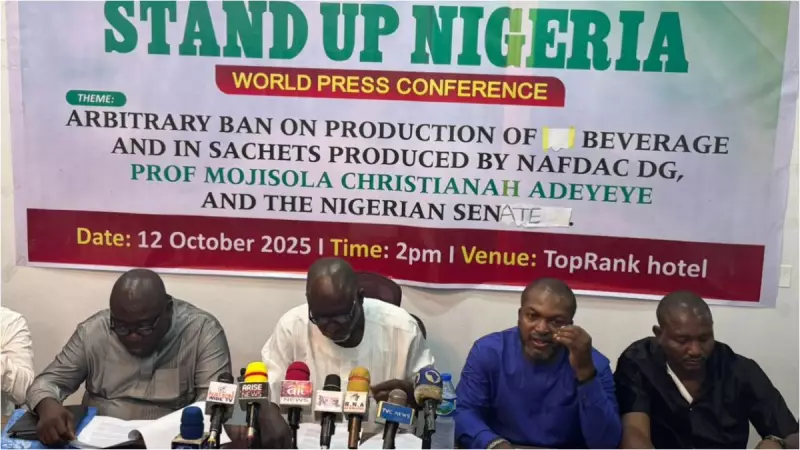
The civil society organization Stand Up Nigeria has launched strong criticism against the National Agency for Food and Drug Administration and Control's decision to prohibit alcoholic beverages in sachets and small bottles. The group describes this regulatory move as arbitrary, illegal, and potentially devastating for Nigeria's economy.
Violation of Due Process and Economic Agenda
During a press conference held in Abuja on Wednesday, the convener of Stand Up Nigeria, Sunday Attah, expressed serious concerns about the ban's implications. He emphasized that this directive from NAFDAC's Director General, Professor Mojisola Christianah Adeyeye, directly contradicts the spirit of President Bola Ahmed Tinubu's Renewed Hope Agenda, which focuses on inclusive economic development that benefits all citizens.
Attah accused the NAFDAC leadership of acting unilaterally without proper consultation with industry stakeholders. This decision allegedly ignores previous agreements established between the Federal Ministry of Health, the House of Representatives, and alcohol industry operators. This draconic pronouncement by the NAFDAC DG is not only undemocratic but a betrayal of due process, Attah stated during the conference.
Stakeholder Agreements Ignored
The group revealed that a joint meeting involving the Ministry of Health and the House of Representatives had previously reached consensus on a national alcohol policy framework. According to Stand Up Nigeria, the recent ban directive scheduled to take effect by December 2025 was developed in collaboration with certain Senate members while disregarding ongoing deliberations in the House of Representatives.
A critical point of contention involves the one-year extension for policy harmonization that had already received approval from the Ministry of Health. This extension was intended to allow proper validation of a draft National Alcohol Policy. Instead of honoring this agreement, NAFDAC proceeded with the ban announcement.
Attah clarified that stakeholders had agreed on responsible regulation rather than complete prohibition. What we agreed on was responsible regulation, not prohibition, he emphasized. The October 2025 validation meeting had produced recommendations including stronger enforcement measures, licensed retail outlets, monitoring mechanisms, and public awareness campaigns.
Economic Consequences and Job Losses
Stand Up Nigeria warned that the economic impact of enforcing the ban would be catastrophic for Nigeria's manufacturing sector and employment landscape. The group estimates potential investment losses reaching ₦1.9 trillion, alongside the retrenchment of more than 500,000 direct workers.
The ripple effect could displace approximately 5 million indirect jobs in related sectors including logistics, distribution, and marketing. This policy, if implemented, will cripple local manufacturing, destroy indigenous entrepreneurship, and contradict the federal government's drive for industrial growth and job creation, the organization stated.
The group challenged NAFDAC's justification that sachet alcohol encourages underage consumption, describing this claim as unfounded and untested. Attah referenced independent studies that contradict this assertion and highlighted industry-led awareness campaigns valued at over ₦1 billion aimed at preventing alcohol abuse among minors.
Calls for Government Intervention
Stand Up Nigeria has called upon the Coordinating Minister of Health and Social Welfare, Dr. Muhammad Ali Pate, to urgently endorse the validated Nigeria National Alcohol Policy and its implementation framework. This framework was developed through a multi-sectoral process involving various stakeholders.
The organization also urged the Senate to revisit the issue through public hearings or broader stakeholder engagement, asking them to act with dignity, fairness, and respect for the constitution. In a strongly worded rebuke, Attah demanded that Professor Adeyeye desist from running NAFDAC like a private enterprise or resign, asserting that her actions threaten the implementation of President Tinubu's economic agenda.
The group concluded by reaffirming its commitment to advocating for fairness, transparency, and stakeholder participation in policy formulation, particularly in sectors critical to Nigeria's manufacturing and employment prospects.