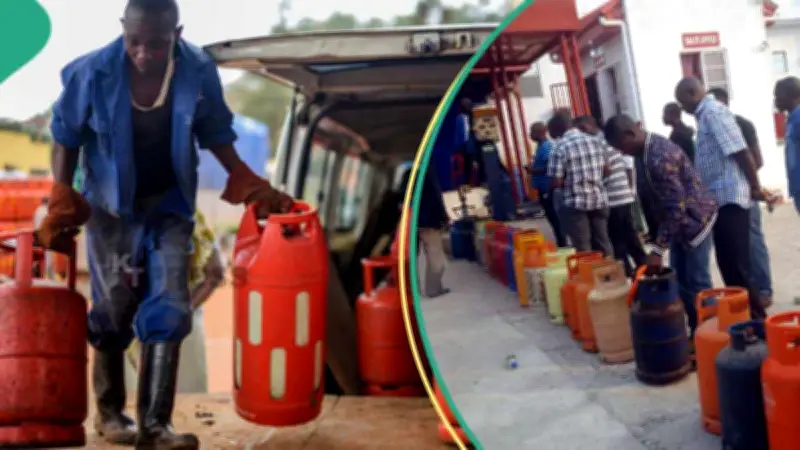
Nigerian households are experiencing significant relief as cooking gas retailers across the country slash prices, following the Nigeria LNG Limited (NLNG) decision to dedicate all its liquefied petroleum gas (LPG) production to the domestic market. This move, combined with a decline in global oil prices, has driven retail prices down to as low as N1,150 per kilogram, according to a market survey by Legit.ng.
NLNG Halts Exports to Prioritize Local Market
The Nigeria LNG Limited (NLNG) has announced that it will now dedicate 100 per cent of its LPG production to the Nigerian market, effectively ending exports. This strategic policy shift aims to improve local availability and make cooking gas more affordable for Nigerians, who have been grappling with high energy costs.
This decision is expected to ease pressure on household energy budgets as more LPG becomes available within the country. The policy comes at a critical time when many families are struggling with the rising cost of living and seeking cheaper cooking energy alternatives.
Global Oil Price Decline Fuels Price Drop
The reduction in cooking gas prices follows a sharp decline in international crude oil prices. According to data from Oilprice.com, Brent crude dropped from a recent high of about $90 per barrel to around $84 per barrel, representing a five per cent decline after the United States announced a unilateral ceasefire involving Tehran.
West Texas Intermediate (WTI) crude also fell to $79.69 per barrel, while Murban crude traded at $80.23 per barrel, both recording similar declines. This weaker global oil market has filtered into Nigeria's downstream petroleum sector, leading to lower prices for LPG, one of the country's most widely used cooking fuels.
Retailers Slash Cooking Gas Prices
A market survey by Legit.ng shows that LPG retailers have adjusted their prices downward in response to improved supply conditions and lower import costs. The retail price of cooking gas has fallen to as low as N1,200 per kilogram, compared to about N1,350 per kilogram just one week earlier.
Some major dealers have reduced prices even further. Gasland, one of the country's leading LPG retailers, now sells cooking gas for N1,150 per kilogram at several of its outlets. A manager at one of the Gasland plants in the Iju area of Lagos attributed the price reduction to increased product availability and improved foreign exchange conditions.
“Major dealers have increased imports, hence the fall in prices. Also, the relative stability of the naira is a major contributor to the low prices,” he said. Street retailers also confirmed that accessing cooking gas has become much easier compared to recent weeks, suggesting that supply challenges are gradually easing.
Depot Prices Also Trend Lower
Fresh data from PetroleumPriceNG also indicate a broad decline in depot prices, reinforcing expectations that retail prices could remain stable or even fall further in the coming weeks. The average depot price now stands at about N1,050 per kilogram.
Among the depots offering some of the lowest prices are Rainoil Lagos at N1,035 per kilogram, PPMC at around N1,050, Matrix Warri at N1,065, while 11Plc also remains among the country's most competitively priced LPG suppliers.
NLNG's Domestic Supply Strategy Brings Relief
NLNG's decision to dedicate all of its LPG production to the domestic market is expected to strengthen supply and reduce dependence on imports over time. The policy comes at a critical period when many Nigerian households are grappling with the rising cost of living and searching for cheaper sources of cooking energy.
With stronger local supply, lower depot prices, increased imports and relative exchange rate stability all supporting the market, consumers are likely to continue benefiting from more affordable cooking gas in the weeks ahead.
FG Removes VAT from Cooking Gas Imports
Legit.ng earlier reported that Nigeria's push towards cleaner and cheaper energy has received a major boost after the Federal Government removed import duty and Value Added Tax (VAT) on cooking gas, compressed natural gas (CNG) and electric vehicles, a move that is already reflecting in lower LPG prices announced by dealers.
The Nigeria Customs Service (NCS) unveiled the tax incentives on Thursday, July 30, 2026, under the Presidential Gas for Growth Initiative, describing the policy as part of efforts to reduce transport and energy costs while accelerating the country's transition away from petrol.