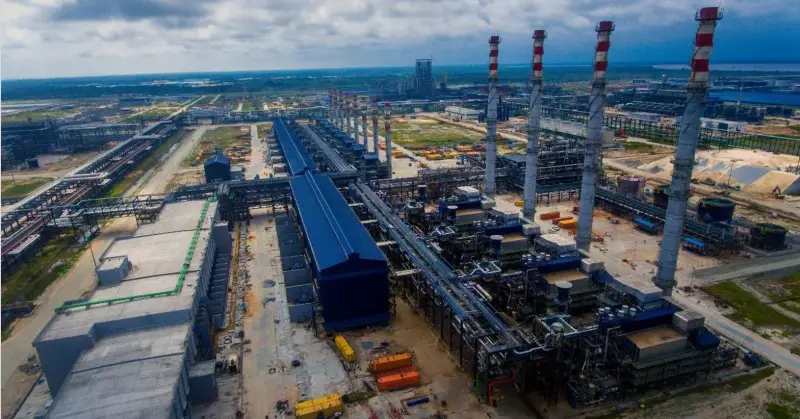
The management of Dangote Petroleum Refinery has issued a strong rebuttal against widespread media reports suggesting an imminent shutdown of its operations for maintenance. The company labelled these claims as completely false and misleading, assuring the Nigerian public of a stable and uninterrupted supply of Premium Motor Spirit (PMS), commonly known as petrol.
Steady Production and Market Supply
In an official statement released on Monday, January 5, 2026, the refinery provided concrete data to back its position. It confirmed that its production activities are ongoing smoothly, with the capacity to supply between 40 million and 50 million litres of PMS daily throughout January and February. This output is solely dependent on current market demand.
The refinery disclosed specific figures to demonstrate its operational tempo. On Saturday, January 4, 2026, it successfully produced 50 million litres of PMS. From its loading gantry, a total of 48 million litres were evacuated to marketers on the same day. The company further revealed that its present stock levels are robust enough to cover more than 20 days of national consumption, effectively dispelling any fears of a supply shortage.
Clarification on Maintenance and Operational Design
Addressing the root of the false rumours, the refinery clarified the nature of its maintenance activities. It explained that the sophisticated, integrated design of its facility allows for routine work on specific units without halting overall production. While maintenance might be carried out on units like the Crude Distillation Unit (CDU) or the Residual Fluid Catalytic Cracking (RFCC) unit, other critical processing sections continue to function.
Units currently in operation and producing various products include:
- The Naphtha Hydrotreater
- The Continuous Catalyst Regeneration (CCR) Reformer
- The Hydrocracker
These units are actively yielding PMS, Automotive Gas Oil (diesel), and Jet A-1 aviation fuel. The refinery emphasised that, following global industry standards, it does not comment on internal maintenance schedules, as these are managed to international specifications without disrupting supply chains.
Price Stability and Accusations Against Importers
Reaffirming its commitment to market stability, Dangote Refinery stated it continues to sell PMS at an ex-gantry price of N699 per litre to all marketers and bulk consumers. It provided a verifiable supply record, noting that since December 16, 2025, it has loaded between 31 million and 48 million litres of PMS daily from its gantry, in alignment with market demand. These volumes are documented in the depot loading records maintained by the Nigerian Midstream and Downstream Petroleum Regulatory Authority (NMDPRA).
The company issued a stern warning against what it described as a campaign of misinformation. It accused certain fuel importers of sponsoring false reports about a refinery shutdown to justify recent increases in petrol pump prices. Dangote argued that such tactics are against the national interest, as they impose unnecessary hardship on Nigerians, especially when local refining has significantly improved product availability.
The refinery highlighted its pivotal role in price stabilisation, warning that in a post-subsidy environment, without domestic production, petrol prices could skyrocket to as high as N1,400 per litre. It urged filling station operators, large-scale users, and institutional buyers to patronise locally refined products, which it guarantees are of high quality, rather than opting for often more expensive and uncertain imported alternatives.
In its concluding remarks, Dangote Petroleum Refinery called on stakeholders and the public to disregard the false reports, remain vigilant against price manipulation, and rely only on verified information from credible sources. It reiterated its dedication to supporting Nigeria’s energy security, economic stability, and journey towards industrial growth.