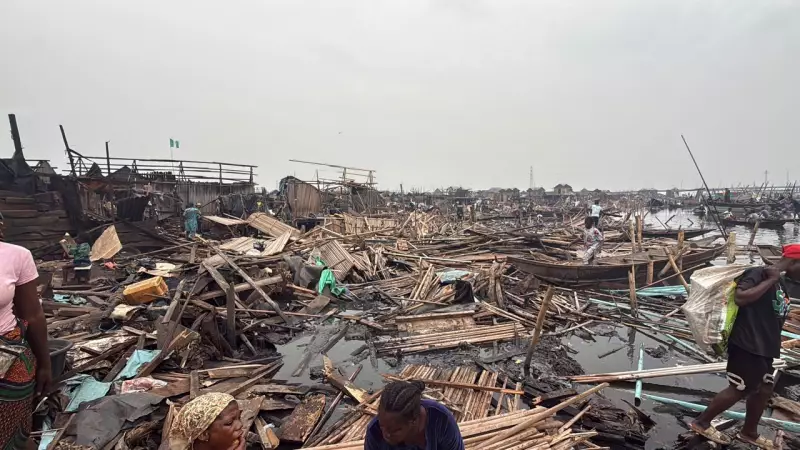
Amphibious excavators, backed by armed police officers, have torn through the iconic waterways of Makoko, Africa's largest floating slum, in a controversial demolition drive. The operation, which began just before Christmas, has crushed hundreds of wooden homes built on stilts above the Lagos lagoon, casting thousands of residents adrift.
Human Cost of the Clearance Operation
The human impact of the demolitions has been severe. Three people, including two infants, have died from the effects of teargas fired by police during the clearances, according to reports from three human rights groups. Residents describe being given no warning before their homes and livelihoods were destroyed.
"They treated us like we are less than animals," said Alex Wusa, a 25-year-old teacher, speaking from a canoe navigating Makoko's now-cluttered waterways. "My house has been demolished. My shop has been demolished. Even the school where I teach has been demolished."
An NGO estimates that over 30,000 people have been displaced, a claim disputed by the Lagos State government. With many families forced to sleep in canoes, a recent heavy rainfall soaked their makeshift shelters, compounding their misery. "This suffering is too much," lamented fishmonger Iyabo Olaleye, who lost two houses. "The rain drenched my children, and I have nowhere to go."
Government Justification and Community Backlash
Lagos state officials defend the action, stating it was necessary for public safety and urban renewal. They claim all structures within 100 metres of high-tension power lines crossing the lagoon were marked for removal. Gbolahan Oki, head of the state's urban renewal office, said residents were given warnings as early as March.
However, a coalition of five NGOs counters that the government demolished homes far beyond the stated 100-metre buffer zone. They accuse the state of "continued collusion with an oligarchy of powerful land-owning families and corrupt private developers." This pattern is familiar in Lagos, where valuable waterfront land is often reclaimed for high-end real estate projects.
Just weeks before the Makoko operation, bulldozers levelled dozens of houses in the Oworonshoki neighbourhood on the opposite side of the lagoon, with officials citing a lack of planning approvals.
The Paradox of Lagos's Housing Crisis
The demolitions highlight a deep paradox in Lagos's acute housing shortage. About half of the state's population lives in slums, according to Professor Timothy Nubi of the University of Lagos. Yet, as informal settlements are cleared, thousands of homes in affluent areas remain vacant due to exorbitant rents.
"When people pay the equivalent of $126 annually for a space under the bridge, you know there is a problem," Nubi stated. "It becomes more alarming when you still see thousands of houses vacant." Even in shanties like Makoko, residents pay significant rents for basic shelter.
Experts like Nubi propose alternative solutions, such as "gentrification" that upgrades slums without displacing their long-standing communities. Makoko, a century-old settlement and a stark symbol of both urban poverty and resilience, continues to exist in a precarious balance between eradication and the right to a home in Africa's largest city.