
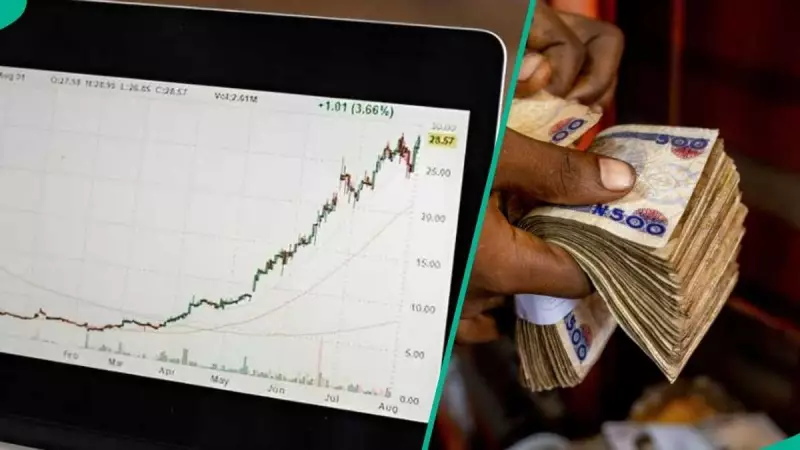
The Nigerian stock market experienced a downward trend on Thursday, January 22, 2026, closing bearish as investors engaged in profit-taking activities across several major sectors. The benchmark All-Share Index declined by 0.52% intraday, reflecting a cautious market sentiment amid sell-offs in key industries.
Market Performance Overview
Data from the Nigerian Exchange (NGX) revealed that the All-Share Index settled at 165,397 points at the close of trading, down from 166,268 points recorded the previous day. This decline translated to a significant reduction in investors' wealth, with market capitalisation decreasing by N557 billion to close at N105.89 trillion. The bearish momentum was driven by widespread profit-taking, particularly affecting the cement, oil and gas, and banking sectors.
Gainers and Losers Analysis
Market activity showed a mixed performance, with 36 companies recording gains while 39 companies experienced losses. The gainers' table was led by several notable performers, including Infinity Energy Resources, United Homes Real Estate Investment Trust, John Holt Plc, and NCR Nigeria Plc. These companies posted impressive gains, with each rising by approximately 10% during the trading session.
On the other hand, the losers' table featured prominent names such as Omatek Ventures Plc, International Energy Group Plc, International Breweries Plc, and Nigerian Enamelware Manufacturing Company. Omatek Ventures led the decliners with a 9.40% drop, followed by International Energy Group with a 6.06% decline and International Breweries with a 6.00% decrease.
Trading Volume and Activity
Despite the bearish sentiment, market activity witnessed an increase in trading volume. The total volume traded rose by 3.43% to reach 823 million shares, valued at N24.93 billion across 43,548 deals. This heightened activity indicates continued investor interest, even amid the overall market decline.
The top five trades by volume were dominated by financial and industrial companies. Access Bank recorded the highest traded volume with 54.28 million shares valued at N1.23 billion, followed by DEAP Capital with 51.16 million shares worth N300 million. Tantalizer, Omatek Ventures, and Japaul Gold & Ventures also featured prominently in the volume rankings, demonstrating diverse trading patterns across sectors.
Sectoral Impact and Investor Sentiment
The profit-taking observed on Thursday reflects a broader trend of investor caution in the Nigerian stock market. The cement, oil and gas, and banking sectors were particularly affected, suggesting that investors are reassessing their positions in these traditionally strong industries. This bearish movement comes amid ongoing economic adjustments and regulatory changes affecting the financial landscape.
Market analysts note that such fluctuations are not uncommon, especially as investors respond to both domestic and global economic signals. The decline in market capitalisation by N557 billion underscores the sensitivity of the Nigerian stock market to profit-taking activities, even when underlying fundamentals remain relatively stable.
Broader Context and Regulatory Developments
The current market dynamics occur against the backdrop of regulatory changes in the banking sector. Earlier reports indicated that United Bank for Africa Plc (UBA) secured a N157 billion rights issue as part of efforts to meet the Central Bank of Nigeria's revised capital requirements. In March 2024, the CBN increased the minimum capital threshold for national commercial banks to N500 billion, giving institutions a two-year window to comply.
While some banks have already met this requirement, others, including UBA, are exploring various strategies to raise the necessary funds. This regulatory environment adds another layer of complexity to market movements, as investors weigh the implications of these changes on bank valuations and overall sector performance.
As the Nigerian stock market navigates these challenges, investors are advised to monitor sectoral trends and regulatory developments closely. The bearish close on Thursday serves as a reminder of the market's volatility, even as opportunities for growth remain in select companies and industries.




