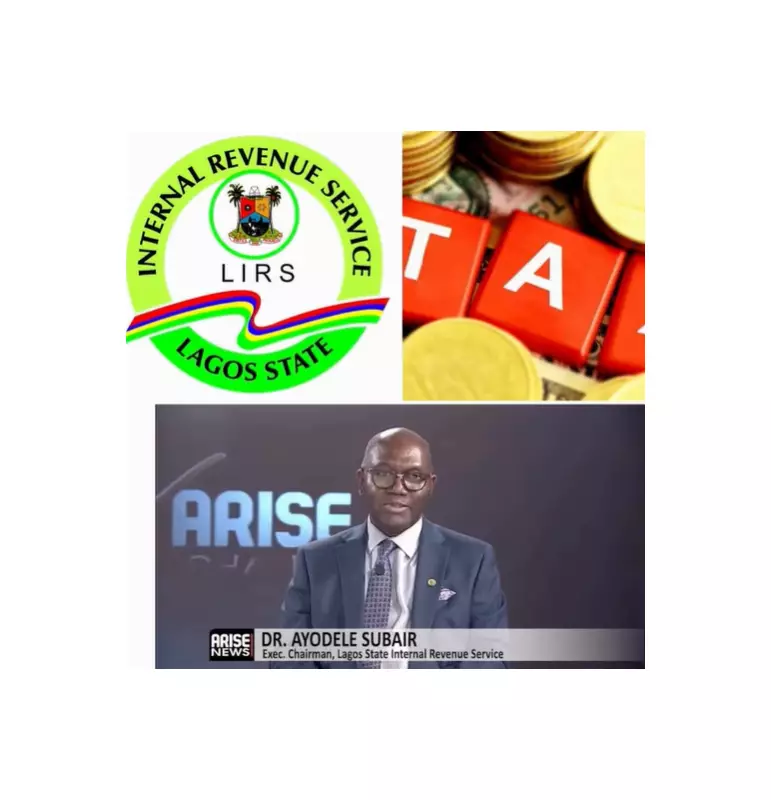
The Executive Chairman of the Lagos State Internal Revenue Service (LIRS), Ayodele Subair, has firmly refuted widespread reports suggesting the agency plans to directly deduct unpaid taxes from the bank accounts of Lagos residents. Speaking during an appearance on Arise TV on Tuesday, January 27, Subair described such narratives as misleading and far from accurate.
Clarifying the Legal Framework for Tax Recovery
Over the weekend, LIRS issued a statement announcing its intention to enforce the recovery of outstanding tax liabilities from defaulting taxpayers through third parties. These third parties include banks, employers, tenants, debtors, and business partners. The agency emphasized that this action is fully authorized under Section 60 of the Nigeria Tax Administration Act, 2025 (NTAA 2025), which grants LIRS the legal authority known as the Power of Substitution.
The official notice explained: "The NTAA 2025 empowers the Lagos State Internal Revenue Service to direct any person holding money on behalf of, or owing money to, a taxpayer who has failed to pay an established final tax liability when due, to remit such money to the Service in settlement (or partial settlement) of the outstanding tax."
Understanding the Power of Substitution Mechanism
According to LIRS, the Power of Substitution represents a lawful collection mechanism designed to ensure the efficient recovery of various unpaid taxes. These include:
- Personal Income Tax (PIT)
- Capital Gains Tax (CGT)
- Stamp Duties
- Withholding Tax (WHT)
The agency clarified that this power applies when a taxpayer fails, neglects, or refuses to settle an established tax liability after it becomes due. In such cases, LIRS may direct any person or entity holding funds on behalf of the taxpayer, or who owes money to the taxpayer, to remit those funds directly to the service.
This directive can extend to:
- Customers and business partners
- Agents and representatives
- Tenants and landlords
- Employers and contractors
- Any other persons or entities in possession of the taxpayer's funds
Importantly, LIRS noted that this authority also covers funds owed to the taxpayer, regardless of whether the debt is immediately payable or still accruing.
Chairman Subair's Detailed Explanation on Arise TV
The initial statement from LIRS generated significant concern online, with many questioning the legality and implications of this approach. In his television appearance, Chairman Subair provided crucial context to address these concerns.
Subair emphasized that the narrative suggesting government invasion of personal accounts for tax collection is not entirely accurate. He explained that the Power of Substitution is applied exclusively to individuals who have defaulted on their tax payments and have exhausted all available dispute resolution mechanisms.
In his own words: "The whole idea is that the power of substitution is a legal instrument that is used to recover unpaid taxes. These unpaid taxes result from assessments that have emerged over time. When assessments are issued, people may object to them, leading to back-and-forth discussions. We have numerous dispute mechanisms in place, including inviting taxpayers for reconciliation exercises."
The Extensive Legal Process Before Enforcement
Subair outlined the comprehensive procedural journey that must occur before LIRS can consider applying the Power of Substitution:
- Tax assessments are issued to taxpayers
- Taxpayers may object to these assessments, triggering discussions and reconciliation exercises
- If no resolution is reached, LIRS issues a Notice of Refusal to Amend (NORA)
- Following NORA, the agency issues a formal demand notice
- Even after demand notices, further discussions may occur
- The tax tribunal procedures commence if disputes persist
- Cases may progress through the High Court, Court of Appeal, and potentially the Supreme Court
"We can see that there is a long timeframe from when the assessments are issued and when we finally dispose of all the cases through the court system," Subair noted. "At that point in time, it becomes apparent that the taxpayer is probably just a defaulter or has become entirely recalcitrant with no intention of paying. That is when we can think of applying the power of substitution. Looking at the time frame, it's not less than five years."
Addressing Public Misconceptions
The LIRS chairman directly addressed the public's concerns about arbitrary account seizures: "So if anybody says the tax authorities want to seize accounts, that might not be a good representation of the action." He stressed that the Power of Substitution represents a last-resort measure for taxpayers who have deliberately avoided their obligations despite extensive legal proceedings and opportunities for resolution.
The agency's statement was specifically issued to clarify the circumstances, procedures, and obligations involved in exercising this statutory power. LIRS aims to ensure taxpayers understand that this mechanism is not about sudden account deductions but rather a structured, court-backed process for addressing persistent non-compliance with tax obligations.
This clarification comes as Lagos State continues to strengthen its revenue collection systems while balancing taxpayer rights with the government's need for sustainable funding for public services and infrastructure development.