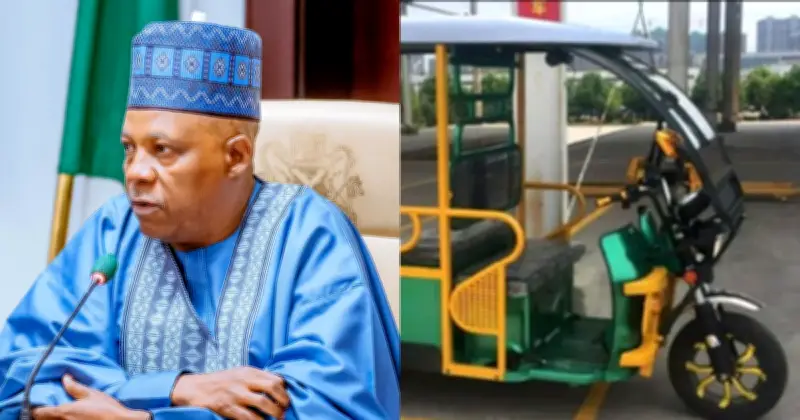
The Federal Government's plan to roll out 10,000 electric tricycles across Nigeria from August has sparked widespread debate, with many citizens questioning how the initiative will function given the country's persistent electricity supply issues. Vice President Kashim Shettima announced the programme on Monday, stating that the electric tricycles would initially be deployed in communities across the North-East by the North East Development Commission (NEDC) before expanding to other regions through various development commissions.
Government's Vision for Clean Transport
According to Shettima, President Bola Tinubu has approved the nationwide expansion of the initiative as part of broader efforts to modernize transportation, reduce mobility costs, and promote cleaner energy alternatives. The Vice President emphasized that the administration is working towards building an integrated transport and logistics network that connects roads, railways, ports, airports, inland waterways, and alternative fuel-powered vehicles. "Our vision is an unbroken logistics chain, where a container moves from a deep-sea port to a rail wagon, then to a CNG-powered truck, and finally to a trader in Ariaria Market or Maiduguri without delay or policy failure," Shettima stated.
Public Skepticism and Criticism
Despite the government's optimism, many Nigerians have expressed doubts about the practicality of electric-powered transportation in a country where electricity supply remains unreliable. Social media reactions have been largely critical, with one user writing, "There is no light but we want to engage in electric tricycles... Okay ooo." Another commented, "Always poverty mentality interventions." Some argued that Nigeria should focus on mass transit systems instead, saying, "Others are thinking metro and buses, these ones will rather turn us to India!!!" Others raised concerns about insecurity and food production, with one commenter stating, "Electric tricycle is not what we need per se, we are hungry, farmers are left with phobia in their camps due to excessive killing by herdsmen, food production has dropped, help us with insecurity so as to boost food production."
Government's Clean Energy Push
The Vice President also highlighted the government's push for Compressed Natural Gas (CNG) adoption, claiming that the initiative is already helping to reduce transportation costs. "We said CNG could cut fuel costs by over 60 per cent, and many called it fantasy. Today, heavy-duty trucks run on Nigerian gas, proving sceptics wrong and returning money to the pockets of transport operators," he said. Shettima further pointed to ongoing reforms in the maritime sector, including the operation of the Lekki Deep Sea Port, implementation of the National Single Window project, and renewed investment in inland waterways.
Transport Unions Endorse Administration
Earlier, Technical Adviser to the Vice President on Transportation, Logistics and Innovation, Prince Segun Obayendo, said transport unions and associations across the aviation, maritime, rail, and road sectors had endorsed the Tinubu administration and pledged support ahead of the 2027 election. The electric tricycle programme is expected to form part of the government's wider clean energy and transportation agenda, although questions remain about charging infrastructure, electricity availability, and how quickly the initiative can be scaled across the country.