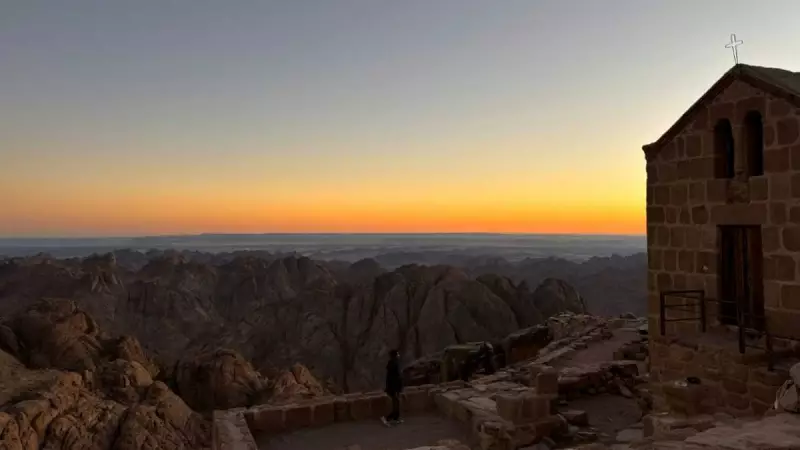
In the shadow of Mount Sinai, a place revered by Judaism, Christianity, and Islam, the quiet of the sacred landscape is now broken by the relentless noise of construction machinery. Egypt is pushing forward with a massive tourism development in the remote town of Saint Catherine, a move that has sparked fierce criticism from heritage experts and fear among the local Bedouin inhabitants.
A Sacred Landscape Transformed
The nearly $300-million initiative, known as the "Great Transfiguration" or "Revelation of Saint Catherine" project, aims to draw mass tourism to southern Sinai. However, the rapid construction of hotels, a conference centre, and hundreds of housing units is dramatically altering the ancient terrain. From above, bright lights and concrete structures now dominate the view, overshadowing the traditional red-brick homes and orchards of the local community.
John Grainger, who formerly managed the European Union's Saint Catherine protectorate project, did not mince words when speaking to AFP. "We should call this what it is, which is the disfigurement and destruction of the site," he stated. The area is a UNESCO World Heritage site, home to the world's oldest continuously operating Christian monastery and the ancestral lands of the Jabaliya Bedouin tribe.
Community Uprooted and Heritage at Risk
The local Jabaliya tribe, whose name derives from the Arabic word for "mountain," have lived in the area for an estimated 1,500 years. While they have long sought better infrastructure to alleviate poverty, the current development has come at a severe cost. Locals report being ignored in consultations, and the project has already led to direct harm.
In a particularly distressing incident in 2022, bulldozers levelled the town's centuries-old cemetery, forcing families to exhume hundreds of bodies. The gravesite has since been turned into a car park. The South Sinai governor's office did not respond to AFP's questions regarding this action or the project's local impact.
"They just came in one day without saying anything and destroyed our cemetery," a veteran Jabaliya hiking guide told AFP, requesting anonymity like others interviewed due to fears of retaliation. He lamented, "The Saint Catherine we knew is gone."
International Concern and Unheeded Warnings
The development has raised significant international alarm. In July 2025, World Heritage Watch urged UNESCO to inscribe Saint Catherine on the list of World Heritage in Danger. This followed a 2023 request from UNESCO itself that Egypt halt further projects, conduct an impact evaluation, and develop a conservation plan. Despite this, construction has continued unabated, with the government announcing in January that the project was 90% complete.
The situation is further complicated by a domestic legal ruling. In May, an Egyptian court decided that the land of the Saint Catherine monastery is state-owned, granting the Greek Orthodox monks only the right to use it. This sparked a diplomatic dispute with Greece and concern from Orthodox leaders, with critics arguing it makes the monastery's future dependent on the state's goodwill.
As five-star hotels like a sprawling Steigenberger resort loom over the ancient monastery's grapevines, a local official expressed scepticism about the project's viability to AFP, "These hotels are huge, the costs astronomical. Are they even going to be full? That's the real problem, but we can't say anything." For the Jabaliya community, the fear is more existential. As the guide summed up, "No one knows what will happen tomorrow. Maybe they'll tell us to get out, that there's no room for us anymore."