Who Pays for a Wedding in Nigeria?
If you have been wrestling with the question of who pays for a wedding in Nigeria, you are in genuinely good company. I have been covering Nigerian family life, culture, and economics for years, and I can tell you that wedding finances are one of the topics people search for most feverishly and understand least clearly. This article is the conclusion of months of digging into costs, customs, and conversations with couples, parents, and planners across Lagos, Abuja, Enugu, and Ibadan. So pour yourself a cup of tea and let us sort this out together.
The short answer is that wedding financing in Nigeria is almost never the responsibility of one person alone. Unlike the Western tradition where the bride's family historically footed most of the bill, Nigerian weddings operate as something closer to a communal financial project, with contributions flowing from the groom, the groom's family, the bride's family, the couple themselves, and a generous supporting cast of relatives, friends, and well-wishers. Exactly who pays for what, and how much, depends enormously on ethnic group, family expectations, religious tradition, and the social status everyone is trying to project.
I remember attending a wedding in Ijebu-Ode a few years back where the groom's mother was personally coordinating the catering for 600 guests while the bride's father had organised and paid for the entire venue. The couple, meanwhile, had quietly funded their own honeymoon and registry wedding using money they had saved for eighteen months. Three different budgets, three different families, one spectacular day. That, in a nutshell, is Nigeria.
Who Pays for What in a Nigerian Wedding in 2026?
The financial architecture of a Nigerian wedding in 2026 looks quite different from what it did even a decade ago. Inflation has pushed costs sharply upward. A ceremony that might have cost a total of ₦5 million in 2018 now routinely runs to ₦15 million or more for a mid-range Lagos celebration. Couples who once relied entirely on family sponsorship are increasingly contributing their own savings, and some are politely but firmly negotiating down the scale of celebrations their parents had imagined.
That said, the broad framework remains recognisable. The groom and his family are traditionally expected to bear the largest share of expenses. This includes the bride price (known as bride wealth, or in Yoruba tradition as eru iyawo), the list of items requested by the bride's family during the traditional introduction, and in many ethnic groups, the cost of the groom's traditional attire and his family's aso-ebi fabric. In Igbo weddings, the groom's family often sponsors palm wine, kola nuts, and other ceremonial items. In Hausa-Fulani ceremonies, the groom covers the saduqi (sadaki), the formal Islamic gift to the bride.
The bride's family, meanwhile, typically covers the costs of the bride's preparation, her traditional attire and jewellery, the food and entertainment at the traditional ceremony venue (which is often held at the bride's family home), and in many traditions, the bride's trousseau. They also bear the cost of hosting the introduction ceremony, which in wealthy Lagos families alone can run to ₦2 million or more before the formal wedding date has even been set.
The couple themselves are increasingly co-funding the white wedding reception, the honeymoon, and the statutory marriage registration. The Ministry of Interior's official marriage portal at candb.interior.gov.ng/marriage allows couples to register their statutory marriage digitally, with the government fee for a marriage certificate sitting at ₦15,000 per couple. (That is the most affordable line item on the entire wedding budget, which probably tells you something about where your money is actually going.)
Friends and the wider community contribute through the aso-ebi system, where guests purchase coordinated fabric from the couple (typically at a profit margin), effectively subsidising part of the celebration while simultaneously signalling their social allegiance. At a well-attended Lagos wedding, aso-ebi sales alone can raise between ₦500,000 and ₦5 million for the couple.
How to Plan Your Nigerian Wedding Payments: A 7-Step Guide
Before you commit a single naira, it helps enormously to have a clear process. After years of watching couples navigate this, here is the payment planning sequence that tends to cause the least family drama.
- Hold a family meeting early. Sit down with both sets of parents before any ceremonies are planned and establish who is contributing what. Vague assumptions are the enemy. Write it down if you can.
- Request the bride price list promptly. The bride's family's list of required items and payments sets the floor for the groom's financial obligations. Get this early so there are no surprise additions three weeks before the ceremony.
- Set a total combined budget by adding up all family contributions alongside what the couple can personally fund. Be brutally honest about the numbers.
- Divide ceremonies and assign financial responsibility to each one. Traditional introduction: bride's family hosts and funds. Traditional marriage: costs split according to ethnic customs. White wedding reception: typically the couple and/or groom's family.
- Open a dedicated wedding savings account. Avoid the trap of mixing wedding savings with general household finances. A joint account specifically for the wedding, fed by monthly contributions from both sets of families and the couple, keeps everyone accountable.
- Plan the aso-ebi sale with a realistic profit margin. Price the fabric high enough to generate meaningful income but low enough that guests actually buy it. Many experienced Nigerian couples price aso-ebi at two to three times the cost price.
- Register your statutory marriage through the official Ministry of Interior eCitiBiz portal well in advance. The process requires documentation and processing time, and doing this in a panic two weeks before the white wedding is a stress nobody needs.
Who Is Responsible for Paying for a Wedding?
This is the question that causes the most confusion, largely because the answer changes depending on which family you ask, which tribe you belong to, and what year the conversation is happening in. Traditionally, the short answer is: the groom's family carries the greater financial burden. This is because Nigerian marriage has historically functioned as an agreement between families rather than merely between two individuals, and the groom's family is expected to demonstrate their worthiness and generosity through tangible financial commitment. The bride price is the most visible expression of this.
However, calling it solely the groom's family's responsibility is increasingly inaccurate. In 2026, the reality for most Nigerian couples is that the groom and his family pay the bride price and traditional items list, the bride's family hosts and funds the traditional ceremony, the couple jointly fund the white wedding reception and statutory registration, both families contribute to catering, decor, and entertainment proportionally, and the wider community subsidises through aso-ebi purchases, monetary gifts, and in-kind contributions.
What I have personally observed is that couples who approach the financial question as a team, who sit with both families and negotiate rather than simply accept whatever is demanded, tend to begin their marriages with far less financial stress. That early conversation is worth every awkward moment.
Wedding Cost Responsibilities by Ceremony Type in Nigeria
The table below breaks down typical financial responsibilities across Nigerian wedding ceremonies. These figures reflect 2026 estimates for a mid-range celebration in a major Nigerian city such as Lagos, Port Harcourt, or Abuja.
- Introduction Ceremony: Bride's family (hosts) / Groom's family (gifts). Typical 2026 cost range: ₦500,000 to ₦2,500,000. Notes: Groom's family brings kola nuts, drinks, and cash gifts.
- Bride Price Payment: Groom's family. Typical 2026 cost range: ₦200,000 to ₦3,000,000+. Notes: Highly variable by ethnic group and family.
- Traditional Marriage Ceremony: Both families, split. Typical 2026 cost range: ₦1,500,000 to ₦8,000,000. Notes: Venue, catering, attire, music.
- White Wedding Reception: Couple and/or groom's family. Typical 2026 cost range: ₦3,000,000 to ₦20,000,000. Notes: Venue, catering, decor, photography.
- Aso-Ebi Fabric: Guests (at couple's profit). Net income: ₦500,000 to ₦5,000,000. Notes: Offsets white wedding costs.
- Statutory Marriage Registration: Couple. Typical 2026 cost range: ₦15,000 to ₦75,000. Notes: Via Ministry of Interior portal.
- Honeymoon: Couple. Typical 2026 cost range: ₦500,000 to ₦5,000,000+. Notes: Increasingly couple-funded.
These figures show clearly that a mid-range Nigerian wedding across all ceremonies can cost anywhere between ₦6 million and ₦40 million in total when all stakeholders' contributions are added together. The distribution of those costs is negotiated, not fixed.
Who Pays for a Yoruba Wedding?
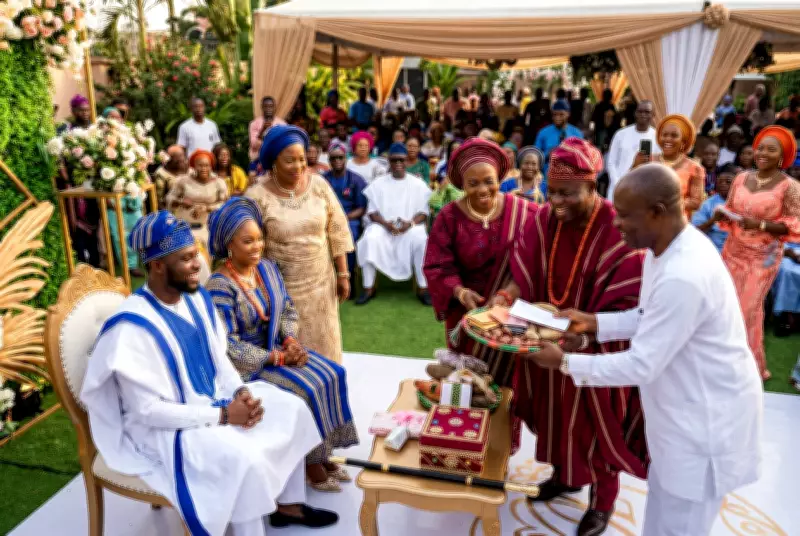
Yoruba weddings are among the most elaborate and financially complex in Nigeria. In a Yoruba traditional wedding, the groom's family presents a detailed list of items to the bride's family known as the eru iyawo (the bride's load). This list is provided by the bride's family and typically includes bottles of honey, obi abata (bitter kola), orogbo, obi (kola nuts), palm wine, schnapps or other spirits, a Bible or Quran, clothing and fabric for the bride's parents and key relatives, cash, and often specific jewellery. The groom's family is expected to provide all of this without complaint.
The bride's family, for their part, hosts the traditional ceremony at their home compound or a hired venue, provides the food for guests, and bears the cost of the bride's traditional attire, her gele, her iro and buba, and all the accessories that make the Yoruba bride look like absolute royalty. The white wedding, which typically follows the traditional ceremony by weeks or months, is generally funded jointly by the couple and the groom's family, with contributions from friends and the aso-ebi system.
One thing that often surprises people outside the Yoruba tradition is that the groom's family also typically funds the matching fabrics for their own delegation. Those hundred aunties and cousins showing up in coordinated gold aso-ebi? The groom's family has usually subsidised that fabric. It is a significant, and often underestimated, expense.
What Do the Groom's Parents Typically Pay for in Nigerian Weddings?
Let us be very specific here. The groom's parents, across most Nigerian ethnic traditions, are typically responsible for the bride price and traditional items. This is the non-negotiable foundation. The bride's family sets the list; the groom's family pays it. In Igbo tradition this can be remarkably modest by design, whilst in some Yoruba and Delta families the lists can run to hundreds of items and millions of naira.
They also fund the groom's traditional and white wedding attire, covering his agbada, buba and sokoto, or senator suit for the traditional ceremony, as well as contributing to or fully covering his white wedding suit. Then there is the aso-ebi for the groom's family. All those family members wearing matching fabric on the groom's side? That fabric was typically purchased in bulk by the groom's family and distributed, or sold at subsidised rates, to relatives. At ₦10,000 to ₦30,000 per yard and hundreds of family members to dress, this figure alone can reach ₦1.5 million.
In most traditions, the groom's family provides alcohol and soft drinks for the ceremony. Palm wine is culturally mandatory in many southern traditions. Beyond this, many families expect a significant contribution toward the white wedding venue, catering, and entertainment, even if the couple is paying the majority. Finally, beyond the formal bride price, many families expect additional gifts to key members of the bride's family: her father, her mother, her eldest uncle. These are not negotiated on any official list but are very much noticed if absent.
The total burden on the groom's parents can vary enormously, but for a modest Lagos wedding, it would not be unusual for the groom's family to contribute ₦4 million to ₦12 million in aggregate across all these categories.
Making Sense of It All: Who Really Pays for a Wedding in Nigeria?
So, who pays for a wedding in Nigeria? The honest answer is that everyone does, in different ways and proportions. The groom's family carries the heaviest formal obligation, particularly through the bride price and traditional items. The bride's family hosts and funds the traditional ceremony. The couple co-funds the statutory registration and increasingly the white wedding reception. The community funds itself through aso-ebi and gifts.
What has changed most significantly in 2026 is the degree to which couples themselves are asserting financial agency. Rising costs, access to financial planning tools, and a shift in generational expectations are all pushing Nigerian couples to negotiate wedding budgets as equal partners rather than passive recipients of family decisions. This is a healthy shift. A wedding that begins with open, honest financial conversations is considerably more likely to produce a marriage that can handle money well.
The communal nature of Nigerian wedding finance is not a burden to escape. It is, at its best, a remarkable demonstration of collective love and investment in a new family unit. The trick is ensuring that the love does not come wrapped in financial pressure that leaves the couple starting their marriage in debt. The groom's family carries the largest formal financial obligation, particularly through bride price and traditional items, but a Nigerian wedding is always a multi-family, multi-stakeholder financial effort. Having clear, documented conversations about who pays for what before any ceremony is planned is the single most effective thing any couple can do to start married life without inherited financial stress.
Frequently Asked Questions About Who Pays for a Wedding in Nigeria
Who traditionally pays for a Nigerian wedding?
Traditionally, the groom and his family carry the largest financial responsibility, covering the bride price, traditional items list, and a significant portion of the reception costs. The bride's family hosts and funds the traditional ceremony, making the total wedding cost a shared effort across both families.
How much does a Nigerian wedding cost in 2026?
A mid-range Nigerian wedding across all ceremonies typically costs between ₦6 million and ₦40 million in total when all stakeholders' contributions are combined. Costs vary enormously based on location, social status, and the number of separate ceremonies the couple chooses to hold.
Does the bride's family pay anything for a Nigerian wedding?
Yes, the bride's family typically hosts and funds the traditional marriage ceremony, covers the cost of the bride's traditional attire and jewellery, and provides food and entertainment at the ceremony venue. In many traditions they also contribute to the white wedding, though the groom's family usually takes the lead on reception funding.
What is bride price and who pays it in Nigeria?
Bride price is a payment made by the groom's family to the bride's family as a formal acknowledgement of the union and an expression of respect and gratitude. It is paid by the groom and his family, and the amount is set by the bride's family, varying widely across ethnic groups from a few hundred thousand naira to several million.
Who pays for the white wedding in Nigeria?
The white wedding reception is typically co-funded by the couple themselves and the groom's family, with some contribution from the bride's family depending on the agreement reached during pre-wedding discussions. Aso-ebi sales by the couple can also generate substantial income that offsets white wedding costs significantly.
What does the groom's family typically pay for in a Nigerian wedding?
The groom's family is usually responsible for the bride price, the eru iyawo or traditional items list, the groom's attire, aso-ebi fabric for the groom's family members, drinks at the traditional ceremony, and a major contribution toward the white wedding reception. In total, this can run to several million naira for a typical Lagos wedding.
Who pays for a Yoruba traditional wedding?
In a Yoruba wedding, the groom's family pays for the eru iyawo (the formal list of gifts presented to the bride's family), the groom's attire, and his family's aso-ebi. The bride's family hosts the traditional ceremony at their compound, funds the food and entertainment, and covers the bride's traditional dress and accessories.
Can a couple pay for their own Nigerian wedding?
Absolutely, and an increasing number of couples are doing exactly this, particularly those who want more control over the scale and cost of their celebrations. Many couples today open a joint savings account specifically for wedding expenses and negotiate clearly with both families about which elements each side will fund.
How does aso-ebi help pay for a Nigerian wedding?
Aso-ebi is coordinated fabric sold by the couple to wedding guests at a profit, and it can generate between ₦500,000 and ₦5 million or more depending on guest list size and fabric price. This income is typically used by the couple to offset the cost of the white wedding reception, making aso-ebi one of the most effective crowd-funding mechanisms in Nigerian culture.
What is the difference between bride price and dowry in Nigeria?
Bride price is paid by the groom's family to the bride's family and is widely practised across Nigerian ethnic groups. Dowry, which involves the bride's family sending wealth with the bride into her new home, is a different custom more common in South Asian traditions and is not a standard Nigerian practice, though gifts from the bride's family to the couple are common.
Is it required to have multiple ceremonies for a Nigerian wedding?
There is no legal requirement to hold multiple ceremonies, but most Nigerian families expect at least a traditional ceremony and a statutory registry marriage. The white wedding church or event reception is culturally expected in Christian communities, making three separate ceremonies the effective norm for many Nigerian couples.
How should couples have the money conversation before a Nigerian wedding?
The most effective approach is to call a family meeting with both sets of parents early in the engagement period, before any costs have been committed, and to establish clearly which family is funding which ceremony. Writing down agreed contributions and setting a firm combined budget prevents the misunderstandings and last-minute financial demands that cause so much pre-wedding stress across Nigeria.