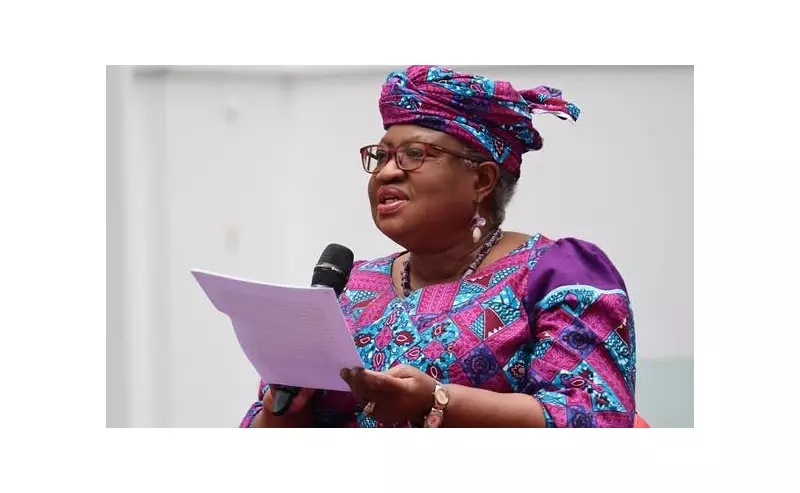
The Director-General of the World Trade Organisation (WTO), Dr Ngozi Okonjo-Iweala, has issued a strong warning to developing economies, stating they can no longer afford to treat trade in services as a secondary priority. She declared that any nation which sidelines this vital sector is putting its own economic growth trajectory in serious jeopardy.
The Global Shift to Services is Now
Speaking at the opening of the two-day Trade in Services for Development Conference in Geneva, Okonjo-Iweala laid out the compelling data behind the global economic transformation. She emphasised that the services sector now constitutes more than two-thirds of global GDP and is responsible for over half of all employment worldwide. In value-added terms, services also account for more than half of all world trade.
The WTO leader shared fresh projections indicating a robust expansion in global commercial services trade, expected to grow by 4.6 per cent in 2025 and 4.4 per cent in 2026. This growth dramatically outpaces merchandise trade, which is forecast to increase by only 2.4 per cent this year and a modest 0.5 per cent next year. A standout performer is digitally delivered services, poised for even faster growth at 6.1 per cent in 2025 and 5.6 per cent in 2026.
"Services are not only the economy of the future; services are the economy of today," Okonjo-Iweala asserted. "Services trade is development in action. It is income, it is dignity, and it is empowerment—particularly for young people and for women."
Africa's Stark Marginalisation in Global Trade
Delivering a keynote address, Nigeria’s Minister of Industry, Trade and Investment, Dr Jumoke Oduwole, highlighted the continent's troubling position. She presented a stark contrast: while services contribute 55 per cent of Africa's GDP, the continent commands a mere two per cent of the global services trade value.
"May I be so bold as to say that the economic development of any country can be measured by the robustness of its services sector and its levels of trade in services," Oduwole stated.
She recounted the severe impact of the COVID-19 pandemic, which exposed the fragility of Africa's services exports. These exports had doubled from $62 billion in 2005 to $124 billion in 2019, only to collapse to $82.7 billion in 2020 as travel and tourism—key pillars for many economies—were devastated. Although a rebound to $150 billion was recorded in 2023, Oduwole cautioned that Africa remains on "the lower rung of the global services value chain."
Nigeria's Own Services Trade Imbalance
The Nigerian economy reflects this continental challenge. Minister Oduwole pointed out that while services contribute a significant 58 per cent of Nigeria's GDP and account for over 45 per cent of formal employment, they make up less than 10 per cent of the country's total exports. She described this disparity as a critical development challenge that must be addressed with urgency.
Regulatory Hurdles as a Major Constraint
Both leaders identified regulatory barriers as a central obstacle holding back the expansion of services trade. Okonjo-Iweala explained that services trade often "does not attract the level of policy attention its economic importance warrants." This policy neglect is partly due to the intangible nature of services, their multiple modes of supply, and their exposure to heavier regulatory scrutiny compared to goods.
The conference, held on 3-4 December 2025, served as a clarion call for developing nations, particularly in Africa, to strategically reposition their economies. The message was clear: to harness growth, create jobs, and empower citizens, prioritizing and actively enabling trade in services is no longer an option but an economic imperative.