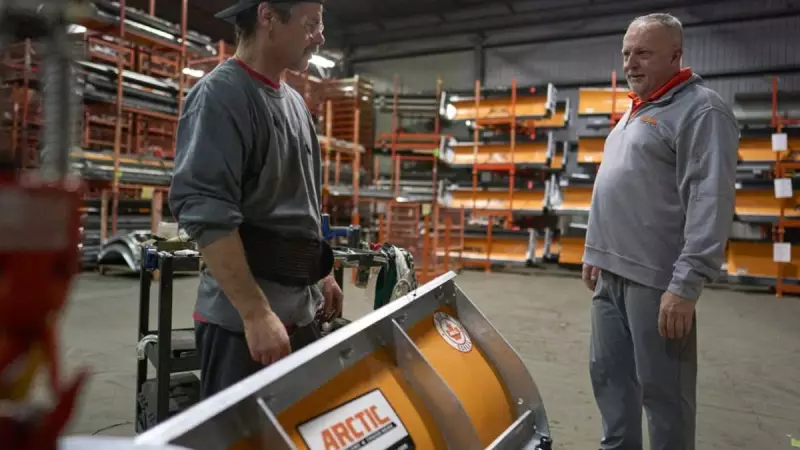
For years, Arctic Snowplows has successfully exported its galvanised steel snow-clearing equipment from its base in London, Ontario, to customers across the United States. However, the landscape has grown frosty for the company since the imposition of tariffs by former US President Donald Trump.
The Heavy Cost of Protectionism
Company President Mike Schulz explained the direct impact on his business. The US tariffs on imported steel have added an extra $500 (approximately US$363) to the cost of a typical $10,000 snowplow. This significant price hike has proven too much for many American buyers to accept. "It's something we can't afford to just absorb and it's something that customers in the States don't want to pay," Schulz stated from his factory floor.
With US sales declining, the firm, established in 1969, is now navigating what Schulz describes as "very uncertain times." The situation reflects a broader challenge for Canada, which has been uniquely affected by Trump's global tariffs on steel, aluminium, automobiles, and lumber due to the deeply interconnected nature of the two economies.
Broader Economic Upheaval and Domestic Shifts
The ripple effects are severe. Algoma Steel, a major Canadian steel producer, recently announced 1,000 layoffs, directly blaming the "unprecedented tariffs imposed by the United States." Bank of Canada Governor Tiff Macklem has framed this as more than a temporary slump, calling it a "structural transition" and part of a "period of global upheaval."
Prime Minister Mark Carney has echoed this sentiment, warning that the deep economic integration with the US seen before Trump's presidency is unlikely to return. His government's strategy involves boosting domestic trade and seeking new international markets. In a recent announcement supporting steel and aluminium businesses, Carney emphasised the need for these sectors to "seize new markets at home and around the world."
Patriotic Buying Isn't Enough
For Arctic Snowplows, this global strategy has practical limits. Schulz noted that while there has been an uptick in Canadian sales—partly driven by patriotic buying in response to Trump's trade war and past threats—it doesn't compensate for the lost American business. "Great, so I picked up a dealer in Saskatoon, but I lost New York. I mean, awesome, I love the patriotism, but the volume offset is just not there," he remarked.
Sales Development Manager Kyla Brooks highlighted the delicate balance in their messaging. The company wants to leverage the "buy-Canadian" sentiment but must be careful not to alienate its remaining US customer base by pushing a "pro-Canadian message" too aggressively.
Exporting to distant markets like Europe is also impractical due to the bulky size and high shipping costs of their products, Schulz added with a chuckle.
Frustration with Negotiating Tactics
Schulz expressed clear dissatisfaction with the Canadian government's approach to the trade dispute. Prime Minister Carney, elected to a full term in April 2025, rolled back many of Canada's counter-tariffs on US imports in an attempt to encourage a deal. However, Trump subsequently called off all trade negotiations with Canada, angered by an anti-tariff advertisement from Ontario's provincial government.
This sequence of events has left Schulz "extremely frustrated." The protective counter-tariffs that helped level the playing field with US competitors are gone, while Canadian businesses have "no indication of any deal upcoming." Catherine Cobden, President of the Canadian Steel Producers Association, summarised 2025 as a "challenging year," noting that the US was the destination for about half of Canada's steel production. She expressed hope that with government measures, Canada could reclaim its domestic market.
The story of Arctic Snowplows, set against a backdrop of falling snow in Ontario, is a microcosm of the larger economic chill brought on by shifting trade policies, demonstrating how geopolitical decisions directly impact manufacturing floors and livelihoods.