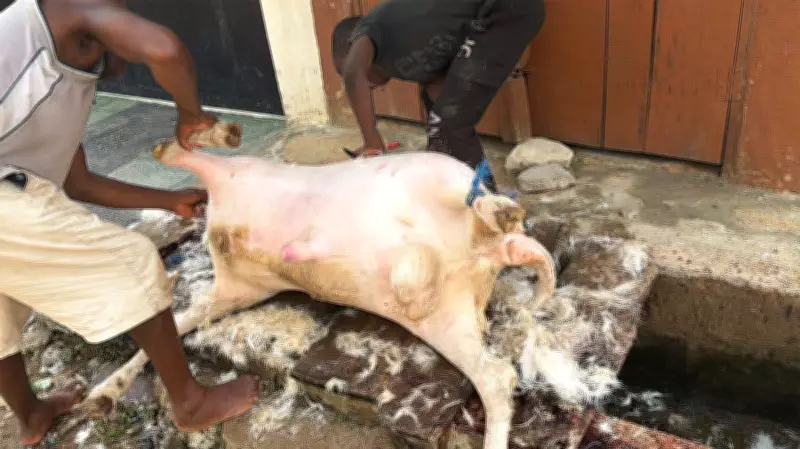
In the name of the Almighty, the Beneficent, the Merciful: 'It is not their (animals) meat nor their blood that reaches Almighty; it is your piety that reaches Him: He has thus made them subject to you that ye may glorify the Almighty for His guidance to you: And proclaim the good news to all who do right.' (Quran 22:37)
No, never. Neither their meat nor their blood is of any use to Him. It could not have been, for the Almighty has no need of meat or blood; His essence is free of any inadequacy that would have warranted the consumption of meat or blood. In fact, the very act of ransoming Prophet Ismail (AS) from the blade, from the knife, was to teach this to us – what matters most is our consciousness, our preparedness to negate everything for His sake, to dedicate everything to His service and worship.
Recall, dear reader, that the sacrifice of animals has always been treated as a form of worship in some religions. In certain ancient and even contemporary societies, animal sacrifice is a form of worship. In others, human blood and flesh, despite their incongruity to reason and revelation, are still prized materials sought after by agents of darkness. The other day, a man was given a traditional title in that king's palace as the Apena of that land; the crowd shouted his praise and sang lullabies in commemoration of his new status. They did that in utter ignorance of the semiotics of the title and personage of the receiver. Is it not true that to be referred to as 'Apena' is, literally in Yoruba parlance, to receive acclaim as the murderer or the killer-in-chief?
Thus, the Eid al-Kabir became institutionalized to put an end not only to the killing of humans by humans as a form of worship to gods, but equally to properly situate the meaning of sacrifice as a positive driver of noble actions. This means that you must have satisfied at least three conditions before you set out to perform the ritual of sacrifice. First, you must have qualified as a Muslim to embark on the act of worship. Second, the animal you chose must have satisfied those conditions without which the whole exercise would have been nugatory. Third, you must have kept in mind the essence of the sacrifice.
With reference to the first condition, the Prophet is reported to have said: 'Every adult (conscious) Muslim, male or female, who owns 613.35 grams of silver or its equivalent in money, personal ornaments, stock-in-trade, or any other form of wealth which is surplus to his basic needs, is under an obligation to offer a sacrifice.' In other words, any Muslim who is financially able and comfortable and could afford a ram is under obligation to offer animals for sacrifice. Animals to be sacrificed must be of sound health and should not suffer any physical deformity. But most importantly, sacrifice is, among other things, meant to commemorate the unparalleled readiness of Prophet Ibrahim (AS) to dedicate his choicest and priceless treasure (his son) to the service of his Creator.
Thus, whenever Muslims sacrifice animals, it is usually with the acute awareness that neither the meat nor the blood of the animals reach Him, the Almighty. What He desires from us is to submit ourselves to His will, to 'slaughter' our pride, our ego, our lack of contentment, and our avarice the same way we are slaughtering the animals in His name. The Almighty says: 'But your God is One God: submit then your wills to Him (as a Muslim): and give thou the good news to those who humble themselves.' (Quran 22:34)
Bear this in mind – that the spiritual vocations and orientation of the righteous and conscious Muslims during the first ten days of this month, which had featured fasting, charity, observance of supererogatory prayers, recitation of the Quran, the glorification of the name of the Almighty, and the eulogy of His apostle, were not meant to be transitory but permanent. Our acts of worship and sacrifice, the stellar virtues of love and compassion that we displayed in the past couple of days, should continue forever in our wakeful moments. No matter the austerity of his condition and the grim realities of his situation, the Muslim subject cannot afford a moment of disconnection from the blessings of his Creator.
Again, bear this in mind and constantly too, that the Eid al-Kabir festival reminds us of the triumph of faith over profanity and the valorization of spiritualism over materialism. Eid al-Kabir is here to remind us that terrestrial success lies not in material acquisitions but in cooperation by Muslim families in carrying out the will of the Almighty. Eid al-Kabir is here to teach us that he is not a successful man who faces the qiblah while products of his loins are paying obeisance to creatures of the Almighty. And in line with the elasticity of the ruling on the sacrifice, Muslims who still desire to perform this essential obligation have until Saturday, May 30, 2026 (Dhul Hijjah 13, 1447 AH) to do it.