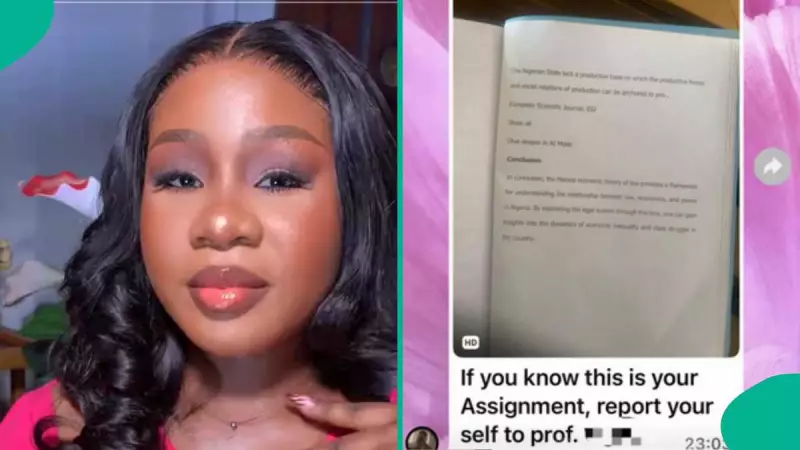
A Nigerian student's attempt to use artificial intelligence (AI) for a school assignment has backfired spectacularly, leading to a public call-out in a class WhatsApp group. The incident, which occurred recently, saw a lecturer easily identify the AI-generated work because the student failed to remove the bot's own internal notations from the submitted text.
The Viral WhatsApp Group Call-Out
The situation came to light after a Nigerian lady, identified on TikTok as @life_of_phan_tasy, shared a screenshot from her class WhatsApp group. The post revealed that a professor had detected an assignment completed with the help of an AI bot, most likely a tool like ChatGPT. The student's critical error was copying and pasting the AI's response without proper review, including the metadata or explanatory notes that the AI model sometimes generates alongside its answer.
An announcement was subsequently posted in the group chat, directing the culprit to report to the course lecturer. The message was blunt: "If you know this is your assignment, report yourself to prof." The public nature of the call-out in the communal WhatsApp group added a layer of embarrassment to the academic penalty the student is likely to face.
Experts Warn of Over-Dependence on AI in Education
This incident underscores growing concerns among educators about the misuse of AI in academic settings. While experts acknowledge that AI holds significant potential to aid learning, they caution against uncritical reliance. According to an analysis by University Canada West, the integration of AI in education is a double-edged sword.
A major risk is the erosion of critical thinking and problem-solving skills. When students become accustomed to AI systems providing instant answers, they may skip the essential process of engaging deeply with the material. Furthermore, technical failures or cyber-attacks on these platforms could disrupt learning for those who have become overly dependent.
Another significant disadvantage highlighted is the "lack of human touch" in AI-generated work. Traditional education relies on human interaction, where teachers offer not just instruction but also mentorship and emotional support. AI, no matter how advanced, cannot replicate the empathy and personal connection a human educator provides. Work copied verbatim from an AI often lacks originality, personal insight, and the nuanced understanding that comes from genuine study.
A Growing Trend of AI Penalties in Nigerian Universities
This is not an isolated case in Nigeria's educational landscape. Legit.ng previously reported on a young Nigerian lecturer who penalised a student for using AI to write an entire project. The lecturer emphasised that the penalty was for the student's failure to use AI smartly as a tool for enhancement, rather than as a substitute for their own intellectual effort.
These incidents have sparked discussions on social media, with many users expressing concern that some students are increasingly bypassing the learning process altogether. The consensus among responsible educators is that AI should be used to supplement research and improve understanding, not to plagiarise or complete assignments without mental engagement. As AI tools become more accessible, Nigerian institutions are likely to continue grappling with how to set clear boundaries and enforce academic integrity.