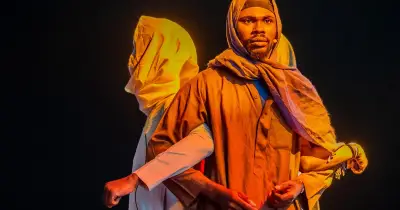
From the pit, a Palace rises. ReachArts Network CIC delivered a sold-out, multidisciplinary production at Theatre in the Mill that will be difficult to unsee or unfeel, writes DAVID EMOKPAE. There is a particular kind of silence that falls over an audience when a story stops being a story and becomes a mirror. It happened twice on Wednesday evening at Theatre in the Mill in Bradford, and it happened to a room full of people who, by the looks of things, did not arrive expecting to be shaken.
A Bold Reimagining
Joseph: Pit to Palace, curated and produced by Carl Dovi and presented by ReachArts Network CIC as its debut production, arrived at a sold-out Theatre in the Mill carrying an ambitious brief: to reimagine the biblical story of Joseph through the interlocking lenses of migration, purpose, and African cultural identity. Written by Damilola Oligbinde (Ifenla) and Kelvin Edinam Amevor, it delivered on every count. More than that, it delivered things nobody put in the brief.
A Diverse Audience
The first thing worth noting is who was in the room. Theatre in the Mill was full, and not full in the way that community arts events are sometimes full, populated mostly by relatives of the cast and loyal supporters of the producing organisation. The audience was genuinely mixed. Different ages. Different ethnicities. Bradford’s South Asian community sat alongside members of Bradford’s African and Caribbean diaspora, alongside white British audience members who, at the interval, were comparing notes with the same eagerness as everyone else. This is not a trivial observation. It is, frankly, the hardest thing in community creative arts to achieve, and it had been achieved before the lights went down.
Cultural Authenticity
As a Nigerian, I will confess a bias: I arrived curious about how African cultural material would be handled by a production straddling so many traditions. I left, frankly, proud. When the actor embodying the king arrived on stage in full Nigerian traditional royal attire, the weight of the fabric, the deliberateness of the movement, I felt the pleasure of recognition. This gave me the nod that someone had done the work, and this is when culture entered the room uninvited and stayed. Carl Dovi himself, taking the role of a father figure in the production, entered wearing a Ghanaian fugu. The contrast between these two sartorial registers, Nigerian and Ghanaian royal authority, was never explained nor footnoted, but simply presented. This is the mark of a confident curatorial hand: trusting the audience to receive cultural specificity without needing a glossary.
Scholars of intercultural performance have long argued that the most generative work happens not when cultures are flattened into a legible universal, but when they are placed in proximity while remaining distinct, allowed to produce meaning through their difference as much as their resonance. This production understood that instinctively. African languages surfaced throughout. The names of foods, greetings and phrases that the African members of the audience caught and smiled at, while the non-African members leaned forward slightly, not excluded but intrigued. This is the linguistic version of what the costumes did visually: asserting cultural presence without demanding assimilation.
Radical Casting Choices
What changed everything was the casting of a woman as Joseph, played by Damilola Oligbinde, who also co-wrote the drama. This was one of the evening’s most quietly radical choices, which was revealed early with no announcement made. No justification was offered. The production simply trusted the audience to follow the story wherever it went. In retrospect, the casting feels inevitable as Joseph’s journey resonates with almost everyone, and this artistic decision removes the notion that it belongs to one gender, body and tradition. As co-writer, Oligbinde stepped into the body of the character she had shaped, resonating with the stands of scholars like Theatre theorist Jill Dolan, who has written about the power of shifting who occupies the central heroic role and how it fundamentally changes the way an audience reads agency, resilience, and the right to rise. This is gender-blind casting at its most purposeful: not diversity as decoration, but casting as interpretation.
Multidisciplinary Elements
Behind the scenes, Ruth Agbolade’s live painting made Joseph’s dreams visible in real time, refusing to separate the art object from its creation, and turning the act of image-making itself into part of the performance. If the costumes, painting and casting were the production’s intellectual architecture, the music and dance were its heartbeat. Tope Dada’s live music performances threaded through the drama not as accompaniment but as commentary, arriving at precisely the moments when language alone could not carry the emotional weight. From a deep observation, the running order of the production was deliberately curated to extend the ownership of the production to everyone in the room.
When quizzed on how he held the production together without it falling apart, Dovi was direct: “We were not stacking. We were excavating.” Each element, painting, music and dance, was chosen not to enrich the drama but to carry what the drama alone could not. “None of these elements is held together by a concept imposed from above. They are held together by the story’s own logic. When you trust the material that deeply, the form follows.”
Core Strengths and Community Impact
At the core, the production did three things well: reimagining an ancient narrative for a contemporary audience; embedding African cultural tradition into a major British arts venue; and speaking in a register accessible to younger generations through its contemporary language and movement vocabulary. But there is a fourth thing happening that deserves to be named. The cast participation model in this production focused on students from the Drama Society, who were given real scenes, and they performed them well. This gives a professional platform with an eye on Bradford’s creative economy.
Festival Convenor and Director of Bradford African Festival of Arts, Dr Olushola Kolawole, praised not just how the story was told that made sense and related to him, but the balance of different themes, which he counted about eight different themes that did not overlap but rolled together. When an anchor institution’s director speaks with that specificity about an emerging organisation, he is not being polite; he is asking for more.
Looking Ahead
ReachArts Network has announced itself with a production that makes you recalibrate what you expect from community-rooted work: disciplined, generous, culturally assured, and for a sold-out room on a Wednesday evening in Bradford, genuinely moving. Dovi announced a second production in October for Black History Month, exploring the intersections of African cultures and their fusion with British experience through a combined arts framework. If Wednesday was the foundation, October is the structure. The ambition is not in question. The challenge will be maintaining the intimacy and specificity that made Pit to Palace land so precisely, because as the scope expands, so does the distance between a bold vision and a lived one.