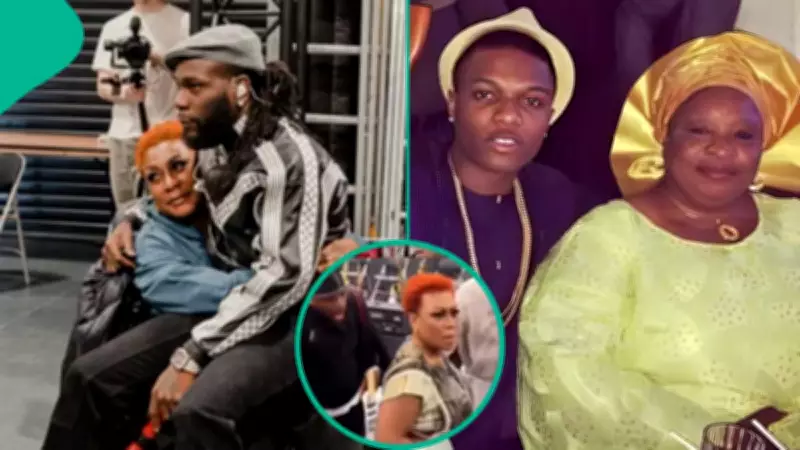
Burna Boy's Mother's Prayer Session Goes Viral Amid Son's Social Media Feud
A video featuring Bose Ogulu, the mother and manager of Grammy-winning Afrobeats star Burna Boy, has rapidly gained traction across social media platforms. The clip captures her leading an intense prayer session surrounded by her son's crew members, with the group fervently supplicating against evil declarations and malevolent spirits. This spiritual gathering emerged directly in the wake of Burna Boy's use of profane language that controversially invoked his mother's name during a heated online exchange with fellow superstar Wizkid.
Context of the Controversial Swear and Feud
The prayer video's virality is intrinsically linked to a recent live stream where Burna Boy, whose real name is Damini Ogulu, vehemently denied allegations made by Wizkid. Wizkid had publicly accused Burna Boy and a ten-man team of physically assaulting his DJ, Tunez, over a failure to play Burna Boy's music at an event. In his denial, Burna Boy stated, "Na only me touch DJ Tunez, no be 10 people. Na two slaps I give am. I swear with my mama. If I dey lie, make Ogun carry my mama go anywhere wey Wizkid mama dey."
This statement was particularly sensitive as it referenced Wizkid's late mother, Jane Dolapo Balogun, who passed away in London in August 2023 at the age of sixty-four. The use of such language, swearing by his own mother and invoking deities in the context of Wizkid's bereavement, ignited significant controversy and debate among fans and observers of the Nigerian music scene.
Details of the Viral Prayer Video
The circulated video shows Bose Ogulu at the center of a circle formed by Burna Boy's team members. They are engaged in passionate prayer, with Bose leading the session in Yoruba, repeatedly uttering, "Oloun ma je a remi kemi. Oloun ma je a remi kemi," which translates to a plea for divine intervention against evil pronouncements. The visual and auditory intensity of the prayer suggests a direct response to the negative energy and public declarations surrounding her son's ongoing feud.
Social Media Reactions and Public Commentary
The emergence of the prayer video triggered a flood of reactions across social media platforms, with users expressing a wide range of opinions on the situation.
- User fj_freshjah commented, "Nor mind d fool people Dey make mama proud e reach burna turn he use him mama play sporty with death."
- bigrexgreatness reacted, "Mama e might be too late o, from your son mouth to GOD'S ear, burna girl done use you play sporty o and u know what that means.."
- abiodunoto wrote, "I thought Burna boy has changed religion!!!. God dey see una, na Holy Spirit you guys dey take catch cruise abi....issokay, make una kontiniu as madam patience talk am."
- habiz_glow_15 stated, "Omo ale ni burna boy olorun make ogun carry are mama go were wizkid mama day inmagin."
These comments reflect public concern, criticism, and theological debates about the appropriateness of Burna Boy's statements and the perceived timing of the prayer session.
Background on the Burna Boy and Wizkid Rivalry
This incident is the latest development in a long-standing, intermittent rivalry between two of Nigeria's biggest musical exports. The feud escalated recently with Wizkid's allegations about the assault on DJ Tunez. Following his live stream denial, Burna Boy further taunted DJ Tunez by sharing a video of himself dancing casually at home while wrapped in a towel, mockingly saying, "Ogbafia dey for ground," as he dropped to the floor—a clip that also went viral.
The involvement of their mothers, both living and deceased, has added a deeply personal and emotionally charged layer to the conflict, moving it beyond typical celebrity disagreements into a realm involving family, respect, and cultural sensitivities around parentage and invocation.
The trending prayer video of Bose Ogulu underscores the intense personal and public repercussions of celebrity feuds in the digital age, highlighting how family members can become unwilling participants in social media dramas. It also raises questions about the boundaries of artistic rivalry, the weight of public statements, and the cultural significance of invoking family in disputes within the Afrobeats community.