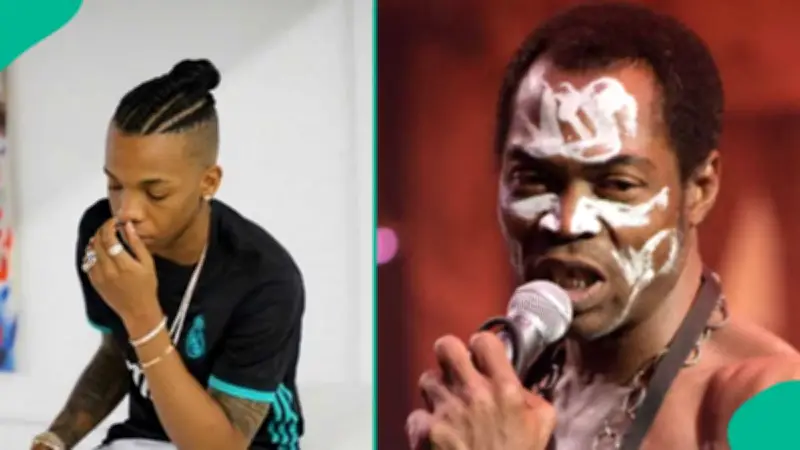
Nigerian singer Augustine Miles Kelechi, known professionally as Tekno, has publicly challenged the widely held belief that the late Fela Anikulapo-Kuti was the originator of Afrobeats. In a recent interview with Hot 97 FM in New York, Tekno argued that while Fela's influence is undeniable, he should not be regarded as the sole creator of the genre. The singer, who grew up in Eastern Nigeria, pointed to legendary musicians like Oliver De Coque as equally significant contributors to the sound that evolved into what is now globally recognized as Afrobeats.
Tekno's Eastern Nigerian Influence and the Role of Highlife
Tekno explained that his perspective is shaped by his upbringing in Eastern Nigeria, where he was exposed to the music of highlife icons such as Oliver De Coque. He noted that his father frequently played De Coque's music during his childhood, which left a lasting impression on him. According to Tekno, the highlife genre, as performed by De Coque and others, contained elements that are now commonly associated with Afrobeats.
“Fela is not the originator of Afrobeats,” Tekno stated during the interview. He elaborated that Fela's extensive travels and international performances with his band played a crucial role in securing his legacy. “Fela gets all the credit because he travelled and performed with his band around the world,” he added, suggesting that this global exposure contributed to Fela's outsized recognition compared to other Nigerian pioneers.
Fela's Global Impact and Tekno's Musical Tribute
Despite his critique, Tekno was careful to acknowledge Fela's monumental status in music history. He described Fela as a legend and credited him with taking Afrobeat to international audiences. “He is a legend. He was the one who took Afrobeat international,” Tekno said, while still maintaining that other artists from the Eastern region played a foundational role in the genre's development.
Tekno also revealed that his own song “Rara” was heavily inspired by Fela's music, offering a personal example of the late icon's enduring influence on contemporary Nigerian artists. The interview has sparked a wave of reactions on social media, with users debating the accuracy of Tekno's claims.
Public Reactions and the Debate Over Afrobeats' Roots
Social media users were quick to respond to Tekno's comments. A user identified as @ziondflutter criticized Tekno's stance, arguing that Fela's intellectual capability in fusing genres set him apart. They wrote: “This guy is just an olodo big time. For someone to fuse these genres together, what does that entail. It means he had that intellectual capability. I did a course while in school about popular music in Nigeria and yes highlife wasn't even owned by Nigeria self, it was Ghanian.”
Another user, @ogarexmas, supported the idea that Fela's Afrobeats is distinct from the highlife tradition of Eastern Nigeria. They commented: “The afrobeats which is currently global now was what Fela used. Oliver D Coque and others from the east were highlife singers. The only modern day artiste that tried using that sound was Flavour. I don't think I have heard a Tekno song that sounds highlife.”
The debate highlights the ongoing conversation about the origins and definition of Afrobeats, a genre that has gained worldwide prominence. Tekno's comments add a new layer to this discussion, emphasizing the contributions of regional musicians who may have been overshadowed by Fela's international fame.