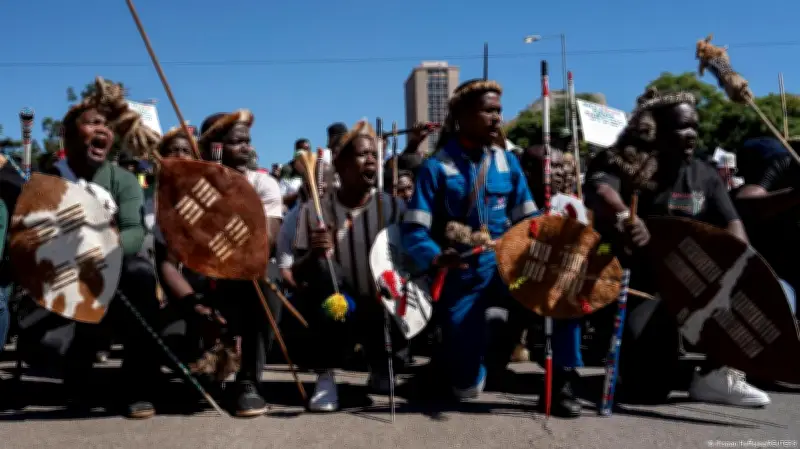
A claim circulating on social media that Nigeria spent an estimated $61 billion supporting South Africa's struggle against apartheid has been verified as mostly true by historical records and academic sources. The claim, posted by X user @MrJamesKe on 23 June, gained significant traction amid renewed xenophobic attacks against Nigerians in South Africa, which prompted the repatriation of over 250 Nigerians.
Claim and Reactions
The post, which stated that Nigeria spent $61 billion on the anti-apartheid struggle, attracted 400,000 views, 150 likes, and 200 reposts as of 26 June. It also generated mixed reactions, with some users questioning Nigeria's financial capacity at the time. One user, @MaMhizzy, wrote, "The big liars of drug nation Nigeria need to be studied. So Nigeria borrowed Mandela $61 billion from Mandela in the 1960s when Nigeria's GDP was about $4 billion?" Another user, @Tygerzs, questioned, "Nigeria's GDP was $56.7 billion in 1993. Where did they get $61 billion from?"
The claim also appeared in a Facebook video by The MERC Podcast, which had over 850,000 views, 35,000 reactions, and more than 5,000 comments as of 26 June. Premium Times observed that the claim often resurfaces during periods of xenophobic tension between Nigeria and South Africa.
Verification of the $61 Billion Estimate
Premium Times traced the widely cited $61 billion estimate to a publication by the South African Institute of International Affairs (SAIIA) titled "Giants of Africa Limp Along – South Africa and Nigeria." The publication describes Nigeria as one of the leading African countries in the anti-apartheid struggle, noting its role in establishing the United Nations Special Committee against Apartheid, financial contributions from ordinary Nigerians, and support for the Frontline States. It estimates that by the end of apartheid in 1994, Nigeria had contributed about $61 billion to the anti-apartheid effort. Importantly, this estimate does not refer to a single cash payment but represents Nigeria's cumulative financial, economic, and diplomatic support over several decades.
Acknowledgments from Nelson Mandela
Former South African President Nelson Mandela acknowledged Nigeria's contributions during his 1990 visit to Nigeria. In a video published on the official YouTube channel of the Lagos State government, Mandela thanked the Nigerian government and its people for their financial and material support. He stated that Nigeria "have been among the most generous donors" to the anti-apartheid movement and also acknowledged Nigeria's scholarships for South African students, as well as the deployment of teachers, doctors, and architects.
Detailed Contributions
A 2020 study published in the peer-reviewed journal Cogent Arts & Humanities on Taylor & Francis Online provides further details. The journal states that Nigeria began supporting the African National Congress (ANC) and the Pan Africanist Congress (PAC) in 1961 and was providing an annual $5 million subvention to both organisations by 1970. Nigeria also established the Southern Africa Relief Fund (SARF) in 1976, popularly known as the "Mandela Tax." Within six months, the fund had raised about US$10.5 million, with contributions from students, civil servants, and public officials. The journal further notes that Nigeria's oil embargo against apartheid South Africa was estimated to have cost the country about $41 billion in lost oil revenue.
In 2012, former President Olusegun Obasanjo confirmed that Nigerian civil servants contributed part of their salaries to the South Africa Relief Fund.
Conclusion
Historical records support the widely cited estimate that Nigeria contributed about $61 billion to South Africa's anti-apartheid struggle. However, it is worth noting that the figure reflects Nigeria's cumulative financial, economic, and diplomatic support over several decades, not a one-time cash donation. This report was produced under the 2026 Kwame Karikari Fact-checking and OSINT Fellowship, co-hosted by DUBAWA and the Digital Technology, Artificial Intelligence, and Information Disorder Analysis Centre (DAIDAC), with support from the Centre for Journalism Innovation and Development (CJID).