
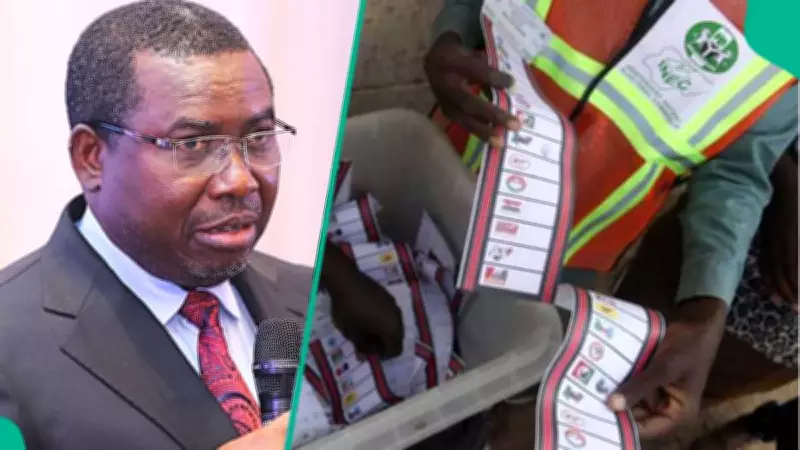
Opinion: Amupitan in the Eye of the Storm: Can INEC Survive This Test? Published 1 May 2026 at 2:18 PM by Ololade Olatimehin (7 min read). Editor's note: Political analyst Oluwafemi Popoola discusses the growing controversy and public concern over the credibility of Nigeria's Independent National Electoral Commission (INEC), especially regarding its new leadership figure, Professor Joash Ojo Amupitan.
Hope in Nigeria's democracy has always walked a delicate tightrope, especially when it begins to orbit a single figure. For now, that figure is Amupitan. What started as a wave of measured optimism has quickly evolved into a storm of scrutiny, where perception clashes with politics and public confidence hangs in the balance. This is no longer just about one man's credibility; it is about the resilience of an institution. With tensions rising and doubts deepening, INEC stands at a critical juncture: can it weather this storm and still retain the trust of the people?
INEC's Long History of Fragile Trust
This moment did not emerge in a vacuum. It is rooted in a long and uneasy history between Nigerians and their electoral body. It is a relationship defined as much by hope as by heartbreak. Over the years, each election cycle has reopened old wounds: allegations of manipulation, logistical failures, judicial reversals, and outcomes that often feel disconnected from the will of the people. Trust, once broken, has proven difficult to rebuild. So when a new figure like Amupitan steps into the spotlight, he does not arrive as just an individual; he carries the weight of accumulated expectations, doubts, and a nation's yearning for a process it can finally believe in.
It is this fragile inheritance that makes the current scrutiny both inevitable and significant. The questions being asked are not merely about his past or personal affiliations, but about whether INEC itself has learned, evolved, and is prepared to rise above the shadows of its own history.
Why Neutrality Is INEC's Lifeblood
The need for an unbiased INEC has never been more urgent. Elections are not merely events; they are the foundation upon which democratic authority rests. When the umpire is perceived as compromised, the entire game loses meaning. Nigeria's political history is littered with contested mandates and post-election grievances, many of which stem not just from the outcomes but from a lack of confidence in the process itself. This is why neutrality is not a luxury for INEC—it is its lifeblood. And neutrality, in today's hyper-connected, perception-driven environment, must not only exist but must be seen to exist, clearly and consistently.
After years of heated debates about the credibility of INEC and the polarising tenure of Mahmood Yakubu, many Nigerians, including this writer, were quietly hopeful that perhaps we had stumbled upon a reset. Amupitan's emergence, nominated by President Bola Ahmed Tinubu, did not initially trigger the usual wave of suspicion. Instead, it sparked curiosity. His profile painted the picture of a technocrat—well-schooled, professionally grounded, and without the loud baggage of partisan entanglement. In a country where even silence can be interpreted as bias, his apparent lack of political noise felt like a virtue. There was no viral clip of him campaigning for any party, no documented history of political grandstanding, no scandal trailing his name. For once, the conversation wasn't about 'whose man' he was, but whether he could be 'the right man.' With the 2027 general election looming, expectations were high. Nigerians wanted an umpire, not a participant.
Allegations, Public Backlash, and Credibility Questions
But optimism in Nigeria has a short shelf life. The first cracks began to show when allegations surfaced linking Amupitan to old social media activity. Screenshots circulated, allegedly showing a now-controversial X (formerly Twitter) account where posts like 'Victory is sure' were made in response to election-related tweets by Dayo Israel during the 2023 elections under the All Progressives Congress (APC). It didn't matter that these posts were from the past; what mattered was what they seemed to suggest—affiliation, sympathy, perhaps even partisanship. In Nigeria, perception is often louder than proof. The reaction was swift: social media erupted, hashtags trended, and calls for resignation echoed across platforms. Opposition voices, including figures aligned with the African Democratic Congress (ADC), amplified the demand for accountability. For many Nigerians, the issue was whether an electoral umpire can be trusted if there is even a shadow of doubt about his neutrality.
Then came another development that deepened the unease. INEC's decision to derecognise the ADC leadership, reportedly aligned with David Mark, following its interpretation of a court judgment, raised eyebrows. The optics of the decision—coming when questions about neutrality were already swirling—felt troubling. It created the impression that institutional decisions might be influenced by something other than strict legal reasoning. However, that decision has now been dramatically reframed by the highest court. In a unanimous verdict, the Supreme Court set aside the Court of Appeal's order that had formed the basis of INEC's action, describing it as 'unnecessary, unwarranted, and improper.' With that ruling, the ADC leadership aligned with David Mark has been effectively restored, ending weeks of legal uncertainty. The implication is profound: what was once presented as a cautious institutional response now sits under the shadow of judicial correction. Such reversals do not merely clarify the law; they complicate public confidence.
A Defining Test for INEC and Nigeria's Democracy
Nigeria cannot afford to walk into a general election with even the faintest suspicion that its electoral body is compromised. The ghosts of disputed elections—from 1964 to 2007—still linger in our political memory. In other democracies, the consequences of a distrusted electoral system are stark. The tensions following the 2020 U.S. election showed how quickly faith in democratic institutions can erode when electoral integrity is questioned. In Kenya, repeated disputes over election outcomes have led to cycles of unrest. The lesson is clear: when citizens lose trust in the process, the outcome—no matter how legitimate—becomes contested. INEC is not just an institution; it is the spine of Nigeria's democracy. If it bends, everything else risks collapse.
Reports indicate that INEC conducted an internal investigation into the controversial social media account allegedly linked to its chairman. According to its findings, a forensic evaluation exonerated him, suggesting no direct connection. On paper, that should have settled the matter. But trust is not built on internal reports alone, especially in a climate already charged with suspicion. Independent scrutiny is still ongoing. Premium Times, alongside its partners, has launched its own review of the controversial X account and the alleged involvement of Amupitan. They are also examining INEC's conclusions and consulting external expert opinions. Their report will be published upon completion. Clarity matters. An independent, well-researched report could either restore confidence or confirm fears. Either way, it would help anchor public discourse in something more solid than speculation.
And so, the story of Amupitan is no longer just about a man under pressure; it has become a mirror reflecting the deeper anxieties of Nigeria's democracy. It is about whether institutions can truly outgrow the burdens of their past, whether transparency can outpace suspicion, and whether leadership can inspire trust in a system long defined by doubt.
Oluwafemi Popoola is a journalist, political analyst, and columnist with 8 years' experience, providing in-depth commentary on governance, public policy, and democracy in Nigeria and beyond.
Disclaimer: The views and opinions expressed here are those of the author and do not necessarily reflect the official policy or position of Legit.ng.




