
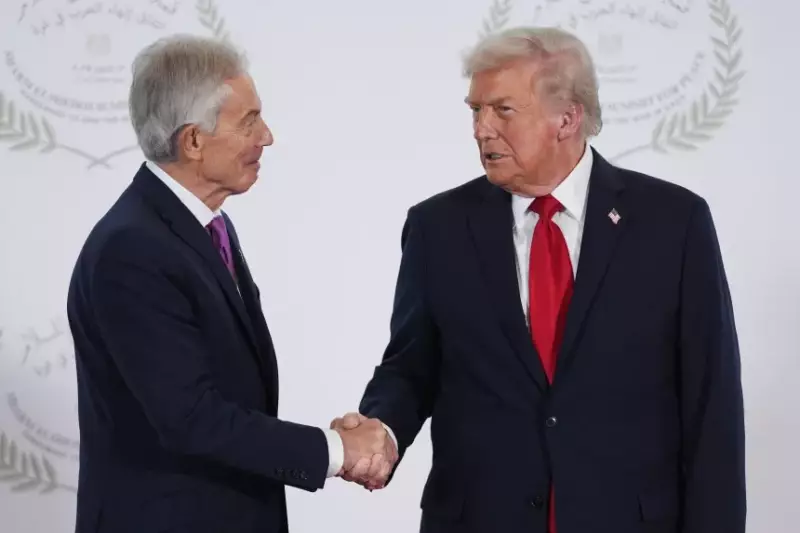
In a significant international development, former British Prime Minister Tony Blair, Canadian Prime Minister Mark Carney, and U.S. Secretary of State Marco Rubio have been appointed to a powerful new body tasked with rebuilding the Gaza Strip after years of devastating war.
Unprecedented Global Panel Formed
The new international body, officially named the "Board of Peace," will be chaired by U.S. President Donald Trump. It forms the core of a United Nations-backed American initiative aimed at demilitarizing Gaza and reconstructing the enclave following the prolonged conflict between Israel and Hamas.
According to U.S. officials, this board will guide long-term stabilization efforts and coordinate major international investment and development projects across Gaza. Its founding membership is a who's who of global political and financial influence.
High-Profile Members and Palestinian Exclusion
Alongside Blair, Carney, and Rubio, the board includes Trump’s special envoy Steve Witkoff, deputy national security adviser Robert Gabriel, Trump’s son-in-law Jared Kushner, prominent investor Marc Rowan, and World Bank president Ajay Banga.
Several world leaders have confirmed receiving invitations. Canadian officials stated Prime Minister Carney has accepted. Turkey confirmed President Recep Tayyip Erdogan was invited, while Argentina’s President Javier Milei announced publicly he was asked to be a founding member. Egypt said President Abdel Fattah el-Sisi is reviewing his invitation.
A notable and controversial absence is any representative from the Palestinian Authority (PA), which governs parts of the West Bank and is expected under the plan to eventually assume control of Gaza after reforms. This exclusion has drawn sharp criticism from Palestinian militant group Islamic Jihad, which accused the board of serving Israeli interests.
Controversies and Governance Structure
Tony Blair’s inclusion has attracted particular scrutiny. His legacy in the Middle East remains contentious due to Britain's role in the Iraq War and his later work as a regional envoy, where Palestinians often accused him of bias toward Israel.
Under the U.S. framework, Gaza’s day-to-day administration will be handled by a separate 15-member Palestinian technocratic committee, chaired by Dr. Ali Sha’ath, a Gaza-born Palestinian with previous PA experience. Its mandate is to restore basic services and rebuild institutions.
Former United Nations Middle East peace coordinator Nickolay Mladenov will serve as the high representative for Gaza, linking the committee, the Board of Peace, and regional partners.
The plan envisions the technocratic committee running Gaza temporarily until a restructured PA can take over, paving a "credible route toward Palestinian self-determination." However, Israeli Prime Minister Benjamin Netanyahu strongly opposes any PA role in Gaza and rejects Palestinian statehood.
Israeli officials revealed they exercised significant influence over the committee's membership, insisting no individuals linked to Hamas or the PA be included. Israel’s internal security agency reportedly approved all 15 names.
A separate Gaza executive board has also been formed, including officials from Turkey, Qatar, Egypt, and the UAE, alongside representatives from the Board of Peace and the technocratic committee. Israel has criticized this board's formation, saying it was not coordinated with Israeli authorities. Netanyahu has instructed Foreign Minister Gideon Saar to raise objections directly with Secretary Rubio.
President Trump hailed the panel on social media as an unprecedented gathering of global influence, calling it the most prestigious international board ever assembled. The White House stated each member will be assigned a specific role deemed essential to Gaza’s recovery and future governance.




