
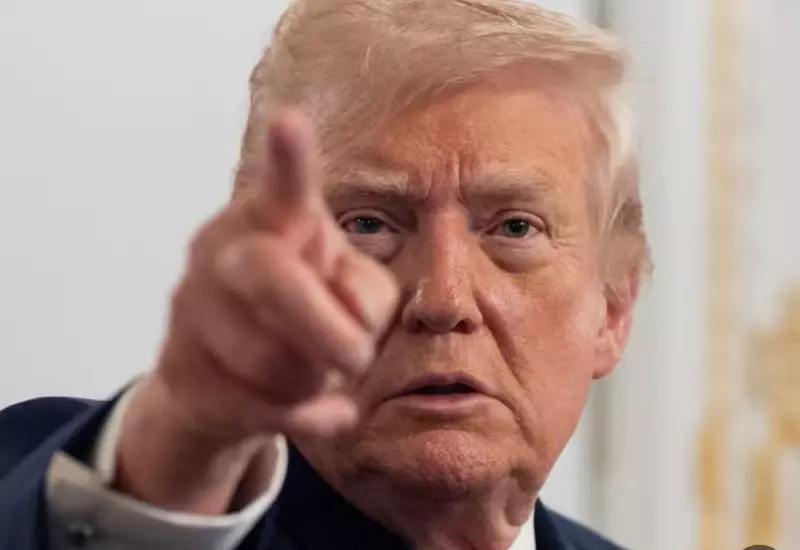
In a dramatic escalation of his administration's immigration policies, President Donald Trump has declared he will permanently halt migration from what he termed "third world countries." This announcement comes just one day after a shooting incident in Washington DC that left two National Guard members wounded, one of whom has since died from her injuries.
Attack Near White House Sparks Policy Shift
The violent incident occurred on Wednesday near the White House, where Sarah Beckstrom and Andrew Wolfe, 24, both National Guard members, were shot. Authorities confirmed that Beckstrom succumbed to her injuries, while Wolfe continues to fight for his life in hospital.
Investigators have identified the suspected shooter as Rahmanullah Lakanwal, an Afghan national who entered the United States in September 2021. His arrival was facilitated by a Biden-era evacuation program that resettled tens of thousands of Afghans following the chaotic US withdrawal from Afghanistan.
According to Reuters, Lakanwal was granted asylum in April of this year under the Trump administration. The CIA further confirmed on Thursday that he had previously worked with agency-backed military units during the US war in Afghanistan. Lakanwal was injured during the attack and remains in custody.
Trump's Late-Night Immigration Declaration
President Trump made his sweeping immigration announcement in a social media post sent after 11pm on Thursday. The post, which began with "a very happy Thanksgiving," marked a significant hardening of the anti-migrant policies that have characterized his second term.
Beyond the permanent migration pause, Trump declared his administration would "end all federal benefits and subsidies to noncitizens" and remove "anyone who is not a net asset to the United States." The president's message did not specify which countries would be affected or clarify his definition of "third-world" nations.
In his social media statement, Trump specifically targeted Somali communities in Minnesota, following up on last week's promise to end temporary protected status for Somali nationals in the state. The president's rhetoric blamed migrants and refugees for issues like high crime rates and America's rising deficit, though he provided no evidence to support these claims.
Immediate Policy Changes and Legal Challenges
The Trump administration has already begun implementing immigration reforms in response to the shooting. US Citizenship and Immigration Services (USCIS) has indefinitely suspended processing of immigration requests from Afghan nationals pending further review.
The Department of Homeland Security later expanded this action to include a review of all asylum cases approved under the Biden administration. While the department didn't clarify if this review would extend beyond Afghan cases, USCIS director Joseph Edlow stated he was directing a "full-scale, rigorous re-examination of every green card for every alien from every country of concern" at President Trump's request.
USCIS pointed to a travel ban Trump previously imposed in June on citizens of 19 countries, including:
- Afghanistan
- Burundi
- Laos
- Togo
- Venezuela
- Sierra Leone
- Turkmenistan
Legal experts question how the president would implement such a comprehensive migration pause, given that previous travel bans during Trump's first term faced significant legal challenges and popular resistance. A 2017 travel ban was particularly controversial and underwent multiple court battles before being implemented in modified form.
National Guard troops have been deployed across Washington DC since August, when the Trump administration declared a "crime emergency" and ordered them to support federal and local law enforcement. Following Wednesday's shooting, Trump announced he would deploy an additional 500 National Guard troops to the capital.
This deployment faces its own legal challenges, as a federal judge last week ordered an end to the National Guard presence but stayed her decision for 21 days to allow the administration time to either remove the troops or appeal the ruling.
The shooting incident has rapidly become a political flashpoint in President Trump's ongoing crackdown on immigration, with the president asserting that the attack "reminds us that we have no greater national security priority than ensuring that we have full control over the people that enter and remain in our country."




