
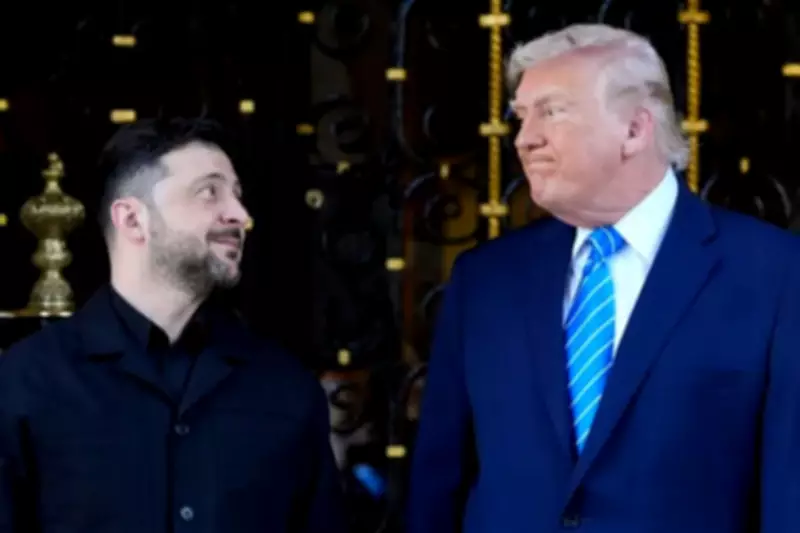
Zelenskyy Suggests Trump's Rush to End Ukraine War Tied to US Midterm Elections
Ukrainian President Volodymyr Zelenskyy has publicly suggested that former US President Donald Trump's urgency to broker a peace agreement in Ukraine is strategically timed ahead of the upcoming United States midterm elections later this year. In a revealing interview with The Atlantic, Zelenskyy argued that securing a deal would represent a significant political victory for Trump, potentially boosting his standing domestically.
Political Timing and Strategic Calculations
Zelenskyy explicitly stated that "the most advantageous situation for Trump is to do this before the midterms" in November. While acknowledging Trump's publicly stated desire to reduce casualties and end the conflict, the Ukrainian leader added a pragmatic perspective: "If we are talking like adults, it's also a political victory for him." This comment highlights the intersection of international diplomacy and domestic American politics.
The Ukrainian president previously indicated that the White House hopes to see the war concluded by June, but he has consistently warned that greater pressure must be applied on Russia if a ceasefire is to be achieved by summer. According to various reports, Moscow is still considering participation in another round of trilateral talks expected to take place in Miami, though details remain uncertain.
Historical Context and Current Stalemate
When Trump began his second term, he famously pledged to end the Ukraine conflict within 24 hours. As the war approaches its fourth anniversary, negotiations remain frustratingly stalled, with both sides routinely blaming each other for delays. Trump has repeatedly accused Ukraine of slowing progress toward a settlement, while Kyiv points to Russian intransigence.
Zelenskyy described ending the war as potentially Trump's "number one legacy," but he firmly maintained that Ukraine will not abandon its core demands. The president reiterated that Ukraine requires firm security guarantees and a verifiable ceasefire before holding national elections, which are currently suspended under martial law imposed during the ongoing conflict.
Election Controversy and Russian Influence
Trump has echoed Kremlin claims by labeling Zelenskyy a "dictator" for remaining in office beyond his original term, despite the legal prohibition on elections during active conflict. Ukrainian law explicitly forbids elections while martial law is in effect, a measure implemented after Russia's full-scale invasion.
In response to these accusations, Zelenskyy asserted that calls for wartime elections serve Moscow's interests rather than democratic principles. "They want to get rid of me," he stated bluntly, adding that he is fully prepared to face voters once security conditions allow. "No one is clinging to power. I am ready for elections. But for that we need security guarantees and a ceasefire," he emphasized.
Diplomatic Efforts and Future Framework
Zelenskyy insisted that Ukraine has never opposed ending the war but accused Russia of resisting meaningful dialogue at every turn. He urged Moscow to use the coming months to reach a substantive agreement while Trump remains highly engaged in the peace process. The Ukrainian leader noted that key elements of any potential US-backed peace framework—including specific security assurances for Ukraine—remain undefined and should be clearly formalized before any agreement is finalized.
Any final settlement, Zelenskyy cautioned, would need substantial public backing in Ukraine through proper democratic processes. He warned against rushing into a flawed deal that might compromise Ukraine's sovereignty or security interests. The president is expected to discuss the conflict extensively at the upcoming Munich Security Conference, where he will meet with numerous international leaders including UK Prime Minister Keir Starmer, US Secretary of State Marco Rubio, NATO Secretary General Mark Rutte, and French President Emmanuel Macron.
Ongoing Challenges and Territorial Disputes
Meanwhile, Russia continues to press its territorial demands in eastern Ukraine and Crimea, significantly complicating efforts to secure a negotiated settlement. The gap between Ukrainian and Russian positions remains substantial, with Moscow showing little willingness to compromise on what it considers acquired territories. This fundamental disagreement represents the largest obstacle to any potential peace agreement, regardless of political timing or international pressure.
The coming months will prove crucial as diplomatic efforts intensify ahead of the US midterm elections. Whether Trump's political calculations align with Ukraine's security needs and Russia's willingness to negotiate remains uncertain, creating a complex geopolitical puzzle with implications far beyond Ukraine's borders.




