Nigeria's proposed 2026 federal budget appears to prioritize the comfort of top officials over urgent national economic rescue, with massive allocations for luxury vehicles, vague 'miscellaneous' expenses, and stationery, despite a public commitment to digitalisation and cost-cutting. This comes at a time of severe revenue uncertainty and widespread hardship for ordinary citizens.
Luxury Vehicles and Vague 'Miscellaneous' Dominate
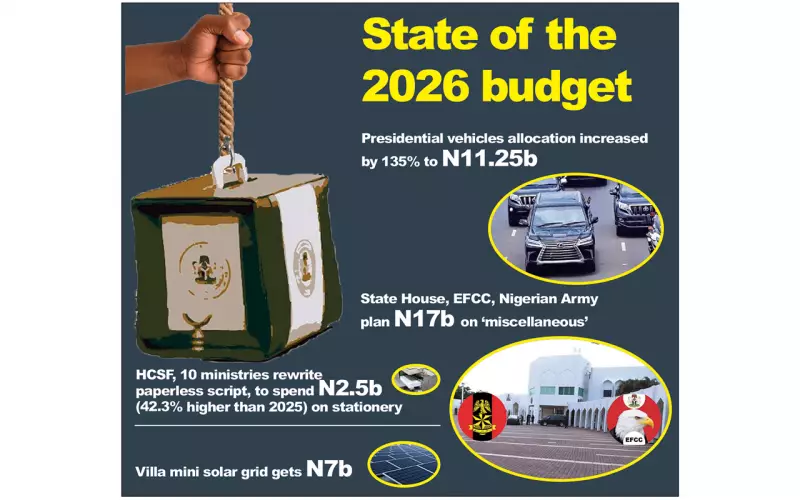
The budget details, now before the National Assembly, reveal startling increases in spending on elite perks. The allocation for presidential vehicle procurement has skyrocketed by 135%, jumping from less than N5 billion in 2025 to a staggering N11.25 billion in the 2026 proposal. This massive expenditure raises serious questions about the government's priorities when many Nigerians struggle to afford basic meals.
Furthermore, the term 'miscellaneous' has become a major budget line, serving as a catch-all for billions. The State House Headquarters, the Nigerian Army, and the EFCC alone have earmarked N16.78 billion for miscellaneous items. The Army leads with N10.52 billion, followed by the State House (N3.17bn) and the EFCC (N3.09bn). Other agencies like the Bureau of Public Procurement (N300m) and NEITI (N584.27m) also feature significant miscellaneous budgets, a trend critics label as a lack of transparency and fiscal discipline.
Digitalisation Promise Clashes with Soaring Paper Budgets
In a striking contradiction, the budget undermines the government's own digital transformation agenda. The Head of Civil Service of the Federation (HCSF), Didi Esther Walson-Jack, had championed a shift to a paperless public service, launching the 1Gov Enterprise Content Management System. By December 2025, all ministries were declared to be operating digitally.
However, the 2026 proposal tells a different story. The HCSF and 10 key ministries plan to spend a collective N2.46 billion on stationery and paper, which is a 42.3% increase from the N1.73 billion spent the previous year. The Ministry of Defence's stationery budget rose 82% to N638 million, while the Ministry of Justice's allocation quadrupled to N525 million.
Only the Ministry of Women Affairs significantly reduced its stationery budget, cutting it by 71% to N40 million. Five other ministries simply copied their 2025 stationery budgets, indicating a casual approach to budgeting that ignores policy goals.
Pattern of Elite Comfort Over National Development
A three-year analysis from 2024 to 2026 reveals a persistent pattern. The State House Headquarters alone has allocated N17.74 billion for vehicle purchases and N36 billion for office and residence rehabilitation over this period. Maintenance costs remain persistently high, with experts suggesting inflated contracts or poor accountability.
The budget also includes questionable projects outside agencies' core mandates. For instance, the Centre for Management Development is set to spend N1.4 billion on supplying HiJet trucks and empowerment items for specific senatorial districts, turning a training institution into a vehicle for political patronage.
Other notable allocations include N7 billion for the 'solarisation of the Villa with a mini solar grid' and billions more for ongoing maintenance of the Presidential Villa, a recurring expense that critics find difficult to justify annually.
This budget proposal, filled with indulgent and frivolous allocations, starkly contrasts with President Bola Ahmed Tinubu's promises of fiscal prudence and accountability. It presents the budget less as a tool for national development and more as a mechanism for sustaining elite comfort, while the economy remains strained and revenues uncertain.