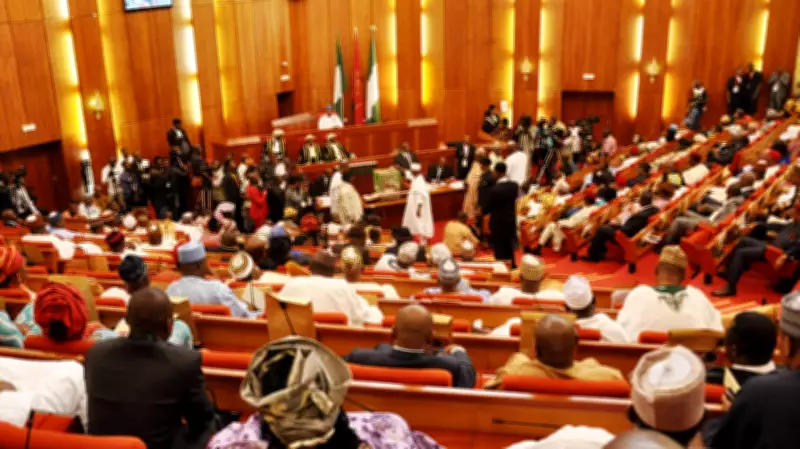
In functioning democracies, public office is a trust – time-bound, accountable, and ultimately relinquished to make way for renewal. In Nigeria, however, a contrary pattern has taken root: power does not retire. It simply relocates. Across the federation, governors who complete their constitutionally permitted tenure now routinely glide into the Senate. What once occurred occasionally has hardened into convention. Increasingly, the upper chamber is seen less as a forum for legislative rigour than as a political afterlife – where influence is retained rather than surrendered.
A Moral Deficit in Political Culture
This trend exposes a deeper moral deficit. It runs against the Yoruba adage “enìkankìí je kí’lèfè” – “a lone eater does not expand the family estate.” Yet our political culture is dominated by a relentless refrain of I, me, and mine. The collective interest – the “family land” – is too often subordinated to personal continuity. The pattern cuts across regions and parties. Former governors – Godswill Akpabio, Adams Oshiomhole, Orji Uzor Kalu, Theodore Orji, Aminu Tambuwal, Adamu Aliero, Aliyu Wamakko, Abdulaziz Yari, Danjuma Goje, Simon Lalong, Gabriel Suswam, Gbenga Daniel and Seriake Dickson – now populate the Senate in numbers that are no longer incidental but institutional.
The issue is not legality. The Constitution permits this transition, and executive experience can enrich legislative work. The problem is repetition. When what is permissible becomes routine, it becomes exclusionary. A democracy that does not renew itself risks becoming a closed circuit of power. At its core, this is not merely a constitutional issue – it is an ethical one. There appears to be a fading of the inward discipline that compels leaders to reflect, to step aside, and to make room. More troubling is the quiet displacement of loyal supporters – many demonstrably capable – by those who, having already held power, continue to extend their stay.
Awolowo's Warning Resonates
Obafemi Awolowo warned that public office must never become an instrument for the survival of the office holder rather than the welfare of the people. That warning now resonates with urgency. When political transition ceases to widen opportunity and instead recycles the same actors, democracy itself begins to thin. As the 2027 election cycle approaches, the pattern is intensifying. A new wave of outgoing governors – Abdullahi Sule, Ahmadu Fintiri, Babagana Zulum, Mai Mala Buni, Dapo Abiodun, AbdulRahman AbdulRazaq, Bala Mohammed, Babajide Sanwo-Olu, and Hope Uzodimma – are already positioning for Senate seats.
In many states, this is not unfolding through open contest but through quiet displacement. Incumbents are edged aside by entrenched authority, financial dominance and control of party machinery. What appears outwardly democratic increasingly resembles a managed transition. The result is a narrowing of democratic space. Office remains formally open but practically restricted. For aspirants outside entrenched circles, the barriers are stark. Money, incumbency and party control combine to sustain a system that reproduces itself with remarkable efficiency.
The Question of Purpose
At this point, the question becomes unavoidable: what is the purpose of government if access to leadership is so predictably constrained? Leadership, as Awolowo insisted, is a responsibility anchored in discipline and service – not an entitlement to be perpetually extended through repositioning. This concern deepens when one considers a constitutional gap. While tenure limits exist within executive offices, there are none across legislative careers. The result is prolonged occupancy that undermines renewal.
Former Senate President David Mark spent twenty uninterrupted years in the Senate (1999–2019) and has since re-emerged as a political party chairman. Senator Ahmed Lawan, after eight years in the House of Representatives, will by next year have spent two decades in the Senate – rising to Senate President and now chairing the defence committee – yet shows no sign of stepping aside. Senator Enyinnaya Abaribe, in continuous service since 2007, is on course to reach the same twenty-year mark. These are not isolated cases. They signal a deeper drift: legislative office is becoming a lifetime seat rather than a temporary mandate.
Implications for Democracy
What we are witnessing is not simply service – it is entrenchment, a political culture where staying has become the norm and leaving the exception. The implications are profound. A legislature heavily populated by former executives risks narrowing the range of perspectives needed for meaningful lawmaking. It risks weakening institutional independence, as networks of influence stretch across branches. More broadly, it fuels public cynicism by reinforcing the perception of a closed political class.
Incremental reform will not suffice. The problem is structural. A democracy cannot sustain legitimacy where pathways to leadership are consistently narrowed. There is a compelling case for reform. A mandatory cooling-off period between executive office and legislative eligibility would interrupt the immediate transfer of power and widen participation. Equally urgent is the need to address the absence of cumulative term limits, which currently allow an unbroken chain of office-holding.
Campaign Finance and Incumbency Abuse
Campaign finance reform is equally critical. The dominance of unregulated money continues to distort competition. Laws exist but lack enforcement. Without credible oversight, financial muscle – not merit – will remain decisive. The abuse of incumbency also demands attention. Where officeholders deploy state resources to secure future positions, electoral integrity is compromised. Such practices require not just prohibition but enforceable consequences.
Beyond Law: A Cultural Shift
Yet beyond law lies culture. Leadership in a democracy is defined not by how long power is held, but by the willingness to release it. Without that ethos, even the best-designed reforms will falter. Nigeria now stands at a moment of reckoning. The issue is no longer whether former governors have the right to serve in the Senate. They do. The deeper question is whether the system leaves room for others to serve at all.
Here, the echoes of Awolowo are unmistakable. He warned of a system where power becomes habitual, leadership repetitive, and opportunity restricted. That warning now finds full expression. The patterns are familiar. The tendencies are consistent. The consequences are unfolding. This is not a coincidence. It is structure – one that allows power to circulate within the same hands, election after election. And so his question returns with urgency: How can a nation progress if the space for leadership is closed? If that diagnosis is accepted, the response cannot be cosmetic. It must be deliberate and structural.
Ultimately, the survival of democracy depends not only on institutions, but on renewal. Without renewal, even strong systems do not collapse suddenly. They fade quietly and gradually from within.