
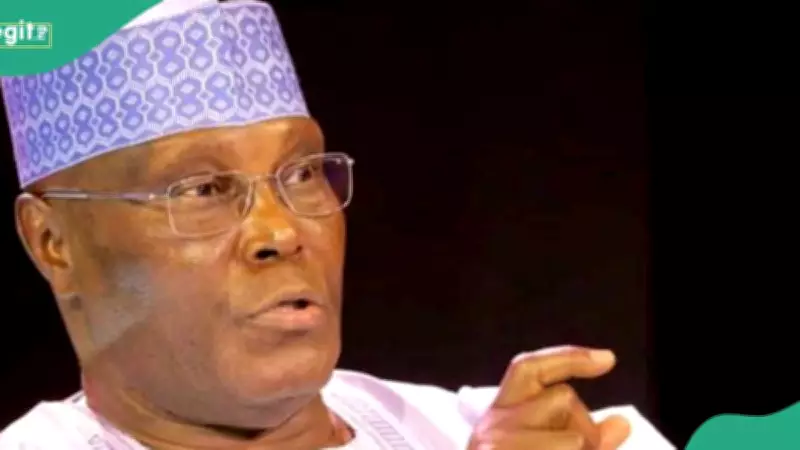
Atiku Abubakar's 2027 Ambition: A Critical Juncture for Nigeria's Opposition Unity
In the complex landscape of Nigerian politics, there exists a pivotal moment when ambition must yield to wisdom, when circumstances demand that even the most noble aspirations make way for new possibilities. This principle applies across all spheres of life—from sports where athletes retire to allow younger talents to emerge, to political leadership where true statesmen recognize when to pass the baton to a new generation.
This analogy becomes particularly relevant as Nigeria looks toward the 2027 general elections, with many questioning whether former Vice President Atiku Abubakar should step aside to allow fresh political voices to contribute to nation-building through elective positions. Nations are shaped not only by those who seek power but by those who dare to relinquish it for the greater good.
Atiku's Democratic Legacy and Political Endurance
Atiku Abubakar's imprint on Nigeria's democratic evolution remains undeniable. Serving as Vice President from 1999 to 2007 under President Olusegun Obasanjo, he occupied one of the most consequential offices during Nigeria's foundational return to civilian rule. Those years demanded both administrative capacity and political dexterity, with Atiku bringing energy to economic reforms, championing privatization policies, and playing key roles in shaping early democratic institutions.
For decades, Atiku has embodied remarkable political endurance. From his tenure as Vice President to his repeated presidential bids, his ambition has been consistent and admirable in its tenacity. That period granted him visibility, legitimacy, and a platform many would consider sufficient to secure a permanent place in Nigeria's political history.
The Fine Line Between Persistence and Political Overreach
However, there exists a delicate boundary between persistence and obsession in politics, and crossing this line can quietly transform strength into liability. As Nigeria approaches the high-stakes crossroads of 2027, Atiku's prolonged presidential quest risks becoming less a symbol of resilience and more a paradox that could deal a significant blow to opposition political parties.
By the time of the 2027 elections, Atiku will approach 80 years of age. In a nation of over 200 million people, teeming with young, educated, and capable citizens, the question increasingly shifts from whether Atiku can run to whether he should. While Nigeria's Electoral Act specifies no upper age limit for political aspirants, biological realities and public sentiment suggest that an octogenarian might be too advanced in years for the nation's highest office, particularly when youthful energy is urgently needed to address blossoming insecurity and other pressing challenges.
Public Perception and the Weight of Long Ambition
Statesmanship is defined not only by the offices one seeks but by the moments one chooses to step aside, mentor, and guide. Leadership at its highest level is generational—it creates space as much as it occupies it. For many Nigerians, concern has shifted from Atiku's credentials and experience to questions of timing, judgment, and ultimate legacy.
After multiple presidential attempts spanning more than three decades, his continued insistence on the presidency risks appearing less like perseverance and more like an entitlement that must be fulfilled at all costs. This perception, whether fair or not, increasingly shapes public sentiment, particularly among younger Nigerians demanding leadership recalibration.
A Changing Nigeria and the Rise of New Political Voices
Nigeria today differs fundamentally from the nation of 1999. It is younger, more restless, and more demanding of substantive change. A new generation of voters—digitally aware, economically pressured, and politically conscious—increasingly resists recycling old hierarchies without question. Their aspirations are shaped less by nostalgia and more by urgency.
Within this urgency, new figures have emerged as vessels of hope. Among them are Mr. Peter Obi and Senator Rabiu Musa Kwankwaso, who in different ways have captured the imagination of younger Nigerians. They represent not perfection but possibility, not consensus but momentum. Atiku once demonstrated awareness of generational bridge-building by selecting Peter Obi as his running mate—a decision that was both strategic and symbolic. However, symbols unsustained eventually collapse under contradiction's weight.
Opposition Unity Under Mounting Pressure
Within Nigeria's fragile opposition architecture, particularly around the African Democratic Congress (ADC), unity is not optional but existential. The stakes of the 2027 election, especially considering governance under President Bola Ahmed Tinubu, have heightened the need for coherent, disciplined, and forward-looking alliances. Any internal fracture risks not only political defeat but also erosion of public trust in the very idea of change.
Against this backdrop, Atiku's recent interview on Arise Television has stirred considerable concern. His assertion that figures including Senator Rabiu Musa Kwankwaso, Mallam Nasir El-Rufai, and Alhaji Aminu Tambuwal "are not as popular" in the North as he is has been widely interpreted as more than a political misstep. These individuals have governed states, held national offices, and built significant constituencies. Publicly diminishing them signals deeper concerns about coalition cohesion, mutual respect, and leadership temperament.
From Contender to Statesman: A Different Legacy Pathway
For Atiku Abubakar, the path forward need not be defined by withdrawal but by transformation. A greater role potentially awaits him: that of statesman, mentor, and political father figure who shapes outcomes without dominating them. This role demands sacrifice but offers legacy; it requires restraint but commands enduring respect.
International examples illustrate this principle powerfully. In the United States, Joe Biden spent decades in public service, including as Vice President to Barack Obama, demonstrating generational partnership's power—experience anchoring vision while youth energizes structure. In South Africa, Nelson Mandela served a single term before stepping aside, allowing democratic culture to flourish beyond his towering presence. His restraint did not diminish his legacy but immortalized it.
The Critical Stakes Ahead of 2027
Should Atiku insist on another presidential run without fostering a genuinely inclusive opposition front, he risks fragmenting the very forces capable of challenging the incumbent. Nigeria's electoral history demonstrates that divided opposition often paves the way for incumbents, not necessarily because they are overwhelmingly popular but because their challengers fail to unite effectively.
A crowded opposition field could split votes along familiar lines: regional loyalties, party affiliations, and personality-driven followings. In such scenarios, the path to re-election becomes less about expanding support and more about benefiting from division.
A Final Consideration on Legacy and National Interest
The Waziri Adamawa's legacy is already significant. His contributions to Nigeria's political evolution remain undeniable. However, legacies are defined not solely by what one achieves but also by what one chooses to relinquish. Having spent decades seeking to lead Nigeria, perhaps the time has arrived to help shape its leadership instead—to deploy his experience, network, and influence in support of a new generation of leaders who embody the aspirations of a changing nation.
This represents not a call to irrelevance but to higher relevance. Ultimately, leadership's true measure lies not in how long one holds power but in how wisely one prepares others to wield it. In that transition from contender to custodian, Atiku Abubakar may yet discover the legacy that has eluded him at the ballot box. Unchecked ambition builds careers, while restrained ambition builds nations.




