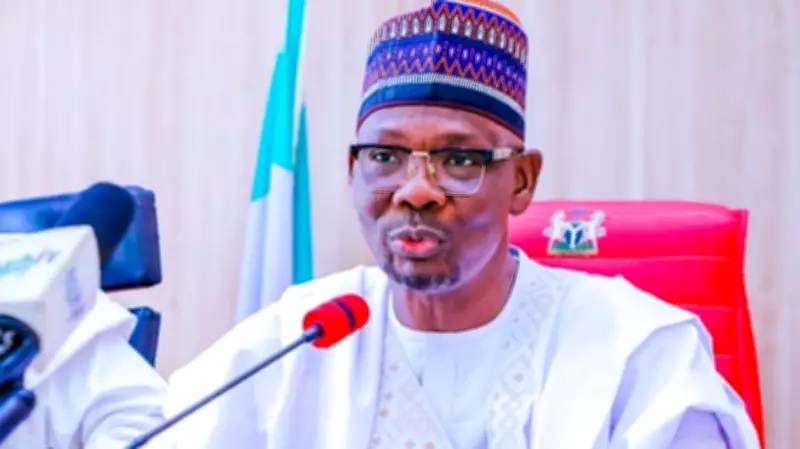
The ruling All Progressives Congress (APC) appears headed for murky waters in Nasarawa State following Governor Abdullahi Sule's unpopular politics of endorsement, as reported by Adamu Abuh and Umar Egbenu Muhammed. A political battle line has already been drawn across party divides in Nasarawa State after Governor Abdullahi Sule endorsed Senator Ahmed Aliyu Wadada as his preferred successor for the 2027 governorship election.
Widespread Opposition to Endorsement
No fewer than 30 governorship aspirants have not only rejected the move but also warned the outgoing governor to allow a free, fair, and credible succession process instead of trying to impose his preferred candidate on the state. Their collective response was simple: "Endorsement will not work in the Home of Solid Minerals." More significant is the sharp reaction from APC stakeholders, including former governors, senators, and top party leaders, who are urging President Bola Tinubu and the APC national leadership to caution Governor Sule or risk grave consequences for the party.
List of Aspirants
Among those linked with the APC ticket are former Inspector-General of Police, Mohammed Adamu; former Nasarawa State Accountant-General and ex-Speaker of the State House of Assembly, Musa Ahmed Mohammed, popularly known as Barade; former Executive Vice Chairman of NASENI, Prof. Mohammad Sani Haruna; and former Deputy Governor, Silas Ali Agara, now Director-General of the National Directorate of Employment (NDE). Others include Architect Shehu Tukur, who contested the party's governorship primary in 2019; Senator Ahmed Aliyu Wadada, representing Nasarawa West in the Senate; former National Primary Health Care Development Agency boss, Dr Faisal Shuaib; Danladi Halilu Evulanza; Julius Ojo Eggon; Dr Kabir El-Bashir; Tanimu Adabson; Prof. Abdulkareem Kana; Dr Zakka Ledwi Yakubu; Dr Ahmed Musa Mohammed; and Musa Mohammed Maikaya.
Opposition Parties Gear Up
The Peoples Democratic Party (PDP), which mounted a strong challenge in 2023, is also expected to be competitive. Leading names in the opposition party include its 2023 governorship candidate, David Emmanuel Ombugadu, a former member of the House of Representatives, and Jafar Ibrahim. The African Democratic Congress (ADC) is also attracting interest, with retired General Nuhu Bala Angbazo, Ayuba Umar, and Mohammed Hassan Abdullahi among those mentioned. In the Social Democratic Party (SDP), serving House of Representatives member Jonathan Gaza Gbefwi is linked with the race. The Labour Party may present Chris Mamman, while the Action Alliance (AA) is said to be considering Stephen Joseph.
Imposition Allegations and Political Fallout
Governor Sule's endorsement of Wadada as his preferred successor has triggered internal resistance and revived old concerns about how power is negotiated in the state. In a political environment shaped by delicate zoning arrangements, elite consensus, and a history of fiercely contested transitions, the allegation of imposition is not merely a procedural concern. It is a potentially destabilizing factor that could alter the APC's electoral fortunes if not carefully managed.
Within Nigeria's party system, the line between endorsement and imposition is often thin. Governors, as dominant political actors, routinely influence succession outcomes. However, the sustainability of such influence depends largely on consultation, timing, and perceptions of fairness. In the case of Nasarawa, critics argue that Sule's early and public backing of Wadada has crossed that line. By presenting a preferred candidate ahead of party primaries and before broad stakeholder engagement, the governor has created the impression of a predetermined outcome. This perception has been amplified by complaints from aspirants who allege subtle pressure on party structures to align with the governor's choice. Whether or not such pressure is formally established, the narrative of imposition has gained traction and, in politics, perception can be as consequential as reality.
Historical Context
Since Nigeria's return to democratic rule in 1999, Nasarawa State has developed a political culture that resists unilateral control. The state's electoral history shows a pattern: attempts to centralize candidate selection often provoke backlash, either within parties or at the ballot box. The early years of the Fourth Republic were dominated by the PDP, which maintained control through a combination of incumbency advantage and elite consensus. However, cracks began to appear when internal disagreements were mishandled, culminating in the eventual rise of opposition forces.
The 2011 election marked a turning point, as Senator Umaru Tanko Al-Makura of the then Congress for Progressive Change (CPC) broke the PDP's hold on power, handing the late Governor Aliyu Akwe Doma an outright defeat. That victory was widely interpreted as a rejection of entrenched political arrangements and a demonstration of the electorate's willingness to challenge perceived imposition.
Subsequent elections have reinforced this pattern. While incumbents have retained significant influence, their success has often depended on their ability to manage internal party dynamics and maintain a semblance of inclusiveness. The emergence of Abdullahi Sule in 2019 was itself the product of careful political negotiation. Backed by outgoing structures but still subjected to competitive processes, his candidacy benefited from a balance between influence and acceptability.
By 2023, however, the political landscape had become more competitive. David Ombugadu's strong showing for the PDP underscored the fragility of the APC's dominance. The election, which extended into prolonged legal battles, revealed a divided electorate and a narrowing margin of victory for the ruling party. For many observers, the lesson from 2023 is clear: Nasarawa is no longer a safe political territory. Any miscalculation, particularly one that alienates key stakeholders, could tilt the balance in favor of the opposition.
Internal Party Divisions
It is within this context that the rejection of Wadada's endorsement by former IGP Adamu takes on added significance. His defiance signals not just personal ambition but a broader unease within the APC. Adamu's insistence on allowing the electorate to decide resonates with a growing sentiment among party members who fear that imposed candidacies could undermine their chances in the general election. His position has also emboldened other aspirants, including Dr Faisal Shuaib, who is believed to enjoy the backing of former Governor Abdullahi Adamu, to remain in the race despite mounting pressure. The result is an increasingly fragmented field, where multiple contenders are mobilizing support bases that may prove difficult to reconcile after the primaries.
Perhaps more troubling for the APC is the apparent lack of consensus among its leading figures. The caution expressed by former governor Umaru Tanko Al-Makura over the timing of the endorsement points to a deeper divide within the party's hierarchy, suggesting that the APC may be heading into the 2027 election cycle without the cohesion that sustained it in previous contests.
Zoning Debate
Governor Sule's argument for rotating the governorship to Nasarawa West, where Wadada hails from, is rooted in the principle of equity. With Nasarawa South and North having held power for extended periods, the case for the Keffi axis is politically compelling. However, zoning in Nasarawa has always been more of an informal understanding than a binding agreement. As such, its interpretation is subject to political convenience. Critics argue that invoking zoning to justify a specific candidate risks conflating two distinct issues: the rotation of power and the method of candidate selection. While many stakeholders may agree on the need to shift power to the West, they are less willing to accept a predetermined candidate for that zone.
Stakeholder Reactions
Reacting to the endorsement of Wadada, the state chairman of the Labour Party (LP), Alex Emmanuel-Ombugu, faulted Governor Sule for choosing Wadada as his preferred successor, noting that the decision was best known to him and not in the best interest of the electorate. He further argued that though the governor has the legitimate right to choose whomever he wants as a preferred successor, the choice of Wadada was against the interest of the masses because the governorship position is not a political appointment. According to him, "The declaration of Senator Wadada by Governor Sule, as far as LP is concerned in Nasarawa State, is a decision best known to him, but not in the interest of the electorate." He added: "Based on the Electoral Act, where there are more than two or three aspirants, consensus has to be agreed upon. If party stakeholders disagree on the consensus arrangement, then a primary election must be conducted to give a level playing field for aspirants."
Weighing in, Dr Joel Daniel-Gimba, the state chairman of the PDP, said the declaration of Wadada by Governor Sule was a walkover for the PDP in Nasarawa State. His words: "You know our capacity. You know the impact PDP has had in Nasarawa State and across Nigeria, and you know that PDP won the last election in Nasarawa State. The records are there, and they are straight. Even if Governor Sule brings Senator Aliyu Wadada 10 times, we are fully ready, and PDP will win."
On his part, a former lawmaker in Nasarawa and the 2023 State Coordinator of the Tinubu/Shettima Campaign Organisation, Yusuf Musa-Omaki, said there was nothing wrong with the governor choosing a preferred successor, but expressed concern over the procedure through which Wadada was declared Sule's successor. According to him, the governor should have considered many factors by consulting critical APC stakeholders, such as former governors and senators, Abdullahi Adamu and Umaru Tanko Al-Makura, who are major party figures, before taking such a step.
Way Forward
The adoption of direct primaries by party stakeholders in the state is intended to address concerns about fairness by giving party members a direct say in candidate selection. In theory, this should neutralize allegations of imposition. In practice, however, the process's credibility will be closely scrutinized. If the primaries are perceived as skewed in favor of a particular candidate, the fallout could be severe.
The PDP, despite its own internal challenges, remains a formidable force in Nasarawa. The enduring influence of David Ombugadu, who is waiting in the wings, ensures that the opposition cannot be dismissed. Ombugadu's performance in 2023 demonstrated his ability to mobilize significant support across the state. Any perception of injustice within the APC could drive disaffected members and voters toward the PDP, enhancing its prospects in 2027. In this sense, the APC's internal crisis is not occurring in a vacuum. It is unfolding against the backdrop of an opposition ready to exploit any sign of weakness.
The current situation places the APC at a crossroads that echoes past political turning points in Nasarawa. The choices made now will determine whether the party consolidates its hold on power or inadvertently creates an opening for its rivals. Managing succession in a way that balances influence with inclusiveness has always been a delicate task. In Nasarawa, where political loyalties are fluid and electoral outcomes increasingly competitive, the margin for error is particularly small.
Governor Sule's endorsement of Wadada has set in motion a chain of events that could redefine the APC's trajectory in Nasarawa State. While the governor's intentions may be rooted in strategic calculation, the perception of imposition has introduced a level of uncertainty that the party can ill afford. Several stakeholders in Nasarawa lament that the position already taken by Governor Sule will leave the electorate with fewer alternative choices in 2027, and it is also an indication that the outcome of the governorship election might be predetermined. The Nasarawa electorate may have been technically ostracized from the electoral process.
History offers a clear warning: in Nasarawa politics, attempts to control outcomes without broad consensus often provoke resistance, with consequences that extend beyond party lines. As the 2027 election approaches, the APC must navigate these challenges with caution. Ensuring a transparent, inclusive, and credible selection process will be critical not only for maintaining internal unity but also for preserving its electoral viability. Anything less could turn the party's greatest strength, incumbency, into a liability.
Meanwhile, the National Chairman of the APC, Professor Netanwe Yilwatda, has said that wherever consensus or endorsement arrangements fail, the party will resort to direct primaries. The don further disclosed that President Tinubu had specifically given directives to that effect.