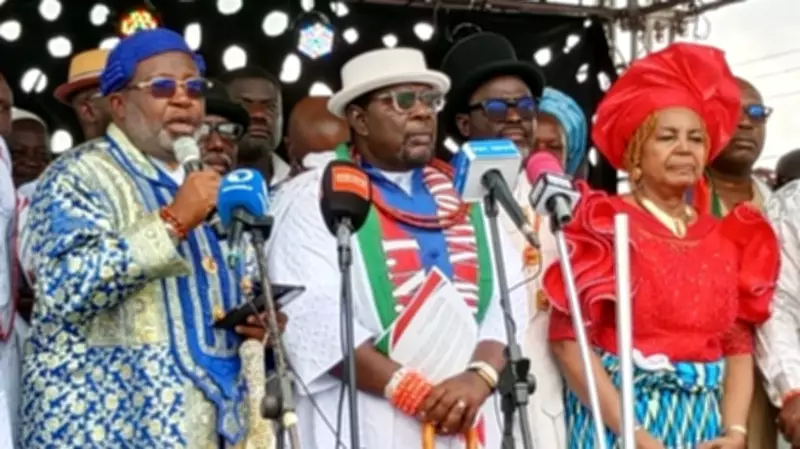
Political scientists have long argued that ethnic nationalism often resurfaces most forcefully during periods of internal crisis and perceived exclusion. American political theorist Benedict Anderson famously described nations as “imagined communities” held together by shared history, identity and collective aspirations, while scholar Claude Ake warned that unresolved questions of justice, representation and resource distribution in multi-ethnic states often deepen regional agitations and identity politics. Those realities played out vividly in Warri recently as the Ijaw National Congress (INC), emerging from months of internal tensions, litigations and political infighting, transformed what could have been a fractured leadership transition into a symbolic rallying point for reconciliation, renewed Ijaw nationalism and fresh agitation for restructuring, resource control and political inclusion within Nigeria’s federal structure.
The inauguration of a new INC leadership was not merely ceremonial; it became an important political moment reflecting both the contradictions and resilience of the Ijaw struggle in the Niger Delta. After months of disagreements that threatened to divide the umbrella socio-cultural organisation, traditional rulers, political leaders, youth groups and delegates from Delta, Bayelsa, Rivers, Edo, Ondo and Akwa Ibom States converged on Warri in what many stakeholders described as a deliberate attempt to restore unity and reposition the Ijaw nation for a new phase of political engagement. The event marked the formal transfer of leadership from outgoing INC President, Prof. Benjamin Okaba, to the newly elected President, Macdonald Igbadiwei.
Yet beneath the colourful regalia, cultural displays and ceremonial speeches was a deeper political subtext shaped by months of internal disputes that nearly overshadowed the congress itself. Before the election, disagreements over zoning arrangements, succession plans and electoral procedures triggered sharp divisions among stakeholders and competing political blocs within the Ijaw nation. The tensions resulted in litigations, public accusations and intense political manoeuvring that raised fears of a legitimacy crisis within the organisation. At the height of the disagreements, rival camps accused one another of attempting to manipulate the process through “backdoor arrangements,” while some stakeholders warned that personal ambitions and sectional rivalries were beginning to eclipse the collective aspirations of the Ijaw people.
The crisis exposed underlying tensions that have historically existed within the Niger Delta political landscape — tensions rooted not only in leadership struggles, but also in questions of representation, influence and access to power. For many observers, the disputes reflected what scholars of post-colonial politics often describe as the recurring challenge of balancing ethnic solidarity with internal political competition in resource-rich regions. Concerns mounted that if unresolved, the crisis could weaken the INC’s credibility and diminish its ability to champion broader Niger Delta interests at a time when conversations around restructuring and resource control are resurfacing nationally.
However, influential Ijaw elders, traditional rulers and prominent Niger Delta figures intervened quietly behind the scenes to prevent the disagreements from degenerating further. Among personalities credited with stabilising the situation through consultations, reconciliation meetings and appeals for unity were the Chairman of the Presidential Amnesty Programme, Dennis Otuaro; Chairman/CEO of Tantita security services Nigeria limited, High Chief Government Ekpemupolo; and Chairman of the INC Board of Trustees, Lulu Briggs. Stakeholders said interventions by elders and traditional institutions became critical in calming tensions among rival camps and rebuilding confidence in the electoral process. The eventual peaceful conduct of the congress and successful transition of leadership were therefore widely interpreted as evidence of a growing democratic culture within the INC despite earlier tensions.
Outgoing President Okaba acknowledged the divisions that trailed the election process and warned against attempts to personalise the organisation or hijack its leadership structure. “The Ijaw nation must be one,” he declared during his valedictory speech, cautioning against divisive tendencies capable of weakening the collective struggle for political recognition, restructuring and economic justice. Okaba also warned against leadership imposed through “backdoor arrangements,” insisting that the mandate of the people must always be respected. His remarks reflected wider concerns among stakeholders that internal fragmentation could weaken the Ijaw nation’s bargaining power within Nigeria’s evolving political landscape.
In his inaugural address, Igbadiwei attempted to strike a reconciliatory tone, extending a hand of fellowship to contestants who lost during the election. “We are going to reach out to all our brothers who contested with us but lost. Together, we can build a better Ijaw nation,” he said. He described his emergence as symbolic and historic, recalling that the first INC congress held in 1991, where pioneer President Professor Dime was elected, also took place in the Western Zone. “Leadership is service, sacrifice and collective responsibility,” he stated, promising that his administration would not take the trust and mandate of the people for granted.
The emphasis on reconciliation and unity became one of the defining themes of the inauguration. Traditional rulers and elders repeatedly warned that internal divisions, sectional interests and personal ambitions could undermine the ability of the Ijaw nation to speak with one voice on critical national issues. They urged political actors and youths to place collective interests above individual ambitions and preserve the unity of the organisation.
Beyond the internal politics of the INC, the congress reopened wider conversations around the political future of the Niger Delta and the unresolved “Ijaw question” within Nigeria’s federal arrangement. Speakers argued that despite the enormous contribution of the Niger Delta to Nigeria’s oil wealth and foreign exchange earnings, many Ijaw communities continue to suffer from poverty, unemployment, environmental degradation and weak infrastructure. One of the major issues raised at the gathering was the renewed agitation for the creation of Toru-Ebe State and Oil River State. According to leaders at the congress, the proposed states would address political marginalisation and improve representation for Ijaw communities, particularly those in Edo and Ondo States.
They also renewed demands for the expansion of local government areas in Bayelsa State from eight to at least twenty-four, lamenting that Bayelsa remains politically disadvantaged despite its strategic economic importance to the country. According to the new INC leadership, increasing the number of councils would improve grassroots development, deepen political participation and strengthen access to federal resources.
Economic concerns dominated discussions throughout the gathering, particularly around resource control and environmental justice. Okaba declared that the Ijaw nation must intensify advocacy for greater ownership and control of resources derived from its land. “The Ijaw Republic has gone beyond a dream; it is now a destination,” he declared, reflecting growing frustration among sections of the Niger Delta over what many perceive as decades of exploitation without commensurate development. Even so, most leaders at the congress framed their demands within constitutional advocacy, restructuring and federal reforms rather than separatist agitation.
Environmental degradation also featured prominently during discussions. Speakers lamented the impact of oil exploration on farmlands, fishing settlements and waterways across the Niger Delta, arguing that many communities continue to bear the environmental burden of oil production without corresponding development. The congress also highlighted grievances in Ibeno, Akwa Ibom State, where leaders accused some institutions of denying oil-bearing Ijaw communities proper recognition and equitable benefits. The new leadership pledged to pursue lawful and constitutional means to secure justice and inclusion for affected residents.
Igbadiwei also reaffirmed the INC’s commitment to enforcing Supreme Court judgments relating to ward delineation in the Warri Federal Constituency, insisting that justice and fairness must prevail in all disputed areas.
Beyond politics and economics, the gathering strongly projected the cultural identity of the Ijaw people. Traditional rulers, women groups and delegates appeared in colourful regalia while repeated calls were made for the preservation of the Ijaw language, customs and heritage amid fears of gradual cultural erosion. “We must never be ashamed of who we are. Our language, traditions and heritage are our strength,” Igbadiwei declared. Observers noted that the congress reflected growing efforts to combine political agitation with cultural revival and social cohesion within the Ijaw nation.
One of the major highlights of the inauguration was the widespread encomium showered on Chief Ekpemupolo popularly referred to as Tompolo for his role in promoting peace, unity and socio-economic stability within the Niger Delta. Traditional rulers, political leaders and stakeholders described him as a rallying figure whose interventions have helped bridge divisions among Ijaw communities and strengthen collective engagement on regional issues. The new INC President particularly referred to him as “the father and eye of the Ijaw nation,” while participants applauded his support for peace-building efforts and development initiatives across coastal communities. Several speakers credited him with contributing to the relative stability currently being witnessed in parts of the Niger Delta previously associated with militancy and unrest.
The choice of Warri as the venue also carried deep political and symbolic significance. As one of the Niger Delta’s strategic oil-producing and commercial centres, Warri has historically remained central to debates around resource control, environmental justice and ethnic representation. By holding the congress there, the INC reinforced the centrality of the Niger Delta struggle to the Ijaw cause while projecting pan-Ijaw solidarity across Delta, Bayelsa, Rivers, Edo, Ondo and Akwa Ibom States.
Ultimately, the inauguration performed by the Pere of Akugbene Mein Kingdom and Vice Chairman of the Delta State Traditional Rulers Council, HM Kalanama VIII, evolved into far more than a leadership transition. It became a renewed declaration of political identity, reconciliation and collective aspiration by the Ijaw nation at a time when debates around restructuring, federalism and equity are once again gaining prominence in Nigeria. From demands for state creation and expanded local government structures to calls for resource control, environmental justice and cultural preservation, the congress reaffirmed that the Ijaw question remains central to the broader national debate about inclusion and the future of Nigeria’s federal system. But beyond the rhetoric and political demands, the gathering also underscored another reality — that the future strength of the Ijaw struggle may depend not only on agitation against external marginalisation, but also on the ability of its leaders to manage internal disagreements, sustain unity and speak with one voice in pursuit of shared aspirations.