
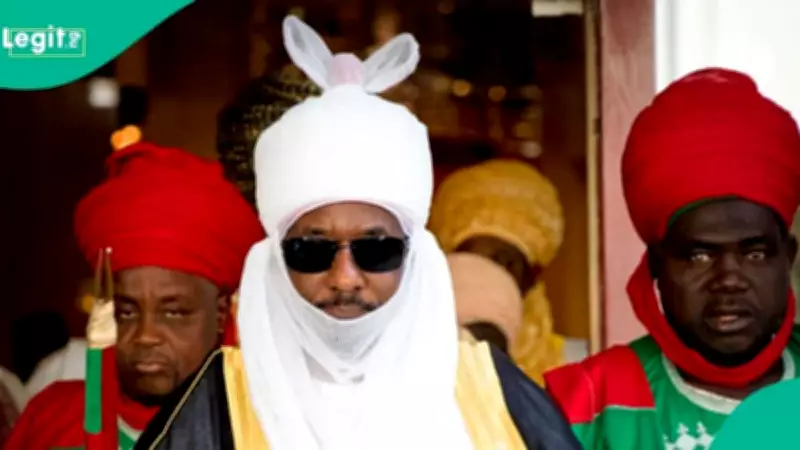
Emir Sanusi Challenges Cultural Justifications for Abuse, Highlights Poverty and State Failures
The Emir of Kano, HRH Alhaji Dr. Muhammadu Sanusi II, has delivered a powerful critique of the societal factors driving violence against women and children in Nigeria. In a recent television appearance, Sanusi emphasized that such abuse is not an inherent part of African culture but rather a consequence of power imbalances and systemic state neglect.
Power Relations and State Protection as Key Factors
Speaking on Channels Television's Morning Show on Wednesday, February 4, 2026, Sanusi explained that violence thrives in environments where men hold disproportionate power and institutions fail to protect vulnerable individuals. "Violence happens in all societies; it is not about African culture. It is about power relations," he stated. "When men have power and women are not protected, men will take advantage of that power. In our society, the weak and the vulnerable are victims."
Sanusi, a former Central Bank governor, stressed that cultural traditions cannot override the fundamental rights of Nigerian citizens. He pointed out that Nigerian law provides protections for women and children, regardless of local customs. "As a country, we have citizens and human beings who have rights. Those rights are inviolable. You cannot violate them because of culture," he asserted.
Education Gaps and Rural Neglect Fuel Child Abuse
The Emir identified failures in education, particularly in rural areas, as a major driver of child abuse and early marriage. He noted that while the Universal Basic Education Act guarantees every child's right to basic education, enforcement remains weak due to inadequate infrastructure. "How many people have ever been arrested for taking children out of school? Do you know why? Because the government has not provided the schools," Sanusi questioned.
He described the harsh realities in many northern villages, where educational opportunities for girls often end after primary school. "You go to a village in some parts of the North, and there is a primary school, but that is it. A girl finishes school at 11. Between 11 and 18, what arrangements have been made for her?" Sanusi highlighted how poverty and lack of alternatives force families into early marriages as a perceived protective measure.
Culture as a Reflection of Poverty and Neglect
Sanusi argued that what is often labeled as "culture" is frequently a manifestation of poverty and state abandonment. He urged governments to prioritize educational infrastructure and access as solutions. "Sometimes, these cultures simply reflect poverty. Let us supply education. Let us build schools," he advocated.
The Emir cautioned against urban elites judging rural communities without understanding their challenges. "When you sit in a city like Kano, you do not know what is happening in the village. When you go there, you need to know how many hours it takes a girl to travel from her village to the local government area, because the roads are not good or safe," he explained.
Call for Shared National Values and Action
Sanusi called for the establishment of common national values that unequivocally reject abuse, regardless of cultural beliefs. "As a nation, we need certain common agreements and certain values. It is simply not acceptable to beat a woman, no matter what you think your culture says. Nigerian law does not allow it," he emphasized.
He concluded by framing abuse as oppression rather than culture, demanding societal change. "Many of these things do not come from culture. They come from people who take advantage of positions of power, exploit and abuse others, and then find justification in the name of culture. It is a culture of oppression, a culture of violence, and that culture needs to change," Sanusi declared.




