Kwara Governor Confirms Deadly Attack in Kaiama Communities
Governor AbdulRahman AbdulRazaq of Kwara State has officially confirmed a devastating terrorist attack that occurred in the Woro and Nuku communities within the Kaiama Local Government Area. The incident, which took place on Tuesday, February 3, resulted in the tragic loss of 75 lives according to the governor's statement.
Details of the Attack and Governor's Condemnation
During a visit to the Emir of Kaiama on Wednesday, January 4, Governor AbdulRazaq provided harrowing details of the assault. He reported that the terrorists launched their offensive around 6 p.m., unleashing massive destruction across the villages. Among the targeted structures was the King's palace, which was deliberately set ablaze by the assailants.
The governor expressed his deepest condolences to the emirate, stating, "I commiserate with you over the death of 75 of your subjects." He emphasized that this attack represented a departure from typical kidnapping-for-ransom scenarios, describing it as "a pure massacre" that must be universally condemned.
Religious Doctrine as Central Conflict Point
Governor AbdulRazaq attributed the violence directly to the villagers' steadfast refusal to adopt what he termed "a converted form of Islamic doctrine." He explained that the nine villages under the emirate's jurisdiction have consistently adhered to traditional Islamic practices without alteration.
"They are abiding by the Islamic faith and basically did not want any alteration to the Hadith," the governor clarified. "Because they refused a change in doctrine and faith, they were attacked and massacred." This resistance to extremist interpretations of religious teachings appears to have triggered the brutal response from the terrorist group.
Alternative Account from US-Based Professor
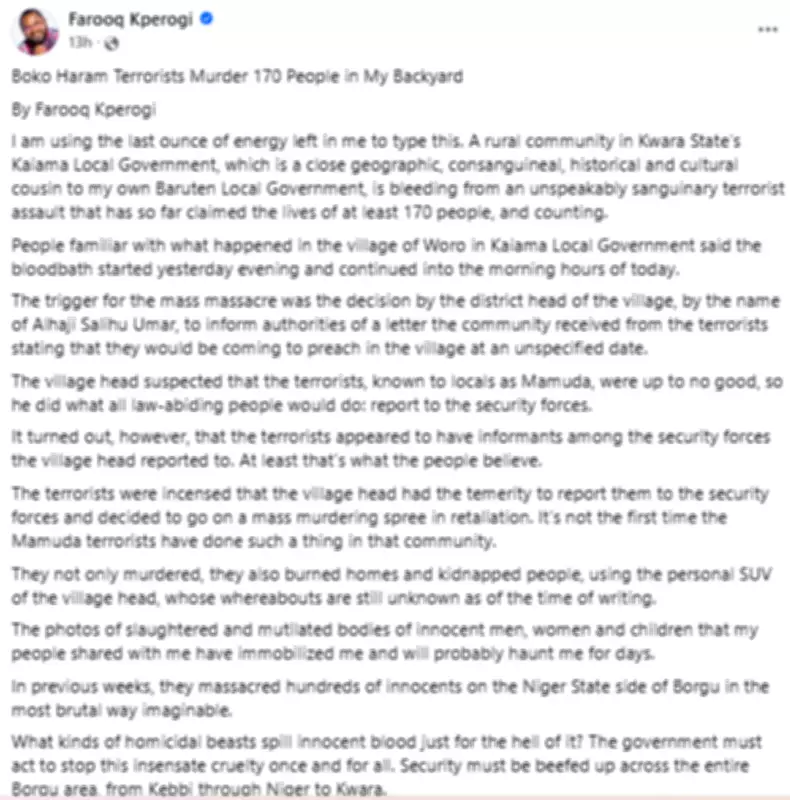
Meanwhile, Farooq Kperogi, a Nigerian professor of Journalism based in the United States, has presented a different perspective based on accounts from community members. According to his sources, the attack stemmed from the village head's decision to alert security agencies about a threatening letter received from the terrorists.
The terrorists, locally known as Mamuda, had reportedly sent a letter announcing their intention to visit the village for preaching purposes. Alhaji Salihu Umar, the district head of Woro village, grew suspicious of their motives and promptly reported the matter to security forces.
Retaliation and Escalating Violence
Professor Kperogi's account suggests that the terrorists discovered the village head's report, possibly through informants within the security apparatus. Enraged by this perceived betrayal, they launched a retaliatory assault that began in the evening and continued into the following morning.
The professor described receiving distressing reports indicating the death toll might be significantly higher than official figures, with some sources claiming up to 170 fatalities. "The photos of slaughtered and mutilated bodies of innocent men, women and children have immobilized me," he wrote, highlighting the horrific nature of the violence.
Pattern of Terrorist Activity in the Region
This incident reportedly follows a pattern of similar attacks by the Mamuda terrorist group in the area. Beyond the mass killings, the assailants engaged in widespread arson, burning numerous homes, and conducted kidnappings using the village head's personal SUV. The whereabouts of Alhaji Salihu Umar remain unknown at this time.
The attack has exposed critical vulnerabilities in local security arrangements and raised serious questions about potential infiltration of security forces by terrorist elements. Both the governor's account and the professor's reporting underscore the complex interplay between religious extremism, community resistance, and security failures that continue to plague certain regions of Nigeria.