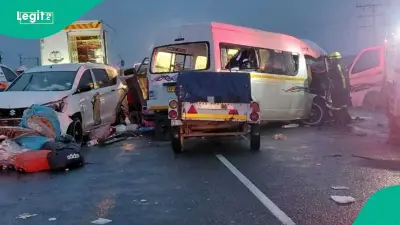
On September 17, 2026, 37 suspected illegal miners died while in the custody of the Nigeria Security and Civil Defence Corps (NSCDC) in Niger State, reviving memories of the 1980 Black Maria tragedy in Lagos in which 50 men lost their lives. The incident occurred after a two-day NSCDC operation that led to the arrest of at least 150 suspects. A witness identified as Garba told the Foundation for Investigative Journalism (fij) that children under 18, including a seven-year-old, were among the deceased.
Survivors Describe Overcrowding and a Mysterious Spray
While the official cause of death has not yet been established, survivors have provided harrowing accounts of the conditions inside the detention facility. According to Pulse, one survivor claimed that detainees were initially locked in a small room before more were brought in. He said they complained that the room was too small and hot. He added that security officials sprayed a substance 'resembling perfume' into the room before people began falling. The detainees pleaded for water but were told that nobody would open the door.
Another survivor said they screamed for help and that guards were informed people were dying one after another. The incident is not the first mass death of this nature in government custody in Nigeria.

The 1980 Black Maria Tragedy: A Historical Parallel
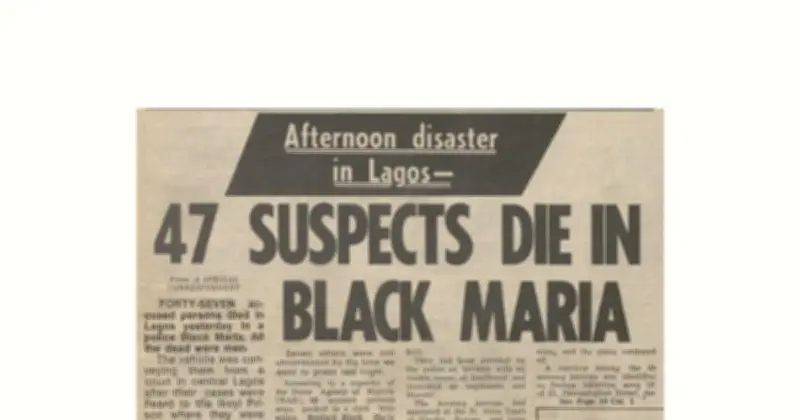
In March 1980, 68 men were packed into a dark blue police Bedford Black Maria with registration number NPF and left sitting in the Lagos heat for about three hours. By the time the doors opened, 47 of them were dead. Three more later died in hospital, bringing the eventual death toll to 50. The incident occurred during the Second Republic under the leadership of late Alhaji Shehu Shagari. Police officers raided Tin Can Island in Lagos in search of a suspected car thief after a gun battle. Instead of finding only the man they sought, officers began arresting young men in the surrounding area, including passers-by, street hawkers, and labourers. A goldsmith was dragged from his shop, and a factory worker was detained despite a colleague's attempt to vouch for him.
In all, 100 men were arrested, and thirty-two were released after questioning. The remaining 68 were taken to the police headquarters at Lion Building on Lagos Island. Forty-three were from the Republic of Niger, 15 were Nigerians, and 10 were Ghanaians. Most were poor migrants and labourers seeking work in Lagos. The night before their court appearance, they were kept in a small room without food or water. The next day, they were taken to St Anna Magistrate's Court at Tinubu Square, accused of wandering and loitering, and remanded to Ikoyi Prison.
Overcrowding and Fatal Delay
Due to a shortage of blank forms and only one clerk processing documents for all 68 men, the paperwork was delayed. While waiting, the courtroom became crowded, and police decided to put the suspects back inside the Black Maria. The vehicle, largely windowless with only small openings for air, was parked in a corner of the yard near the court entrance and left under the direct sun for more than three hours. Within about half an hour, the men began groaning, shouting, and banging on the vehicle. A man who informally managed the court's parking area raised the alarm, and visitors complained about the noise. A military prosecutor confronted the police officers and objected to the treatment. The door was briefly opened, and a few cups of water were passed inside, but it was insufficient. When the military prosecutor returned, the men were still crying out, and he warned the driver they would die.
According to Samuel Fury Childs Daly's study of the incident, the driver reportedly replied, “Dead men don’t cry.” Not long afterwards, the noise stopped. At about 1:30 pm, the paperwork was completed, and the Black Maria left for Ikoyi Prison. The journey was short with no traffic, and the vehicle arrived at about 2:05 pm. When prison officers opened the doors, they found a pile of bodies: 47 men were dead, 17 were unconscious, and four were still conscious. Survivors were rushed to hospital, where intravenous fluids and artificial respiratory support were used. Some victims were treated on the hospital floor due to the number of casualties. Three more men died there, making the final death toll 50.

Aftermath and Lingering Questions
The tragedy caused national outrage and became known as the Black Maria Tragedy. The House of Representatives condemned the incident, and a judicial inquiry was set up. The tribunal sat at the Federal High Court in Ikoyi from March 17 to April 8, 1980. Fifty-three witnesses testified, and 97 exhibits were presented. The inquiry found that the Black Maria was carrying far more people than it was designed for. Autopsies on 20 of the 50 bodies showed that all had died from asphyxiation. The judge identified Inspector Reuben Ikem as the officer principally responsible for ordering the vehicle to be overloaded. He also blamed the driver and police escort for refusing to act while the men struggled and died. The judge recommended prosecution for manslaughter under Section 317 of the Criminal Code, but it does not appear that they were prosecuted.
Black Marias have been part of Nigerian policing for decades. They were later repainted in the colours of the national flag and renamed “Green Marias”, but the change of paint did not change what they represented. The deaths in Niger State have reopened an old wound. In 1980, 68 men entered a police vehicle alive, and fifty never made it out alive. Forty-six years later, 67 detainees were held in NSCDC custody in Minna, and thirty-seven died. The 37 detainees were arrested during an operation against suspected illegal mining. They were supposed to be in the custody of the state while their cases were dealt with, but instead, 37 families are mourning.