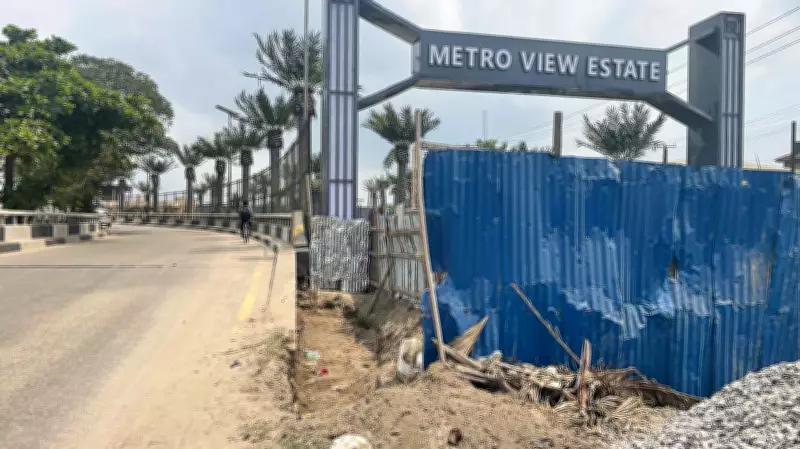
One Year After Otumara Demolitions, Evictees Agonize Amid Luxury Estate Plan
Forced evictions and home demolitions in Ilaje Otumara and Baba Ijora, located within Lagos Mainland Local Council, have sparked intense debate over alleged land grabbing activities in Lagos. Many victims of the demolitions, which took place on March 7 and 10, 2025, continue to face homelessness and harsh living conditions one year later. While government authorities have framed these actions as part of urban renewal efforts, the auctioning of the land for private estate development, with government agencies showing little concern, reveals a deeper pattern of displacement driven largely by economic interests. This pattern is reportedly occurring in various communities across Lagos.
Community Leaders Decry Broken Promises and Legal Violations
Residents of Otumara express frustration that their votes have not translated into improved infrastructure over the years. Despite community efforts to enhance their environment, politicians, particularly from the ruling party in the state, often visit during election cycles to seek votes with promises of infrastructure upgrades, only to abandon these pledges post-election. Jude Ojo, a community leader and pastor at the Redeemed Christian Church of God, provided a detailed background on the evictees' struggles. He noted that Otumara is one of many waterfront communities in Lagos that formed an alliance in 2016 to protest against the Lagos State government under former Governor Akinwumi Ambode. This led to a precedent-setting judgment from the Lagos State High Court, which ruled that forced evictions, such as those in Otodo Gbame from 2016-17, violate the right to dignity under Section 34 of the 1999 Nigerian Constitution. A permanent injunction against displacement without prior consultation and resettlement was also established, protecting Ilaje Otumara and other informal settlements.
Ojo explained that since mid-2021, Ilaje Otumara had been engaging positively with the Lagos State Urban Renewal Agency (LASURA) on a planned partnership for regeneration, with residents meant to be integral to the process. In late 2021, a regeneration committee was set up, and by mid-2022, the community conducted a census showing 2,808 households with at least 12,313 residents. In March 2023, Governor Babajide Sanwo-Olu campaigned in Otumara, promising to continue the project. However, since mid-2023, progress reversed, starting with forced evictions in Oworonshoki and continuing with demolitions in Orisunmibare, Otto, Oko Baba, and Aiyetoro communities.
Sudden Demolitions and Government Assurances Ignored
On February 11, 2025, the Lagos State Building Control Agency (LASBCA) entered Ilaje Otumara and Baba Ijora, arbitrarily marking hundreds of homes and businesses for removal within two days. Residents protested at the Lagos Mainland Local Council, where the chairwoman pledged support. The following day, they demonstrated at Alausa, appealing to the Governor and House of Assembly to intervene. Over the next two weeks, meetings were held with LASBCA, LASURA, the Ministry of Physical Planning and Urban Development, and the Special Advisor to the Governor on Urban Development, who assured the community that evictions would not occur and partnership for regeneration would continue.
Despite these assurances, on March 7, 2025, without prior warning, LASBCA officials, police, and armed individuals descended on the communities with excavators and a detention vehicle. They demolished nearly the entirety of both communities over March 7-9, 2025, leading to widespread vandalism, looting, and displacement of thousands of residents. Ojo expressed shock that an elected government would displace over 15,000 residents without providing alternatives, especially after politicians, including Sanwo-Olu's campaign team, had promised urban regeneration on a win-win basis during elections.
Personal Stories of Hardship and Loss
The demolitions have left many residents in dire straits. Afolabi Esther Abiola, a landlady and school-owner with seven tenants, now squats with her mother in Magbon, Badagry, relying on family and friends for food and struggling to keep her daughter in university. Alfa Ajibade, a landlord at 34 Church Street, Ilaje, described the demolition as "like heavens were fallen," with his household scattered and his livelihood as an imam and Arabic tutor destroyed. His family now lives separately, with his wives and children in different locations.
Collins Okereke reported that his mother died due to the stress of displacement, and her corpse remains in the mortuary. His family is scattered, with him staying in Orile. Alimaje Joseph, who has lived in Otumara since 1984, used her pension to build two houses for her children after her husband's death but is now homeless, staying on the roadside. Bright John, a groundnut seller, gave birth on March 7, the day the demolition started, and now lives in a makeshift structure, using nylon to cover herself and her baby during rain.
Legal and Ethical Concerns Raised by Analysts
Public affairs analyst Damilola Solomon criticized the actions, stating that it is ironic for people with government connections to trample on others, rendering them homeless for economic gain. He emphasized the inhumanity of such wealth acquisition at the expense of thousands. Lawyer Mariam Alo highlighted that the Ilaje Otumara community, existing for over 150 years in Ebute Metta, was forcefully evicted despite ongoing engagements with LASURA on upgrading the settlement. She noted that this eviction violates a subsisting court judgment that protects waterfront communities from forced evictions without adequate notice, affirming that such displacements violate the right to dignity.
Alo pointed out that legal safeguards are in place to prevent these actions, and ongoing legal proceedings challenge the eviction's legality. However, development activities have already commenced on the land, mirroring patterns seen in past evictions like Otodo Gbame. This raises serious concerns about disregard for judicial authority and the rule of law, undermining the courts as the last hope for common citizens.