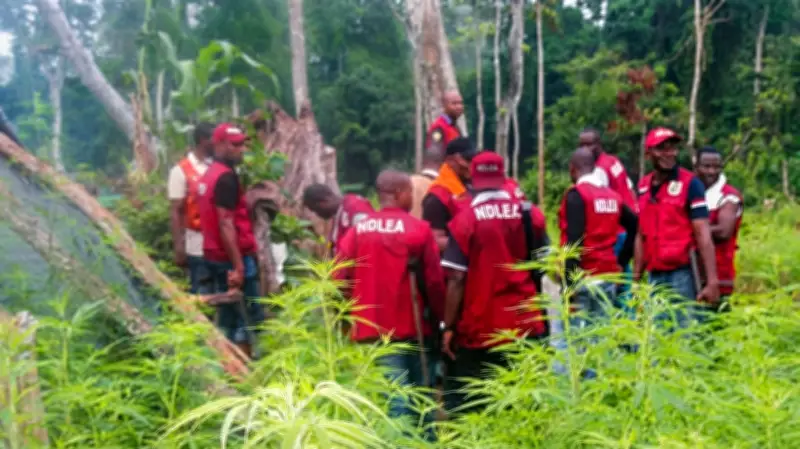
Nigeria's anti-drug agency, the National Drug Law Enforcement Agency (NDLEA), recently disrupted a methamphetamine syndicate in what is the country's largest seizure to date. Authorities seized drugs and precursor chemicals valued at approximately $363 million and arrested 10 individuals, including three from Mexico, in Ogun State. Ogun State, known as the "Gateway State" of Nigeria, is a significant economic, industrial, and historical centre in southwestern Nigeria.
Coordinated raids yield massive seizure
On May 20, 2026, the NDLEA announced that coordinated raids on a farm in Ogun State and related properties in Lagos State uncovered an industrial-scale clandestine meth lab and confiscated 2.4 tons of methamphetamine along with chemical materials. It is essential to note that the production of methamphetamine in clandestine laboratories involves volatile, corrosive, and toxic chemicals. These substances can include common industrial chemicals, solvents, and reactive materials that pose significant risks of explosion, fire, and environmental contamination.
Historical context of drug trade in West Africa
It is crucial to clearly state that illicit drugs have long been part of the West African trade routes. This article highlights five key factors contributing to the growth of the drug network in Nigeria. These include improvements in airport and seaport security, the demand for large and diverse drug supplies in Europe and Asia, weak internal security along the West African trans-Saharan routes, involvement of some political leaders in the drug trade, and collaborations among terrorists, bandits, and drug cartels.
Impact of security upgrades on drug production
Since Boko Haram's radicalisation by Abubakar Shekau, who committed suicide in 2021 during the Battle of Sambisa Forest, and the rise of the Islamic State West Africa Province (ISWAP), long before Lakurawa was formed from Niger and Mali and moved to establish bases in Sokoto State, the Nigerian government had prioritised cutting off the logistics and supplies of terrorists, bandits, and drug cartels. However, efforts have mainly focused on enhancing airport and seaport security, with Interior Minister Dr. Olubunmi Tunji-Ojo making significant efforts to modernise these security measures. In contrast, land borders have not received the same level of security upgrades. As a result, drug cartels from Mexico and other South American nations, unable to easily transport illicit drugs through airports and seaports, are now shifting their tactics to produce drugs domestically. This shift underscores the impact of strengthened airport and seaport security on criminal strategies.
Demand from Europe and Asia drives production
The strong demand for large and diverse drug supplies in Europe and Asia has made West Africa a crucial global hub for cocaine logistics. Recently, cartels have expanded their range to include methamphetamine. With my expertise and training, there is a strong indication that smaller-scale production of MDMA — a synthetic drug that functions as both a stimulant and hallucinogen — and Synthetic Cathinones — a group of human-made stimulants chemically related to the khat plant — has begun in the region. This is because these substances are often produced in the same labs, known as "combi-labs" or flexible labs. Notably, at least one-third of all cocaine consumed in Europe transits through this area. What was once a minor stopover has now become an essential "storage and redistribution" centre, where multi-ton shipments from Latin American cartels — particularly Brazil's PCC — are repackaged for profitable markets across Europe and increasingly in Asia, with West Africa emerging as a production base.
Weak internal security along trans-Saharan routes
Internal security along the West African trans-Saharan routes is weak. It is essential to clarify that the Trans-Saharan trade is an ancient network with a history of both legal and illegal commerce. It began operating regularly around the 4th century CE, although small-scale, localised exchanges predate that period. These routes still function, and drug cartels are aware of these historic pathways, often collaborating with local partners. Due to prolonged activity by terrorists and bandits along these trade corridors — connecting West Africa to North Africa and subsequently to Europe — law enforcement and military forces have largely regarded these areas as no-go zones. Some villagers pay taxes to terrorists and bandits, as noted by the ADF magazine of the US African Command. Drug cartels also exploit these old trade routes to smuggle illicit drugs into Europe, especially as airport and seaport security in Nigeria tightens. This situation poses challenges for Nigerian authorities, as various terror groups use the same logistical routes for their operations. The use of the same logistics routes by all these terror groups is moving them from the tactical to the strategic level of operation. Additionally, the division of ECOWAS following the exit of Mali, Burkina Faso, and the Republic of Niger has created a security gap along these trade pathways.
Political involvement in drug trade
It is important to recognise that some political leaders' involvement in the illicit drug trade has further bolstered unity and backing among terrorists, bandits, and drug cartels. This is an objective viewpoint, as the Nigerian government has explicitly acknowledged. For example, in April 2026, the Nigeria Sanctions Committee (NSC) issued a list naming 48 individuals and 12 entities accused of sponsoring terrorism. The list includes notable figures such as political associates, key businessmen, and Bureau De Change (BDC) operators. Evidence suggests that these political figures are possibly shareholders in Nigeria's illicit drug production, a link confirmed by the U.S. Africa Command (AFRICOM). During a testimony before the U.S. Congress, AFRICOM Commander Gen. Dagvin Anderson indicated that terrorist and extremist groups in West Africa and the Sahel are increasingly funding their insurgencies through narcotics trafficking. Despite these allegations, reports, and evidence, the Nigerian government has yet to prosecute any political leader suspected of terrorism sponsorship effectively. Moreover, the Nigerian federal government dismissed terrorism financing charges against former Attorney-General Abubakar Malami and his son Abdulaziz Malami.
Need for comprehensive action
It is vital to highlight that if the Nigerian government does not stop illicit drug production by the cartel — which funds terrorists, bandits, and drug gangs — their financial base will stay robust. This could cause their illegal activities to advance from tactical to strategic threats, risking Nigeria's sovereignty. However, this fight is not only the government's; citizens also have a duty to observe and report. Additionally, the government must ensure that law enforcement responds quickly to community reports.
Abiodun Ramon Oseni is a former U.S. police officer and U.S. Army veteran. Abiodun Ramon Oseni is a Fellow of the Institute of Security, Nigeria.