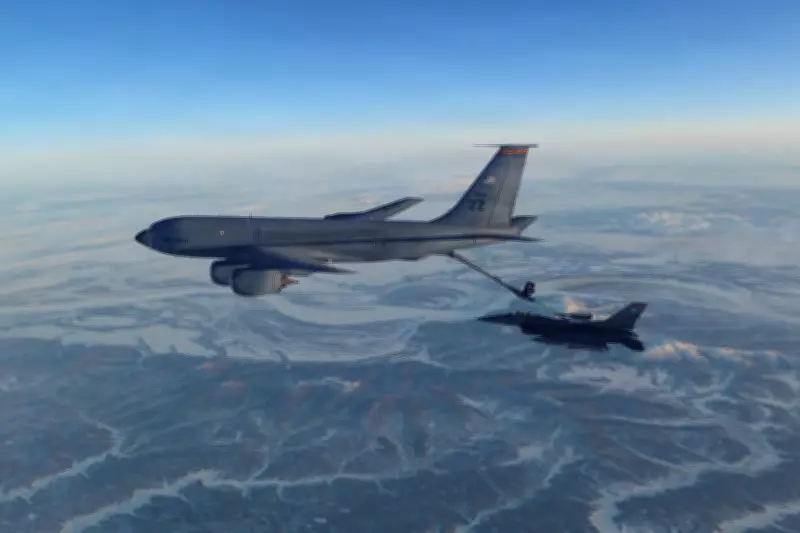
US Military Refueling Aircraft Crashes in Western Iraq During Ongoing Conflict
A United States Air Force refueling aircraft has crashed in western Iraq while conducting operations as part of the ongoing military campaign against Iran, sparking fears of potential servicemember fatalities. The incident occurred during Operation Epic Fury, the extensive military campaign being executed by American forces across the region.
Details of the Aircraft and Crash Incident
According to official statements from United States Central Command, the aircraft involved was a Boeing KC‑135 Stratotanker, a specialized military plane designed to refuel other aircraft during extended missions. Officials confirmed that the tanker went down following an incident involving two aircraft operating within friendly airspace, with no immediate reports indicating hostile fire was responsible for the crash.
The precise location was identified as western Iraq, though military authorities have not yet released definitive information regarding the status or condition of the crew members aboard the aircraft. The crash investigation remains ongoing as recovery efforts proceed in the area.
Escalating Regional Tensions and Military Actions
This aviation incident unfolds against a backdrop of intensifying military tensions throughout the Middle East, driven by continued strikes conducted by the United States and Israel against Iranian-linked targets. US President Donald Trump has publicly reaffirmed his administration's commitment to sustained military action against Iran, characterizing the nation as an "evil empire" and vowing that Washington will prevent Tehran from advancing its nuclear weapons program.
In a statement disseminated via the Truth Social platform, President Trump emphasized that the United States remains steadfast in its objective to halt Iran's pursuit of nuclear capabilities and to counter activities that destabilize the regional security environment.
Recent Israeli Strikes and Iranian Demands
Concurrently, the Israel Defense Forces announced they had recently conducted a strike on the Taleghan compound, a facility which Israeli intelligence asserts was being utilized to develop critical capabilities associated with nuclear weapons technology. This action further complicates the already volatile security landscape.
Iranian President Masoud Pezeshkian has articulated specific conditions for potentially de-escalating the conflict, stating that hostilities could cease if Iran's "legitimate rights" were formally recognized, reparations were provided for damages, and binding guarantees were established against future attacks. However, President Pezeshkian clarified that ultimate authority regarding such decisions rests with Iran's supreme leader, Mojtaba Khamenei.
Impact on Global Energy Markets and Maritime Security
The persistent conflict has significantly influenced global energy market dynamics, with crude oil prices once again approaching the $100 per barrel threshold following renewed attacks on commercial cargo vessels transiting the strategic Strait of Hormuz. Tensions remain critically elevated in the Gulf region, where multiple ships have been targeted in recent days, including tankers near Iraq and another vessel off the coast of the United Arab Emirates.
These maritime incidents underscore the expanding repercussions of the conflict on international shipping lanes and global energy supply chains, highlighting the interconnected nature of regional military actions and worldwide economic stability.