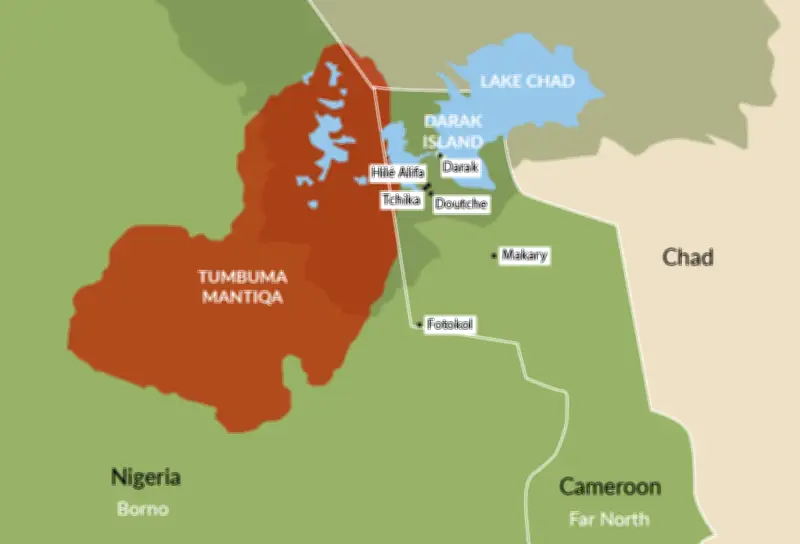
For over a year, the Islamic State West Africa Province (ISWAP) has been intensifying pressure on communities and military positions in northern Cameroon's Darak district. The group aims to extend its control beyond the Tumbuma Mantiqa region in northeast Nigeria, which serves as both a hideout and a fundraising hub. Located in an isolated part of the Lake Chad Basin, Darak's population is highly vulnerable.
Recent Attacks and Displacement
A 5 February ISWAP attack displaced over 2,000 people from Darak Island. Residents are caught in the crossfire between insurgents and security forces. ISWAP subjects locals to its laws, forcing them to pay taxes as a sign of allegiance and to provide income for the group. Security forces, in an effort to disrupt these activities, physically abuse residents accused of collaborating and confiscate property such as canoes and phones.
Strategic Importance of Darak
ISWAP's target area includes at least three districts: Darak, Hilé Alifa, and Fotokol. The region is strategically important due to cross-border trade opportunities, fish-rich waters, and fertile land, which have become more valuable as Lake Chad shrinks. A major border dispute between Cameroon and Nigeria from 1994 to 2002 highlights the area's significance.
Accessibility and Weak State Presence
Darak Island is accessible only by canoe and is located near ISWAP's Tumbuma Mantiqa territory. The district is a logistical hub near the Nigeria-Cameroon border, with busy fishing and cross-border trade. Weak state presence, due to poor infrastructure and insurgent attacks on government facilities, makes expansion viable for ISWAP. Few officials live in Darak.
Propaganda and Coercion
ISWAP openly spreads propaganda at community gatherings like weekly markets. In January, insurgents declared Darak part of their dawla (state) and ordered people to address them as 'Dan mallam' (sons of the Prophet). They exploit shared Islamic beliefs, claiming that 2024 floods and fish proliferation were divine rewards for jihad, while destruction was punishment for apostates. Propaganda spreads via word of mouth, digital media, and slogans shouted in villages.
Appointed Lieutenants
ISS research reveals ISWAP has appointed three Cameroonian lieutenants: Malam Abaicho, Malam Abdulrahman from Makary, and Malam Djimé from Tchika, tasked with bringing Darak under ISWAP control.
Violence and Punishment
ISWAP backs rhetoric with violence. Since January, there have been cases of whipping, fines, imprisonment, and abductions. In Doutché, herders were whipped and fined ₦300,000 ($220) after an ISWAP judgment in a land dispute. Near Darak, herders were whipped for late tax payments. In Tchika, people were flogged for alcohol consumption, and farmers beaten for entering agricultural areas without permission.
Military Attacks and Civil-Military Relations
ISWAP aims to gain local support by promising to rid Darak of the military. ISS sources say the group has attacked 10 military outposts since January, damaging infrastructure and dismantling Cameroonian posts along the border. These attacks weaken the social contract between population and government, leading to deterioration in civil-military relations and closure of schools and health centers.
Recommended Strategies
A change in military strategy is needed. Operation Alpha, launched in 2014 by Cameroon's army and the Multinational Joint Task Force, must be reinforced with offensive operations to clear the area and dismantle ISWAP strongholds. This requires more troops and training for marshy terrain with adapted equipment: motorised canoes, tactical drones for close observation, medium altitude long-endurance drones for wide surveillance, and armed combat drones for targeted strikes.
Joint military action between Cameroon and Nigeria would help secure the border area. Nigeria's Hadin Kai offensive against Boko Haram in Borno State could complement Cameroonian operations through intelligence sharing and tactical coordination. Civil-military initiatives are also needed to build trust and raise public support, strengthening community resilience and reducing vulnerability to ISWAP propaganda.
Allowing Darak to fall under ISWAP control would embolden the group, undermine sovereignty gained after the border dispute, and raise the terrorism threat in northern Cameroon.
Célestin Delanga is a Research Officer in the ISS Regional Office for West Africa and the Sahel. Abélégué Alliance Fidèle is an Independent Researcher.