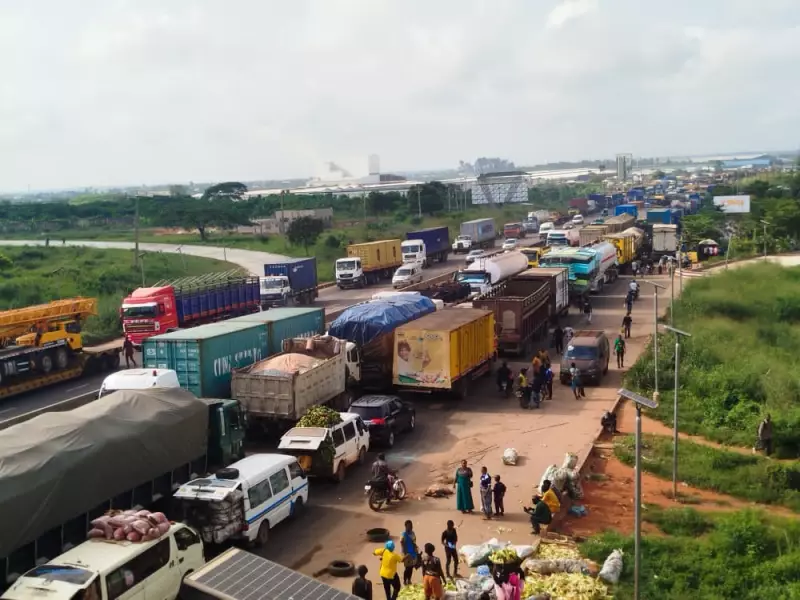
As the festive season approaches, the perennial nightmare of traffic gridlock in Lagos State returns to the forefront, with a staggering annual economic loss of N3.8 trillion hanging over Africa's most populous city. The question on every commuter's mind is whether technology can finally provide the relief needed to salvage this dire situation.
The Staggering Cost of Standstill
Lagos, Nigeria's undisputed commercial nerve centre, grapples with an overwhelming density of vehicles. Recent data paints a stark picture: an estimated two million private cars and 75,000 commercial buses (danfos) operate within the state, with over 1.8 million vehicles using its roads annually. This translates to a crushing 224 vehicles per kilometre of road, a figure far exceeding national and global averages.
The human and financial toll is devastating. A report by the Danne Institute of Research reveals that the average Lagos resident endures a 2.1-hour commute delay every working day. Financially, vehicle owners spend an extra N133,978.68 yearly on fuel, while public transport users are burdened with additional costs of N79,039.40 annually. For businesses, the opportunity costs are crippling, ranging from N600,054 to N149 million yearly depending on their size.
These individual burdens coalesce into the colossal N3.834 trillion yearly loss attributed to traffic congestion, a figure that underscores a systemic crisis crippling productivity and quality of life.
Root Causes: From Infrastructure to Attitude
The causes of this chronic congestion are multifaceted. The report identifies impatience, poor driving attitudes, and weak traffic management as primary culprits. These are compounded by dilapidated road infrastructure, rampant violation of traffic laws, and the disruptive activities of touts (agberos) at bus stops.
Mr. Kehinde Hamzat, the Lagos Sector Commander of the Federal Road Safety Corps (FRSC), emphasises the role of the city's magnetic pull. "Lagos is a magnet for people from across Nigeria, and beyond, attracted by the opportunities," he stated, highlighting the immense pressure on limited infrastructure. He also pointed to the challenging relationship between drivers and traffic officials, noting that enforcement is often met with hostility.
Geographically, the pain is widespread. Critical arteries like the Lagos-Ibadan Expressway, Ikorodu Road, Apapa corridors, Lekki-Epe Expressway, and Lagos-Abeokuta Expressway are routinely paralysed. Apapa, in particular, stands as the infamous symbol of the crisis, with perpetual gridlock whether approached via Oshodi-Tin Can or Wharf Road.
Tech and Policy: The Path to Redemption?
In response, authorities and experts are advocating for a technological and multi-modal shift. Mr. Sola Giwa, the Special Adviser to the Governor on Transportation, recently announced the enforcement of an Electronic Call-Up (e-Call-Up) system for all tankers and articulated vehicles along the Lekki-Epe corridor. This is supported by seven dedicated truck parks approved by the government to curb unregulated parking.
Mr. Taofik Adebayo, Public Relations Officer of the Lagos State Traffic Management Authority (LASTMA), detailed their tech-augmented approach. "With our advanced cameras, we capture traffic offenders from a distance of 70-100 meters," he explained. The system records the location, time, and date of infractions, aiming to deter violations. He urged the public to use LASTMA's toll-free numbers for rapid breakdown response, as a single stalled vehicle can impede up to 45 others.
Economic analyst Dr. Muda Yusuf proposed broader systemic solutions, including:
- Major investment in mass transit systems like BRT buses and rail expansion.
- Developing water transportation networks.
- Expanding road capacity with more flyovers.
- A cultural shift towards remote work and online transactions to reduce physical movement.
As Lagosians brace for the heightened congestion of the Yuletide season, the convergence of technology, stringent policy enforcement, and citizen cooperation appears to be the most promising, if not the only, pathway to reclaiming the billions lost in traffic and restoring sanity to the city's streets.